DAOs in Real Estate Tokenization: How They Work
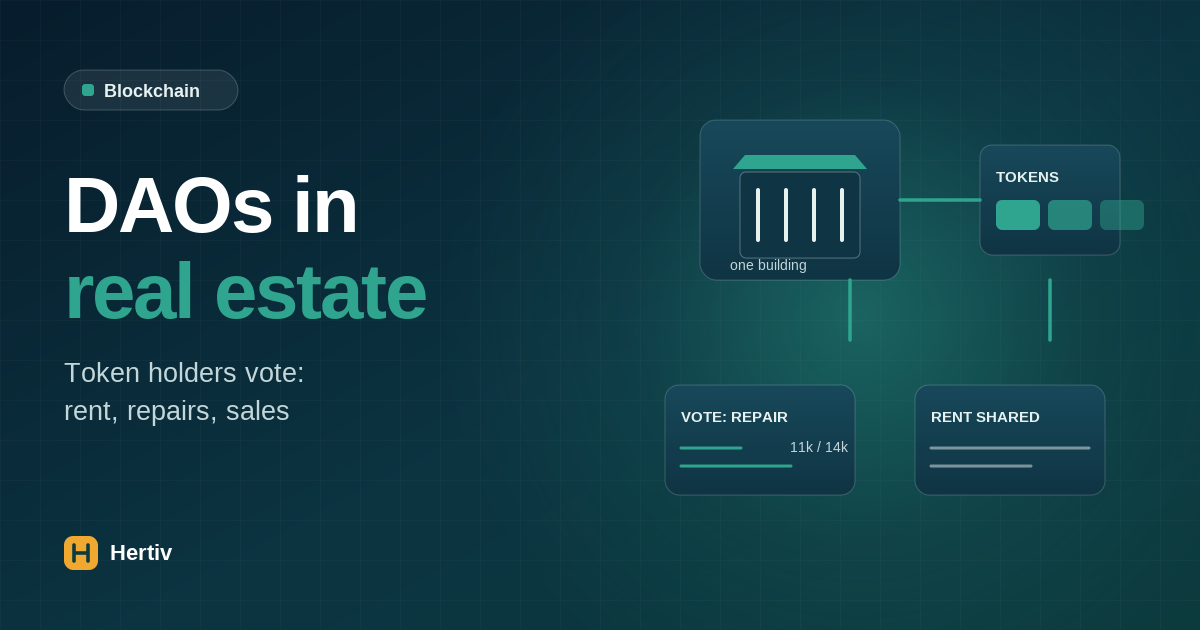
A DAO can govern a tokenized property by letting token holders vote on rent, repairs and sales. It adds control, but needs a legal wrapper and clear rules.
On this page
Short answer
A DAO in real estate tokenization is a group of token holders who govern a property together through on-chain votes. Token holders decide on rent, repairs, budgets and sales, while a legal entity holds the property title and a smart contract records the votes and enforces the outcomes.
What is a DAO in real estate tokenization?
A DAO in real estate tokenization is a decentralised autonomous organisation that governs a tokenized property. The property is split into tokens, each token gives its holder a share of the income and a vote, and the holders decide together how the property is run.
The DAO itself does not usually own the property directly. A legal entity, such as a company or a trust, holds the title, and the DAO's token holders vote on what that entity should do. The smart contract records votes and can automate payments, such as distributing rent to token holders in proportion to their holdings.
This is different from simply buying a property token. A token alone gives you a share of the income; a DAO gives you a say in the decisions. That say is the point, but it is also the hard part, because collective decisions need rules, quorums and someone to carry them out. Real estate tokenization explains the token side of the model in more detail.
How does a DAO govern a tokenized property?
A DAO governs a tokenized property through proposals and votes. Any holder can usually propose a change, holders vote with their tokens, and the outcome is recorded on-chain for everyone to see.
| Decision | Who proposes | Who carries it out |
|---|---|---|
| Set the rent | Any token holder | Property manager |
| Approve repairs | Manager or holder | Property manager |
| Choose a tenant | Manager | Property manager |
| Refinance or sell | Any token holder | Legal entity directors |
| Change the fee | Any token holder | Smart contract |
Most DAOs do not vote on daily operations. They vote on the big decisions and leave routine work to a property manager under a written agreement. The manager reports income and costs, and holders can vote to replace the manager if the work is poor. That split keeps decisions fast while keeping control with the holders.
How does voting work in a property DAO?
Voting in a property DAO usually works on a one-token-one-vote basis, so a holder with 1,000 tokens has ten times the votes of a holder with 100. Some DAOs cap the influence of the largest holders, or require a minimum number of holders to take part before a vote counts.
A quorum rule matters because small holders rarely vote. If a vote needs 20% of tokens to take part and only 5% ever vote, nothing gets decided. Good DAOs set quorums low enough to work and high enough to stop a single holder deciding alone. Time limits help too: a proposal that stays open for two weeks gives holders time to read it without stalling the property.
Votes are recorded on-chain, which makes the result easy to check. The harder question is what happens after the vote. A vote to sell a building needs lawyers, agents and a buyer, so the DAO needs a legal entity that can sign contracts and carry out the decision. Without that, a vote is only a suggestion.
What legal structure does a property DAO need?
A property DAO needs a legal structure because a DAO on its own cannot hold a title, sign a contract or be sued. The usual answer is a company, a trust or a foundation that holds the property and acts on the DAO's votes.
The structure should spell out three things: who holds the title, who must follow the DAO's votes, and what happens if the directors disagree with a vote. If those are unclear, the DAO's decisions have no legal force and the directors can ignore them. Some jurisdictions now offer DAO-specific legal forms, but most property DAOs still use an ordinary company with its rules written to follow token-holder votes.
Regulation is the other half of the question. Property tokens are often treated as securities, which means the offering may need registration or an exemption. That is a legal question for each country, not a technical one, and it should be settled before any tokens are sold. See how to tokenize real estate for the steps and the compliance points involved.
How do you set up a DAO for a tokenized property?
You set up a DAO for a tokenized property by sorting the legal structure first, then the tokens, then the voting rules. The order matters, because the technology cannot fix a missing legal wrapper.
- Choose the legal entity. Decide who holds the title and how the entity must follow token-holder votes.
- Value the property and split it into tokens. Agree the price, the token count and what each token represents.
- Write the voting rules. Set quorum, voting periods, proposal rights and which decisions need a vote.
- Build or pick the contracts. Token, voting and distribution contracts, reviewed by an auditor.
- Appoint a property manager. Agree fees, reporting and how holders can replace the manager.
- Sell the tokens compliantly. Follow the securities rules for each country where buyers live.
- Run the first votes. Start with small decisions so holders learn the process before a big one.
Budget for legal and audit work from the start. It is usually a larger share of the cost than the smart contracts, and skipping it is the fastest way to stall the project. Real-world asset tokenization use cases show how other teams have structured similar projects.
Example: a DAO running a small office building
Example (hypothetical): a group tokenizes a small office building worth $2,000,000 into 20,000 tokens at $100 each. The tokens are held by 120 people, and a company holds the title. The DAO votes on rent, repairs and the manager's fee.
In the first year the building earns $120,000 in rent after costs. The smart contract distributes it in proportion to holdings, so a holder with 100 tokens receives $600. A roof repair costing $30,000 goes to a vote: 14,000 of the 20,000 tokens take part, and 11,000 vote in favour, so the repair is approved and paid from the building's reserve.
The arithmetic is simple, and that is the point. Each holder can check the rent, the votes and their own share. The DAO works because the decisions are few, the manager handles the daily work, and the legal company follows the votes. The group plans one major vote a year and routine votes only when something breaks or a lease changes.
What are the common mistakes?
The most common mistakes are launching the DAO before the legal structure, setting voting rules nobody can meet, and voting on too much.
- No legal wrapper. A DAO without an entity cannot hold title or sign contracts, so its votes have no force.
- Quorum set too high. If holders rarely vote, a high quorum means nothing ever gets decided.
- Voting on daily work. Holders should decide rent and sales, not which plumber to call.
- No manager agreement. Without a written deal, the manager's duties and fees are unclear.
- Ignoring securities rules. Selling tokens without checking the rules in each buyer's country creates legal risk.
- One holder controls the vote. If a single holder owns most tokens, the DAO is a company with extra steps.
Key takeaways
- A DAO gives token holders a vote on rent, repairs and sales, not just a share of income
- The property title sits with a legal entity; the DAO directs it through votes
- Low quorums, clear proposal rights and a property manager keep decisions moving
- Tokens are often treated as securities, so compliance comes before any sale
- Vote on the big decisions and leave daily operations to the manager
Frequently asked questions
Can a DAO own a building directly?
Usually not. A DAO on its own cannot hold a title, sign a contract or be sued, so a company, trust or foundation holds the property and acts on the DAO's votes. The legal documents should say the entity must follow token-holder decisions.
How do token holders get paid?
Rent and other income are usually distributed by a smart contract in proportion to each holder's tokens. A holder with 100 of 20,000 tokens receives 0.5% of the distributed income, minus fees and reserves set by the DAO.
What happens if nobody votes?
Nothing gets decided, which is why quorum rules matter. Good DAOs set quorums low enough to reach, use time limits on proposals, and reserve votes for big decisions so holders are not asked to vote every week.
Is a property token the same as a share?
It can be similar in effect, but the legal treatment depends on the country and the structure. Property tokens are often treated as securities, so the offering may need registration or an exemption.
Who manages the property day to day?
A property manager, under a written agreement with the DAO's legal entity. The manager handles tenants, repairs and reporting, and token holders can vote to replace the manager if the work is poor.
Can a DAO sell the property?
Yes, if the voting rules allow it and the legal entity can carry out the sale. A sale usually needs a higher quorum than routine decisions, and the proceeds are distributed to token holders in proportion to their holdings.


