DAO Use Cases in Real Estate: 8 Ways Owners Govern Together
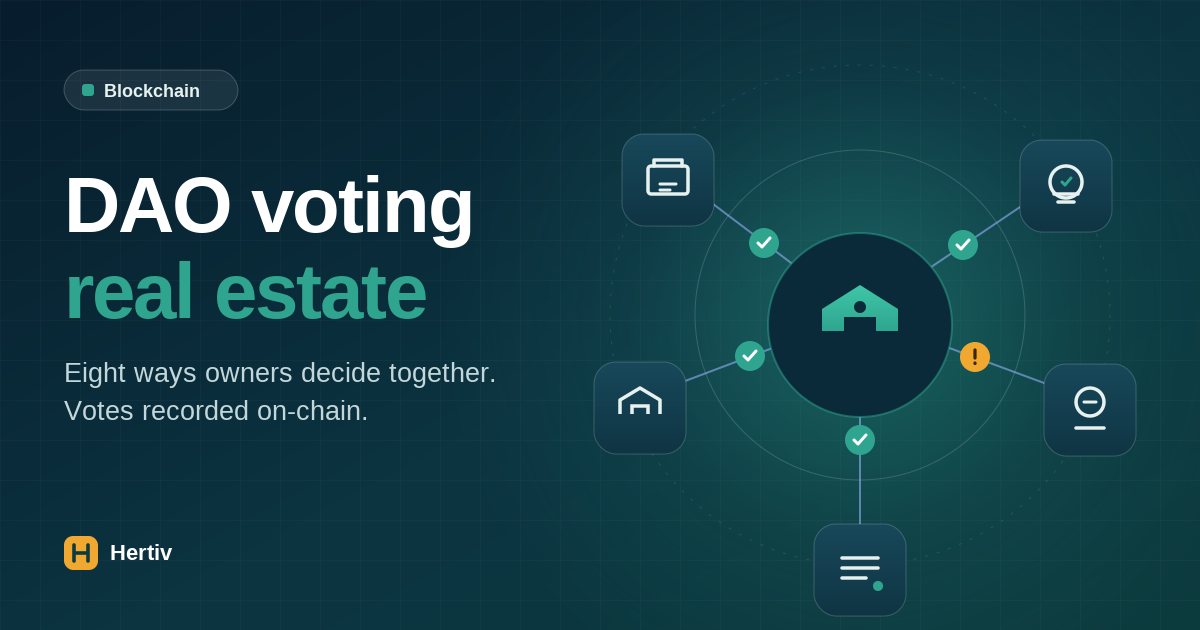
A DAO lets property owners vote on rents, repairs and sales instead of one manager deciding alone. Here are eight use cases that work, and what each needs.
On this page
Short answer
A DAO in real estate is a group of owners who make property decisions by voting on-chain, with the results recorded where every owner can see them. It works best for shared decisions that repeat: setting rents, approving repairs, splitting income and agreeing sales. It does not replace legal ownership or local property law, so the DAO needs a legal wrapper and clear rules before it holds real value.
Which DAO use cases work in real estate?
A DAO in real estate is a group of owners who vote on property decisions instead of leaving them to one manager. Each vote is recorded on-chain, so every owner can check what was decided and who voted for it. The model fits decisions that repeat and affect everyone who owns a share.
Use the table to shortlist. A use case only works when the owners can actually act on the vote, which means the legal owner of the property must follow what the DAO decides.
| Use case | What owners vote on | Best for |
|---|---|---|
| Fractional ownership voting | Sale, rent and major changes | Shared properties |
| Rental income distribution | When and how rent is paid out | Income properties |
| Property management decisions | Which manager to hire | Remote owners |
| Maintenance budgets | Repairs and upgrades | Older buildings |
| Tenant screening | Rules for new tenants | Rental portfolios |
| Development funding | Whether to fund a build | Small developers |
| Secondary trading and exits | When shares can change hands | Locked-in owners |
| Disputes and rule changes | How to settle disagreements | Long-term groups |
Start with one use case, not all eight. A DAO that runs one decision well teaches the group how voting works before it takes on the rest of the property.
Fractional ownership voting and rental income
1. Fractional ownership voting: best for shared properties
When several people own shares in one property, a DAO gives each owner a vote weighted by their share. Big decisions such as selling, changing the rent or refinancing go to a vote, and the result is written on-chain.
This works when the legal structure matches the vote. The property is usually held by a company or trust bound to follow the DAO result, so a vote is not just an opinion poll. DAOs in real estate tokenization explains how that wrapper is set up.
Pros: every owner sees the same record; small owners get a real say.
Cons: votes take time; a large holder can dominate; legal setup costs money.
2. Rental income distribution: best for income properties
A DAO can set the rules for how rent is shared: when it is paid out, what share goes to a reserve fund, and what happens when a tenant pays late. Once agreed, a smart contract can carry them out without a manager handling each payment by hand.
The key detail is the reserve. Owners should agree in advance how much rent stays back for repairs and empty months, because a property that pays out everything has nothing left when the roof leaks. The split only works if the rent actually arrives in the account the contract reads.
Pros: payouts follow agreed rules; less admin work; owners can check the numbers.
Cons: late rent still needs a human to chase; contract errors can misdirect funds.
Property management and maintenance budgets
3. Property management decisions: best for remote owners
Owners who live far from a property often struggle to judge a manager. A DAO lets them vote on which management firm to hire, what the contract should cover, and when to replace a firm that is not performing. Service reports can be shared with the whole group before each vote.
This works best when the vote is tied to clear evidence, such as response times, repair costs and tenant complaints. Without numbers, the vote becomes a popularity contest.
Pros: remote owners stay in control; managers answer to the whole group; poor service is visible to everyone.
Cons: owners must read the reports to vote well; day-to-day problems still need a manager on call.
4. Maintenance and renovation budgets: best for older buildings
Old buildings need steady spending, and owners often disagree about what to fix first. A DAO can vote on a yearly maintenance budget, rank the jobs by urgency, and release funds in stages as work is finished and checked.
Staged release is the part that matters most. Paying the full budget up front leaves owners with little bargaining power if the work is poor, while paying in stages tied to inspection keeps the contractor honest. DAO use cases in other sectors follow the same pattern.
Pros: spending follows an agreed plan; funds are released against finished work; urgent repairs get priority.
Cons: emergency repairs cannot wait for a vote; owners may underfund the reserve; inspections add cost.
Tenant screening and development funding
5. Tenant screening and onboarding: best for rental portfolios
A DAO can agree the rules for who rents a property: income checks, references, deposits and the length of the first lease. When the rules are written down and voted on, every applicant is treated the same way.
The rules must stay inside the law. Fair housing and anti-discrimination rules apply whatever the DAO decides, so a lawyer should check the criteria before the first vote. Screening itself is still done by people or a service, not by the DAO.
Pros: consistent rules for every applicant; less room for favouritism.
Cons: rules must be checked against local law; screening takes human effort.
6. Development project funding: best for small developers
A DAO can fund a small development by pooling money from many backers, each holding a share of the project. Backers vote on the budget, the builder and the milestones, and funds are released as each stage is completed.
Milestone funding protects backers when a project runs late or over budget. If the builder misses a stage, the DAO can pause the next payment and vote on whether to continue, change the builder or wind down. This only works if the milestones are written in plain language before any money moves.
Pros: small backers can join a development; money moves against finished work; backers can stop a failing project.
Cons: building is slow and votes add delays; cost overruns still happen.
Secondary trading, exits and dispute resolution
7. Secondary trading and exits: best for locked-in owners
Property shares are hard to sell, because finding a buyer takes time and paperwork. A DAO can set rules for when shares can be sold, who can buy them, and how the price is agreed, so an owner who needs to leave is not trapped for years.
The rules need a buyer pool to work. A right to sell means little if nobody wants the share, so groups should agree in advance whether existing owners get first refusal and how a fair price is set. How to tokenize real estate covers the mechanics.
Pros: owners get a defined way out; pricing rules are agreed in advance.
Cons: buyers may still be scarce; price disputes are common.
8. Dispute resolution and rule changes: best for long-term groups
Groups that own property together for years will disagree. A DAO can set the rules for settling disputes: who mediates, what evidence counts, and how a final decision is reached. It can also vote on changing its own rules.
Rule changes need a higher bar than routine votes. If a simple majority can rewrite the rules, a large holder can change them to suit itself, so most groups require a larger share of votes for changes to ownership rights or payouts.
Pros: disputes follow a known process; rules can improve over time; decisions are recorded for later review.
Cons: mediation still costs time and money; a majority can outvote a minority.
How to choose the right DAO use case
Choose the use case by the decision you already argue about, not by the technology. A DAO helps when owners disagree often and the decision repeats; it adds little when one person already decides well and nobody objects.
- List the decisions that cause friction. Rent levels, repairs, manager choice and exits are the usual candidates.
- Check the legal wrapper first. The property must be held in a form that can follow a DAO vote, or the vote has no force.
- Pick one use case to start. Run a single vote on a real decision and see how the group handles it.
- Write the rules before the first vote. Who votes, how much a share is worth, and what majority is needed should be agreed in advance.
- Keep a human for emergencies. Leaks, legal notices and tenant crises cannot wait for a voting window.
For teams building the platform itself, real estate tokenization services cover the legal and technical setup that a DAO vote depends on.
What are the common mistakes?
The most common DAO mistakes in real estate are skipping the legal setup, letting one holder dominate, and voting on things that need a fast human decision.
- No legal wrapper. A vote that the legal owner can ignore is a suggestion, not a decision.
- One holder, all the power. If one owner holds most shares, the DAO is a company with extra steps.
- Voting on emergencies. A burst pipe needs a plumber now, not a seven-day vote.
- No reserve fund. A property that pays out all its income cannot afford repairs.
- Rules nobody reads. If owners do not read proposals, a small active group decides everything.
- Ignoring local law. Property, tenancy and tax rules apply to DAOs the same as to any other owner.
Key takeaways
- A DAO works for repeated shared decisions: rents, repairs, payouts and sales
- The vote only matters if the legal owner of the property must follow it
- Start with one use case and a clear rulebook, not all eight at once
- Staged payments and a reserve fund protect owners better than any voting design
- Emergencies and legal duties still need a human, not a vote
Frequently asked questions
What is a DAO in real estate?
A DAO in real estate is a group of property owners who make decisions by voting on-chain, with each vote weighted by the share owned. The property itself is usually held by a company or trust that is bound to follow the vote, so the decision has legal force.
Can a DAO legally own a property?
In most places a DAO cannot hold a property directly, so the property is held by a company, trust or similar legal wrapper that follows the DAO vote. The exact form depends on local law, and a lawyer should set it up before any money moves.
How do owners vote in a property DAO?
Owners vote with tokens or shares that represent their stake, usually through a voting tool connected to the DAO. Each vote is recorded on-chain, so the result and who voted are visible to every owner.
What happens if owners disagree?
The DAO follows its own rules: a vote decides, and a higher majority is usually needed for rule changes. If the dispute is about legal rights, the legal wrapper and local courts still apply, whatever the vote says.
Do DAOs replace property managers?
No. A DAO decides policy, such as which manager to hire and what budget to set, but day-to-day work still needs a manager on call. Tenants, repairs and emergencies cannot wait for a voting window.
Can I sell my share in a property DAO?
It depends on the rules the DAO agreed. Most groups allow sales to other owners first, then to outside buyers who pass the same checks. Finding a buyer can still be slow, because property shares are not as easy to sell as listed shares.


