DAO Startup Ideas Worth Building First
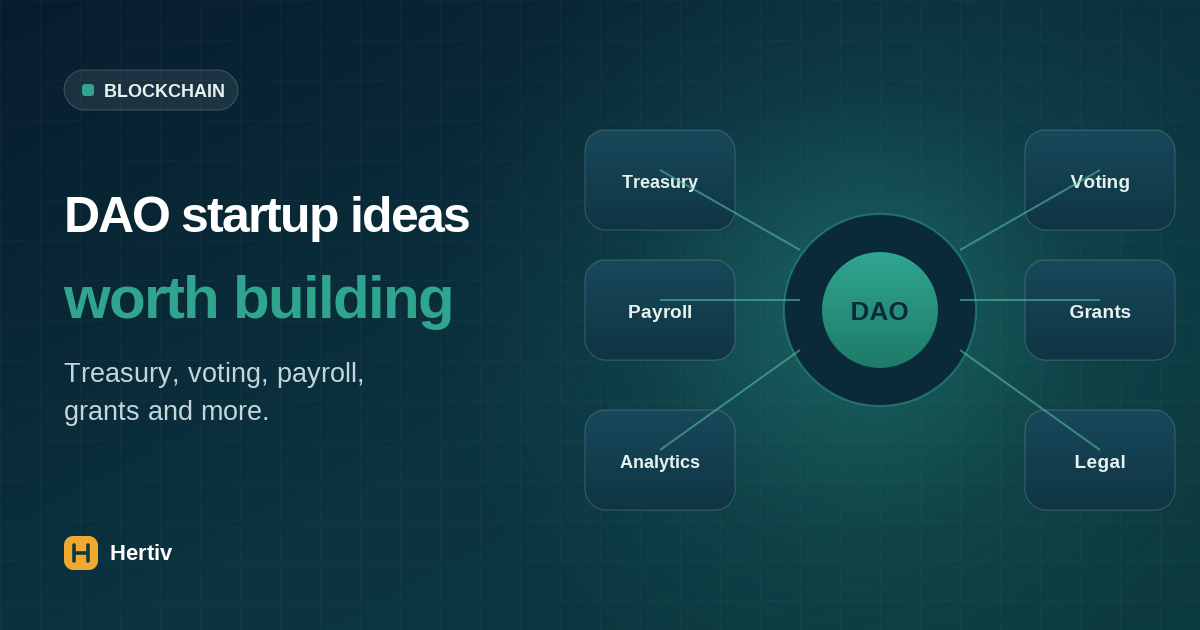
DAOs need tools for voting, treasury, payroll and grants. These six startup ideas solve real problems for decentralised organisations.
On this page
Short answer
A DAO startup idea is worth building when it solves a problem that decentralised organisations already feel: voting that nobody trusts, a treasury nobody can track, or contributors who are hard to pay. The six ideas below cover those gaps. Each one is a real product category, and each needs a clear answer to who pays and why a DAO would switch.
Which DAO startup ideas are worth building first?
The DAO ideas worth building first are the ones where the pain is already visible: a treasury spread across wallets, a vote that takes a week to organise, or contributors waiting to be paid. The table below compares six ideas on what they do and who pays for them.
| Idea | What it does | Who pays | Effort |
|---|---|---|---|
| Treasury dashboard | Tracks DAO funds in one view | DAOs with a treasury | Medium |
| Voting toolkit | Runs proposals and votes | DAOs that vote often | Medium |
| Contributor payroll | Pays contributors in tokens | DAOs with regular payouts | Medium |
| Grants platform | Manages grant applications | DAOs and foundations | Low to medium |
| DAO analytics | Reports on voters and activity | Large DAOs, researchers | Medium |
| Legal wrapper service | Sets up a legal entity for a DAO | DAOs that sign contracts | High |
Start with the idea closest to a problem you have seen yourself. A founder who has sat in a DAO treasury meeting will build a better treasury tool than one who has only read about DAOs. What is a DAO explains the structure these products serve.
Treasury and voting tools
1. Treasury dashboard: best for DAOs that cannot see their own money
A treasury dashboard pulls together every wallet, token and position a DAO holds and shows it in one view, with a history of what came in and what went out. Many DAOs keep funds in several wallets and chains, so even the treasurer cannot answer the simple question of how much the DAO holds.
The product earns trust by being accurate and boring: correct balances, clear labels and a full transaction history. A dashboard that shows a wrong number once will not be used again.
Pros: clear need, visible value, works for any DAO with funds. Cons: needs reliable chain data, and large DAOs may build it themselves.
2. Voting toolkit: best for DAOs that vote often
A voting toolkit runs proposals, collects votes and records the result in a way anyone can check. Good voting tools handle delegation, quorum rules and different voting styles, such as token-weighted or one-person-one-vote, without making the process confusing.
The hard part is not the vote itself but the discussion before it. Tools that help a proposal move from an idea to a clear, votable question are more useful than tools that only count ballots.
Pros: every DAO votes, and better voting raises participation. Cons: crowded category, and voting rules differ widely between DAOs.
Payroll and grants
3. Contributor payroll: best for DAOs with regular payouts
Contributor payroll pays people in tokens on a schedule, with the right amounts, the right tokens and a record of every payment. Many DAOs still pay contributors by hand, which is slow and error-prone when dozens of people are involved.
The product must handle the awkward cases: a contributor paid in two tokens, a payment that needs approval from two signers, and a record that the accountant can actually use. Getting those details right matters more than a polished dashboard.
Pros: recurring revenue, clear pain, and a natural fit with treasury tools. Cons: payment rules and tax treatment differ by country.
4. Grants platform: best for DAOs that fund builders
A grants platform manages the full cycle of a DAO grant: applications, reviews, milestones and payments. Many DAOs run grants in spreadsheets and chat threads, which means applications get lost and milestones are never checked.
The value is in the workflow, not the form. A platform that tracks a grant from application to final payment, with the evidence attached, saves the grants team hours every week.
Pros: low build effort, and foundations as well as DAOs need it. Cons: small budgets per customer, so volume matters.
Analytics and legal wrappers
5. DAO analytics: best for large DAOs that need to see themselves clearly
DAO analytics turns on-chain activity into answers: who votes, who stops voting, which proposals pass, and where the treasury is going. Large DAOs generate a lot of data, but few people can read it without help.
The best analytics products answer one question well, such as voter turnout, rather than showing every chart at once. A clear weekly report that a DAO lead actually reads is worth more than a dashboard with fifty metrics.
Pros: data is public, so there is no integration work. Cons: hard to charge for, since the data is free.
6. Legal wrapper service: best for DAOs that need to sign contracts
A legal wrapper service helps a DAO set up a legal entity that can hold assets, sign contracts and hire people. Many DAOs reach a point where they cannot open a bank account or sign an agreement without one.
This is the hardest idea on the list, because it needs lawyers in each country and the rules are still changing. It is also the most valuable for the DAOs that need it, because there is no way around it.
Pros: high value per customer and little competition. Cons: needs legal expertise and varies by country.
How to choose a DAO startup idea
Choosing well matters more than building fast. Follow these five steps before writing code.
- Talk to DAO operators first. Ask treasurers, moderators and contributors what they do by hand today. The best ideas come from their complaints, not from a list.
- Check who pays. A tool for a DAO with no treasury and no revenue has no one to charge. Pick an idea where the buyer is clear.
- Look at what already exists. Top DAO platforms shows the crowded categories. Pick a gap, not a copy.
- Build the smallest useful version. A treasury view for one chain beats a half-finished tool for five chains.
- Plan for trust. DAOs move money, so security, audits and transparent code matter from the first version.
The idea that wins is rarely the most original. It is the one that solves a painful, frequent problem for DAOs that can pay.
Common mistakes
The most common mistake is building for DAOs in general instead of one kind of DAO. A tool for a gaming DAO and a tool for an investment DAO have different users, different budgets and different problems. Pick one and serve it well.
Another mistake is ignoring the legal side. A product that moves money or runs votes can create real liability, so get advice early rather than after a problem.
Teams also underestimate how much DAOs change. A DAO can vote to change its own rules in a week, and a product that assumes fixed rules will break. Design for change, and keep the team close to the DAOs that use the product. DAOs in real estate tokenization shows how one niche shapes the tools it needs.
Key takeaways
- Build for a pain DAOs already feel, such as treasury, voting or payroll.
- Treasury dashboards and voting tools have the clearest demand.
- Pick one kind of DAO and serve it well instead of building for all DAOs.
- Check who pays before building: a tool needs a buyer with a budget.
- Security and audits matter from the first version, since DAOs move money.
Frequently asked questions
What is the best DAO startup idea?
The best idea depends on the problem you have seen yourself. Treasury dashboards, voting tools and contributor payroll have the clearest demand, because DAOs already feel those pains every week.
How do DAO startups make money?
Most charge a subscription or a small fee on the value they handle, such as payments or grants. The buyer is usually the DAO treasury, so the product must solve a problem the DAO already pays to fix.
Do I need blockchain experience to start?
Some helps, but understanding how DAOs actually work matters more. Spend time in a DAO first, learn its workflow, and build for a real problem you have watched. Talk to treasurers and moderators before you build anything.
Are DAO tools a crowded market?
Some categories, such as voting, are crowded, while others, such as payroll and grants, have more room. Check the existing platforms first and pick a gap rather than a copy.
What legal issues should a DAO startup consider?
Products that move money or run votes can create liability, and the rules differ by country. Get legal advice early, especially for payroll, grants and legal wrapper services, before you take money from a DAO treasury.
How do I validate a DAO startup idea?
Talk to DAO operators, such as treasurers and moderators, and ask what they do by hand today. If several DAOs describe the same pain and can pay to fix it, the idea is worth testing.


