Top DAO Platforms Worth Comparing
Compare six DAO platforms on voting style, execution and cost. Find the right fit for your community, fund or contributor team.
On this page
Short answer
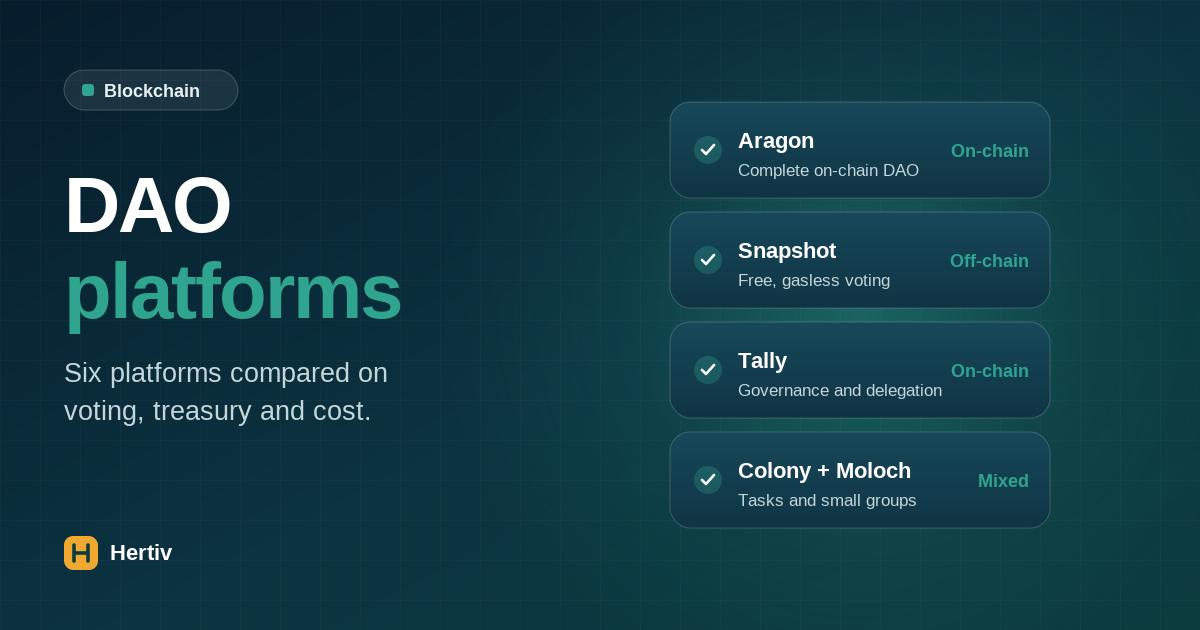
Six DAO platforms cover most needs: Aragon suits a complete on-chain DAO, Snapshot suits free and frequent voting, Tally suits on-chain token governance with delegation, DAOstack suits custom governance, Colony suits paying contributors for tasks, and Moloch suits small grant groups. Choose by how often you vote and whether results must execute on chain.
Which DAO platforms are worth comparing?
The DAO platforms worth comparing are Aragon, Snapshot, Tally, DAOstack, Colony and Moloch. Each one helps a group make decisions and manage shared funds, but they differ on where voting happens, how proposals are executed, and how much technical skill they need.
A DAO, or decentralised autonomous organisation, is a group that runs by rules written into smart contracts, with members voting on proposals. The platform you choose decides how proposals are made, how votes are counted, and whether the result happens automatically or needs a human to act on it.
| Platform | Governance style | Voting | Best for |
|---|---|---|---|
| Aragon | Full on-chain DAO | On-chain token votes | Teams that want a complete DAO |
| Snapshot | Off-chain voting | Free, gasless votes | Communities that vote often |
| Tally | On-chain governance | On-chain, with delegation | Token-holder governance |
| DAOstack | Modular framework | Reputation-based votes | Complex, custom governance |
| Colony | Task-based work | Reputation-weighted votes | Teams that pay for tasks |
| Moloch | Minimal framework | On-chain, member shares | Grants and small groups |
Start from what your group actually does. A community that votes weekly on small decisions needs a different tool from a fund that moves money once a month. The sections below compare each platform on its own terms, then explain how to choose.
Aragon: best for a complete on-chain DAO
1. Aragon: best for a complete on-chain DAO
Aragon is a long-running platform for creating and running DAOs entirely on chain. It provides templates for common DAO shapes, such as a company-style DAO or a membership DAO, and it bundles voting, treasury management and permissions into one package.
Because votes and treasury actions happen on chain, the results are enforced by the contract rather than by trust. That makes Aragon a strong fit for groups that move real funds and want the rules to be visible and hard to change without a vote.
Pros
- Complete DAO in one package, with voting and treasury
- On-chain execution, so votes carry real force
- Templates for common DAO shapes
Cons
- On-chain votes cost network fees
- More setup than a simple voting tool
- Custom rules need developer help
If your group holds a treasury and votes on spending, Aragon is the most complete starting point. For the basics of how DAOs work, see what is a DAO.
Snapshot: best for free, frequent voting
2. Snapshot: best for free, frequent voting
Snapshot is an off-chain voting tool: members vote by signing a message with their wallet, and no transaction is needed, so voting is free. It is the most widely used tool for signalling votes, where the result guides a decision rather than executing it on chain.
Snapshot supports many voting styles, including token-weighted votes, quadratic voting and weighted choices, and it works across many chains. Communities use it for weekly decisions, grants and temperature checks, because voting often costs nothing and takes seconds.
Pros
- Free, gasless voting for members
- Many voting styles, including quadratic voting
- Works across many chains
Cons
- Votes are not enforced on chain by default
- Needs a separate tool to execute results
- Token-weighted votes can favour large holders
Snapshot suits groups that vote often and want participation to be easy. Pair it with a treasury tool or a multisig wallet so that vote results are carried out rather than just recorded.
Tally: best for on-chain token governance
3. Tally: best for on-chain token governance
Tally is a governance dashboard and tooling layer for DAOs that run on chain, especially those built on token-governance frameworks such as Compound Governor and OpenZeppelin Governor. It shows proposals, votes and delegation in one place, and it lets members vote and delegate from the same interface.
Delegation is Tally's strong point. Token holders who do not want to vote on every proposal can hand their voting power to a delegate they trust, and they can take it back at any time. That keeps participation high even when most holders are passive.
Pros
- Clear view of proposals, votes and delegates
- Delegation keeps governance active
- Built for on-chain governance frameworks
Cons
- Best for DAOs already running on-chain governance
- On-chain votes cost network fees
- Less suited to off-chain communities
Tally fits protocols and token projects whose governance already lives on chain. It is less useful for a new community that has not yet set up token voting.
DAOstack: best for complex, custom governance
4. DAOstack: best for complex, custom governance
DAOstack is a modular framework for building DAOs with custom governance rules. Rather than offering one fixed structure, it provides building blocks that a team can combine into the governance shape it needs, including reputation-based voting and prediction markets for proposals.
Its best-known idea is holographic consensus, where small groups can approve proposals quickly while the whole DAO can still step in on contentious ones. That design suits large groups that need both speed and oversight.
Pros
- Modular design for custom governance
- Reputation-based voting, not just token weight
- Designed for large, active DAOs
Cons
- Steeper learning curve than template tools
- Needs developer time to set up well
- Smaller community than the largest platforms
DAOstack is for teams that know their governance needs are unusual and are willing to invest in a custom setup. For simpler needs, a template-based platform will be faster. Smart contract development covers how custom DAO rules are built and checked.
Colony: best for paying contributors for tasks
5. Colony: best for paying contributors for tasks
Colony is built around work rather than votes. A DAO creates tasks, contributors claim them, and payment is released when the work is accepted. Reputation earned from completed work gives members more weight in future decisions.
That design fits teams that operate like a company with many small jobs: bounties, content, development tasks and reviews. Instead of voting on every decision, the DAO votes on the rules and the budget, and the day-to-day work runs through tasks.
Pros
- Work and payment in one flow
- Reputation grows from completed tasks
- Suits teams with many small jobs
Cons
- Less suited to pure voting communities
- Needs active task management
- Reputation rules take time to tune
Colony is the right choice when the DAO's main job is getting work done and paid for, rather than debating proposals. It is a poor fit for a community that only votes.
Moloch: best for small groups and grants
6. Moloch: best for small groups and grants
Moloch is a minimal DAO framework built for small groups that share funds, most famously for grants. Members hold shares, propose how funds are spent, and vote. Anyone who disagrees with a decision can leave and take their share of the remaining funds, a mechanism known as ragequit.
The framework is deliberately simple: a few contracts, a small set of rules, and no extra features. That simplicity makes it easy to audit and cheap to run, which is why many grant DAOs and investment clubs started on Moloch or its forks.
Pros
- Simple, minimal design that is easy to audit
- Ragequit protects members who disagree
- Low cost to run and maintain
Cons
- Few built-in features beyond voting and funding
- Not designed for large, complex DAOs
- Needs custom tooling for a polished interface
Moloch suits a small group that wants to pool funds and vote on spending, without the overhead of a full platform. For larger groups, a fuller platform will save time.
How to choose a DAO platform
Choose a DAO platform by matching it to how your group actually makes decisions and moves money. A platform that fits your governance shape will be used; one that fights it will be ignored.
- Decide what must be enforced on chain. If votes must move funds automatically, shortlist on-chain platforms such as Aragon, Tally or Moloch. If votes are guidance, Snapshot is enough.
- Count how often you vote. Weekly votes favour free, off-chain voting. Monthly votes on large sums justify paying network fees for on-chain execution.
- Check who holds power. Token-weighted voting favours large holders. If that worries you, look at reputation-based systems such as DAOstack or Colony.
- Test with a real proposal. Run one real decision end to end, from proposal to execution, before moving the treasury onto the platform.
- Plan the treasury separately. Even the best voting tool needs a safe place to hold funds, usually a multisig wallet with clear signers.
Do not choose on features alone. The platform your members will actually open and vote on is the right one, even if another platform looks better on paper.
What are the common mistakes?
The most common mistakes are choosing a platform before defining governance, letting a few large holders decide everything, and moving the treasury before testing the full flow.
- Picking tools before rules. Decide who can propose, who can vote, and what a vote can change, before you compare platforms.
- Ignoring voter turnout. A DAO with 5 percent turnout is run by whoever shows up. Use delegation or simpler votes to raise participation.
- Moving the treasury too early. Test the full proposal-to-payment flow with a small amount first.
- Token weight without limits. Pure token voting hands control to the largest holders. Consider caps, reputation or delegation.
- No plan for disputes. Decide in advance what happens when a vote is contested or a proposal is unclear.
DAO platforms are tools for group decisions, not a substitute for deciding how the group works. Set the rules first, test with a small amount, and pick the platform that your members will actually use. For real-world DAO examples, see DAOs in real estate tokenization.
Key takeaways
- Aragon is the most complete on-chain DAO package, with voting and treasury in one place
- Snapshot makes voting free and easy, but results need a separate tool to execute them
- Tally's delegation keeps on-chain governance active even when most holders are passive
- DAOstack and Colony use reputation, not just token weight, to decide who has influence
- Moloch is minimal and cheap, and its ragequit rule protects members who disagree
- Test the full proposal-to-payment flow with a small amount before moving the treasury
Frequently asked questions
What is the best DAO platform for beginners?
Snapshot is the easiest place to start, because voting is free and needs no setup beyond a wallet. For a DAO that holds funds, Aragon is the more complete beginner option, since it bundles voting, treasury and permissions. Start with Snapshot for votes, then add an on-chain platform when money is involved.
Do DAO platforms cost money?
Off-chain voting on Snapshot is free for voters. On-chain platforms charge network fees for each vote and each executed proposal, and those fees depend on the chain and the network load at the time. Some platforms also charge for hosting or premium features, so check the vendor site for current pricing.
Can a DAO change platforms later?
Yes, but it takes work. The treasury, the member list and the proposal history must move, and members must learn the new tool. That is why it is worth testing a platform with a small amount first. Moving a large treasury between platforms is a project, not an afternoon.
What is the difference between on-chain and off-chain voting?
On-chain voting happens as blockchain transactions, so results are enforced by the contract and cost network fees. Off-chain voting happens by signed messages, so it is free, but the result is only a signal and needs a separate step to take effect.
How does delegation work in a DAO?
Delegation lets a token holder hand voting power to someone they trust, such as an active community member or a delegate. The holder keeps their tokens and can take the power back at any time. It keeps governance moving when most holders do not vote on every proposal.
Do I need a developer to run a DAO?
Not always. Template platforms such as Aragon and Snapshot can be set up without code. Custom governance, unusual voting rules, or integrations with other contracts usually need a developer. Budget for developer help if your DAO does more than simple votes and treasury spending.


