Crypto Exchange vs OTC Trading: Which Is Better?
A crypto exchange suits small, frequent trades, while an OTC desk suits large ones. Here is how pricing, slippage and risk differ, and how to pick the right route.
On this page
Short answer
For most people, a crypto exchange is better: it is open to anyone, fills small orders instantly at the market price, and charges a published fee. OTC trading is better for large trades, usually six figures and up, because a desk gives one fixed quote for the whole amount, so a big order does not move the price against you. The right choice depends on trade size.
What is the difference between a crypto exchange and OTC trading?
A crypto exchange is a public marketplace where buyers and sellers trade through an open order book, while OTC trading is a private deal between a trader and a desk at one agreed price. The two routes serve the same need, buying and selling crypto, but they price and settle the trade in different ways.
On an exchange, you place an order and it fills against other users' orders at the best available prices. The price you see is the market price, and the order book is visible to everyone. In OTC trading, short for over-the-counter, you ask a desk for a quote on a specific amount, and the desk offers one price for the whole trade. Nothing appears on a public order book.
| Feature | Crypto exchange | OTC desk |
|---|---|---|
| Where the trade happens | Public order book | Private, between trader and desk |
| Pricing | Market price plus a maker or taker fee | One fixed quote for the full amount |
| Best for | Small to mid-size, frequent trades | Large trades, often six figures and up |
| Price certainty | Known only after the order fills | Known before you commit |
| Minimum size | Very low, often a few dollars | Commonly $50,000 to $250,000 or more |
| Privacy | Orders are visible on the book | Private, no public order |
The key difference is not the asset: both routes trade the same coins. The difference is how a large order is handled. An exchange fills it level by level through the book, while a desk absorbs it at one price. For a deep market, see order book versus automated market maker trading.
How does a crypto exchange work?
A crypto exchange works by matching buy and sell orders in a public order book. When you place a market order, it fills immediately against the best orders on the other side, starting at the top of the book and moving down through the price levels until your order is complete.
That walk through the book is where slippage comes from. Slippage is the gap between the price you expected and the average price you actually paid. For a small order in a deep pair such as BTC/USDT, the gap is tiny. For a large order in a thin pair, the order eats through the cheap levels and fills the rest at worse prices.
Exchanges charge a maker fee when you add an order to the book and a taker fee when you take liquidity from it. Most also let you use limit orders, which only fill at a price you set, and stop orders, which trigger when the price reaches a level. These tools help, but they do not remove the basic limit: the book only holds so much volume at each price.
Exchanges are open around the clock, and anyone who passes verification can trade. That access is their main strength. The trade-off is that your funds sit on the platform until you withdraw them, and a large visible order can signal your intent to the rest of the market.
How does OTC trading work?
OTC trading works through a request for quote, usually called an RFQ. You tell a desk what you want to trade, how much, and in which direction, and the desk returns a firm price for the whole amount. If you accept, the trade is booked at that price, whatever the market does in the minutes that follow.
- Contact the desk and state the trade. The pair, the amount and the direction, such as selling 50 ETH for US dollars.
- Receive a quote. The desk prices the full amount from its own liquidity and returns one all-in price, usually valid for a short window.
- Accept or walk away. You are not obliged to take the quote, and you can ask another desk to compare.
- Settle the trade. You send the asset to the desk, and the desk sends the other side to your wallet or bank account, on the terms agreed.
Desks set minimum trade sizes, commonly from $50,000 to $250,000, and they onboard clients with identity and business checks before the first trade. Many large exchanges run their own OTC desks alongside the public exchange, so a trader can use both routes with one account. For a list of OTC providers, see the top OTC crypto exchange companies.
Settlement is the part to plan carefully. With a desk, you carry counterparty risk during the settlement window: the desk holds your side of the trade until it pays out. Reputable desks settle quickly, often within a day, and publish their terms in advance.
What does each route cost?
The cost of each route has two parts: the fee you can see and the slippage you cannot. On an exchange, the fee is published, often a small percentage of the trade, but slippage grows with order size. On an OTC desk, there may be no separate fee at all, but the quote includes a spread, which is the desk's margin built into the price.
| Cost | Crypto exchange | OTC desk |
|---|---|---|
| Visible fee | Maker or taker fee on each fill | Often no separate fee |
| Spread | Bid-ask spread on the book | Built into the quote |
| Slippage | Grows with order size | None once the quote is accepted |
| Withdrawal cost | Network fee to move funds off | Depends on the settlement terms |
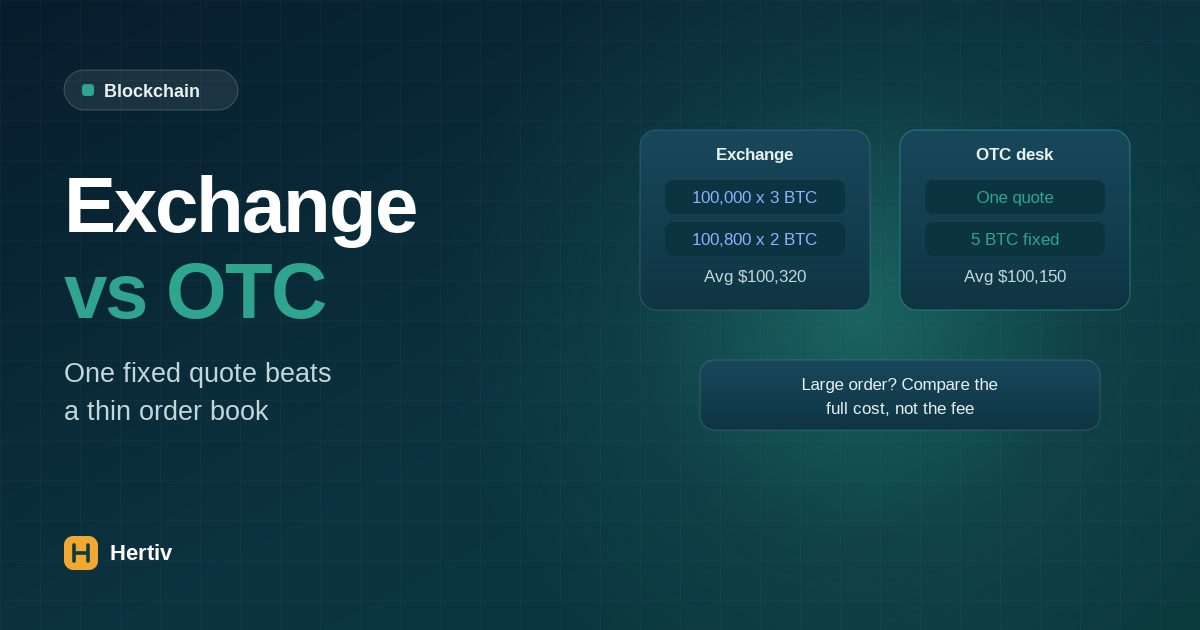
Example (hypothetical): a trader wants to buy 5 BTC when the market price is $100,000. On an exchange, 3 BTC fill at $100,000 and the other 2 BTC fill at $100,800, because the book is thin at that level. The total is 3 x 100,000 + 2 x 100,800 = $501,600, an average of $100,320 per coin.
An OTC desk quotes $100,150 for all 5 BTC, so the total is 5 x 100,150 = $500,750. The OTC route costs $850 less in this example, even though the desk's quote is above the headline price.
The lesson is to compare the full cost, not the headline fee. A low exchange fee means little if slippage adds far more, and a desk quote above the market price can still be cheaper when the order is large.
When is a crypto exchange the better choice?
A crypto exchange is the better choice when your trades are small next to the order book, frequent, or in deep pairs. If you buy $500 of BTC every week, an exchange fills the order at the market price with almost no slippage, and the published fee is the whole cost.
Exchanges also win on access and speed. There is no minimum trade size to worry about, no quote to wait for, and you can trade at any hour. For a first purchase, a small test trade, or a regular savings plan, the exchange is the simpler route.
Exchanges suit traders who want to manage their own orders. Limit orders, stop orders and recurring buys give you control without a phone call or a broker. If you trade in the most liquid pairs, such as BTC/USDT or ETH/USDT, the order book is deep enough that slippage stays small even for mid-size orders.
The exchange is also the right place when you need to move between many assets quickly. Swapping one coin for another, taking a position, or exiting one are all instant, and the range of listed assets is far wider than any single desk offers.
When is OTC trading the better choice?
OTC trading is the better choice when a single trade is large enough to move the price on a public order book. As a rule of thumb, once a ticket reaches six figures, or a large share of the pair's daily depth, the slippage on an exchange starts to cost more than a desk's spread.
OTC also suits trades in illiquid assets. A token with a thin order book can swing several percent on a single large market order, while a desk can quote the whole amount at one price from pooled liquidity. For a business converting a large sum into stablecoins, or a fund buying a block of tokens, that certainty matters more than the headline fee.
Privacy is another reason. A large public order signals intent: other traders and bots can see it and trade ahead of it. An OTC trade stays private between the trader and the desk, so the market never sees the order coming.
Settlement flexibility helps too. A desk can settle in fiat to a bank account, in stablecoins to a wallet, or in a mix, on agreed terms. That fits a company paying suppliers or a seller cashing out a large holding. See how to launch a crypto OTC derivatives platform for the desk side of this market.
What are the common mistakes?
The most common mistakes when choosing between an exchange and OTC trading are judging by the headline fee, ignoring slippage, and using the wrong route for the trade size.
- Comparing fees instead of total cost. A low taker fee means little if slippage adds more than the fee saves.
- Placing a large market order on a thin book. The order fills at worse and worse prices as it walks the levels.
- Accepting the first OTC quote without comparing. Desks price differently, so a second quote can save real money.
- Ignoring settlement risk with a desk. Check the desk's reputation, terms and settlement time before sending funds.
- Leaving large balances on an exchange. An exchange holds your funds until you withdraw them, so move what you do not need to trade.
- Using OTC for tiny trades. Desk minimums and onboarding make OTC pointless below them; an exchange is faster and cheaper there.
Key takeaways
- A crypto exchange is the public, low-minimum route for most trades
- An OTC desk gives one fixed price, so large orders avoid slippage
- Slippage, not the headline fee, is usually the biggest cost of a large trade
- Compare the full cost of both routes before you trade
- Check a desk's reputation and settlement terms before sending funds
Frequently asked questions
Is OTC trading only for institutions?
No. OTC desks serve institutions, companies and high-net-worth individuals, but any trader who meets the desk's minimum, often $50,000 to $250,000, can use one. Below that minimum, an exchange is the practical route, since desks do not take small tickets.
Does OTC trading avoid fees completely?
Not exactly. Many desks charge no separate trading fee, but the quote includes a spread, which is the desk's margin built into the price. The right comparison is the total cost of the trade, including spread and slippage, not whether a fee line appears.
How much slippage should I expect on an exchange?
It depends on the size of your order against the depth of the order book. A small order in a deep pair such as BTC/USDT may slip by only a few dollars. A large order in a thin pair can slip by several percent, because it fills through many price levels.
Is OTC trading safer than using an exchange?
It is different, not safer in every way. OTC trading avoids market impact and price slippage, but it adds counterparty risk: you trust one desk to settle. An exchange spreads risk across the platform, but your funds sit in its custody until you withdraw them.
Can I use both an exchange and an OTC desk?
Yes, and many traders do. Small and frequent trades go through the exchange, while large block trades go through a desk. Several large exchanges run their own OTC desks, so you can use both routes under one account and one verification.
What is a block trade in crypto?
A block trade is a single large transaction executed as one unit, rather than broken into many small market orders. In crypto it usually means a trade large enough to move the price on a public order book, often starting around $50,000 to $100,000 in value.


