Top OTC Crypto Exchange Companies: 6 to Compare
OTC crypto desks let businesses trade large amounts without moving the market. Compare six well-known desks on coverage, settlement and minimum trade size.
On this page
Short answer
An OTC crypto exchange lets a business buy or sell a large amount of cryptocurrency directly with a desk instead of on a public order book, so a big trade does not move the price. The six desks most often used by companies are Kraken OTC, Coinbase Prime, Gemini OTC, Cumberland, Galaxy Digital and FalconX. They differ in minimum trade size, coins covered, settlement options and country coverage.
Which OTC crypto exchange companies should a business compare?
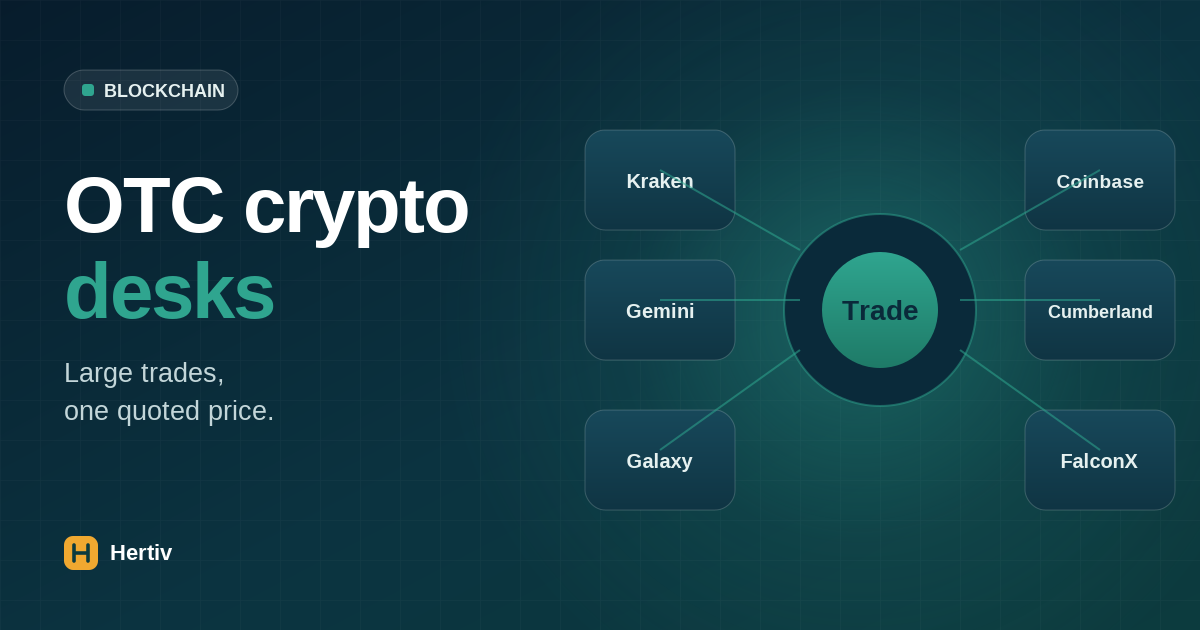
An OTC crypto exchange is a desk that buys and sells cryptocurrency directly with a client, off the public order book. A business that needs to move a large amount, such as paying a supplier in a stablecoin or selling a treasury position, uses an OTC desk because a trade of that size on a public exchange would move the price against it.
The desk quotes one price for the whole trade, settles it directly, and keeps the trade private.
The six desks below are the ones companies most often shortlist. They are all run by established firms with trading, custody or brokerage arms, and they all serve business clients rather than retail traders. The table compares them on what each one is best for and how settlement works.
| Desk | Best for | Settlement | Coverage |
|---|---|---|---|
| Kraken OTC | Round-the-clock trades | Same-day, bank or crypto | Wide coin list |
| Coinbase Prime | One prime broker | Custody and bank | Wide coin list |
| Gemini OTC | Regulated US trading | Same-day, bank or crypto | Main coins |
| Cumberland | Deep liquidity | Bank or crypto | Wide coin list |
| Galaxy Digital | Trading plus lending | Bank or crypto | Wide coin list |
| FalconX | Credit and trading | Bank or crypto | Wide coin list |
Every desk on this list sets a minimum trade size, and the minimum is large: OTC desks are built for trades far above retail size. Ask each desk for its current minimum and its fees, and check the vendor site for the latest terms before you commit.
<h3>1. Kraken OTC: best for round-the-clock trades</h3>
Kraken OTC is the over-the-counter desk of Kraken, one of the oldest crypto exchanges still running. It trades around the clock, which suits businesses in different time zones and teams that need a quote outside office hours. The desk handles large trades in the main coins and a wide list of smaller ones, and it settles in fiat or crypto.
Kraken OTC fits a business that already trades on Kraken or wants a desk backed by a long-running exchange. It is less of a fit for a company that needs lending, credit lines or a full prime brokerage service, which is what the next desk on this list offers.
Pros:
- Trades around the clock, seven days a week
- Backed by a long-running regulated exchange
- Wide list of coins beyond the majors
Cons:
- No lending or credit line attached
- Minimum trade size is large
- Some countries are not served
<h3>2. Coinbase Prime: best for one prime broker</h3>
Coinbase Prime is the prime brokerage arm of Coinbase, and it combines trading, custody and financing in one account. A business can hold coins in Coinbase custody, trade them through the OTC desk, and borrow against them without moving assets between providers. That single-account setup is the main reason companies pick it.
Coinbase Prime fits a business that wants trading and custody from one regulated provider and is happy to pay for that convenience. It is a weaker fit for a small team that only needs a single large trade now and then, or for a business outside the countries Coinbase Prime serves.
Pros:
- Trading, custody and financing in one account
- Regulated provider with audited custody
- Deep liquidity in the main coins
Cons:
- Higher cost than a plain OTC desk
- Onboarding takes time and paperwork
- Not available in every country
<h3>3. Gemini OTC: best for regulated US trading</h3>
Gemini OTC is the desk of Gemini, the US crypto exchange, and it trades with the same compliance and custody setup as the exchange itself. A business gets a quoted price for the full trade, settles the same day in dollars or crypto, and holds coins in Gemini custody if it wants to. The desk is known for clear pricing and for working with companies that need a clean audit trail.
Gemini OTC fits a US business that values regulation and a simple, well-documented process. It covers fewer coins than the bigger desks, so a team trading a long list of smaller tokens will need a second desk.
Pros:
- Regulated US exchange and custody
- Same-day settlement in dollars or crypto
- Clear pricing and a clean audit trail
Cons:
- Smaller coin list than the biggest desks
- Mainly suited to US clients
- Minimum trade size is large
<h3>4. Cumberland: best for deep liquidity</h3>
Cumberland is the crypto trading arm of DRW, a large trading firm, and it is one of the biggest liquidity providers in crypto. It trades with exchanges, funds and businesses, and it can fill very large orders without moving the price much. A business that needs to move a large position in one trade, or to trade regularly, gets quotes from a desk that sees a lot of flow.
Cumberland fits a business with large or frequent trades that cares most about price and fill. It is not a retail product and it is not a custody provider, so a team that also needs somewhere to hold coins will pair it with a custodian. For how a stablecoin fits into a large trade, see what a stablecoin is.
Pros:
- Very deep liquidity for large orders
- Backed by a large, established trading firm
- Quotes for a wide list of coins
Cons:
- No custody service of its own
- Built for large and frequent traders
- Onboarding is thorough and takes time
<h3>5. Galaxy Digital: best for trading plus lending</h3>
Galaxy Digital is a crypto financial services firm that runs an OTC trading desk alongside lending, asset management and investment banking. A business can trade a large position, borrow against its holdings, and get market research from the same firm. That breadth suits companies that want a trading partner rather than a single desk.
Galaxy fits a business that trades often and wants lending or advisory alongside execution. It is less of a fit for a team that needs one simple trade and nothing else, or for a company outside its client base.
Pros:
- Trading, lending and advisory in one firm
- Deep liquidity in the main coins
- Research and market views included
Cons:
- Built for larger clients
- Minimum trade size is large
- Services vary by country
<h3>6. FalconX: best for credit and trading</h3>
FalconX is a crypto prime broker that combines an OTC trading desk with credit, so a business can trade first and settle later within an agreed limit. That credit line matters for funds and trading firms that need to move fast without prefunding every trade. FalconX also offers derivatives and staking alongside spot trading.
FalconX fits a trading business that needs credit and a wide product range. It is a weaker fit for a company that makes one simple spot trade a year, or for a team that wants a plain desk with no credit relationship.
Pros:
- Credit lines for faster trading
- Spot, derivatives and staking in one place
- Built for trading firms and funds
Cons:
- Credit needs approval and collateral
- Minimum trade size is large
- Not a fit for one-off small trades
How to choose an OTC crypto exchange company
Choosing an OTC crypto exchange company starts with the trade itself: what coin, how much, and how fast it must settle. A desk that is perfect for a weekly bitcoin trade may be the wrong choice for a one-off sale of a smaller token. Write the trade down first, then shortlist desks that cover it.
- List the coins and the size. Write down every coin you need to trade and the size of a typical trade.
- Check the minimum. Ask each desk for its current minimum trade size and confirm your trades clear it.
- Compare the full cost. Ask for the quoted price, the settlement fee and any custody fee, and compare the total.
- Check where it can serve you. Confirm the desk onboards companies in your country and under your entity type.
- Test with a small trade. Run one trade, check the settlement time and the paperwork, then move the larger trades.
For the cost of building your own exchange instead, see cryptocurrency exchange development cost.
For the rules on launching a trading venue, see how to launch a stablecoin for a sense of the compliance work involved.
What are the common mistakes?
The most common mistake is trading on a public exchange when the trade is large enough to move the price. A business that sells a big position on an open order book usually gets a worse price than a desk would quote, and the trade is visible to everyone watching the book.
Another mistake is comparing only the quoted price and ignoring settlement. A desk with a slightly better price but slow settlement, or settlement in a form the business cannot use, costs more in the end. Ask how settlement works, in what currency, and how long it takes.
Teams also skip the onboarding check. OTC desks run identity and compliance checks on every client, and onboarding can take days or weeks. Start it early, and do not plan a trade for the same week you first contact a desk. And never pick a desk only because it covers one coin: coverage changes, so check the current list before each trade.
Key takeaways
- An OTC desk trades large amounts directly with a client, off the public order book.
- Kraken OTC and Gemini OTC suit round-the-clock and regulated US trading.
- Coinbase Prime combines trading, custody and financing in one account.
- Cumberland and Galaxy Digital suit large or frequent trades with deep liquidity.
- Compare minimum trade size, full cost, settlement and country coverage before choosing.
Frequently asked questions
What is an OTC crypto exchange?
An OTC crypto exchange is a desk that buys and sells cryptocurrency directly with a client instead of matching orders on a public book. A business uses it for large trades, because a big order on a public exchange would move the price. The desk quotes one price for the whole trade and settles it directly.
How much does an OTC crypto trade cost?
The cost is the difference between the desk's quoted price and the market price, plus any settlement or custody fee. Desks do not publish a fixed rate card, so a business should ask each desk for a quote on the same trade and compare the total. Check the vendor site for the latest terms.
What is the minimum trade size for an OTC desk?
Every OTC desk sets a minimum, and it is large: these desks are built for trades far above retail size. The minimum varies by desk and by coin, so ask each desk for its current figure before you plan a trade.
Do OTC crypto desks need identity checks?
Yes, every desk runs identity and compliance checks on its clients before trading, and onboarding can take days or weeks. Have company documents, ownership details and source-of-funds information ready before you start.
Can a business hold coins with an OTC desk?
Some desks, such as Coinbase Prime and Gemini OTC, offer custody alongside trading, while others, such as Cumberland, only trade and expect the client to hold coins elsewhere. Ask whether custody is included before you choose.
Is OTC trading better than using a public exchange?
For large trades, yes: a desk quotes one price for the whole amount and the trade stays private, so it does not move the market. For small trades, a public exchange is usually cheaper and faster.


