Order Book vs AMM: Which DEX Model Fits Your Trade?
Order book DEXs match buyers and sellers at set prices, while AMMs price trades from liquidity pools. Compare how each works, its cost, and which suits your trade.
On this page
Short answer
An order book DEX matches buyers and sellers at set prices, while an AMM DEX prices trades from a liquidity pool. Order books usually win on large trades in deep markets because you can set an exact price, while AMMs win on small swaps and new tokens because a pool always quotes a price. The better model depends on your trade size, the pair and the depth behind it.
What is an order book DEX?
An order book decentralised exchange is a trading venue where buy and sell orders are listed in a book and matched by price, with the exchange running on a blockchain instead of a company server. Traders place limit orders at the price they want, or market orders that take the best price on offer.
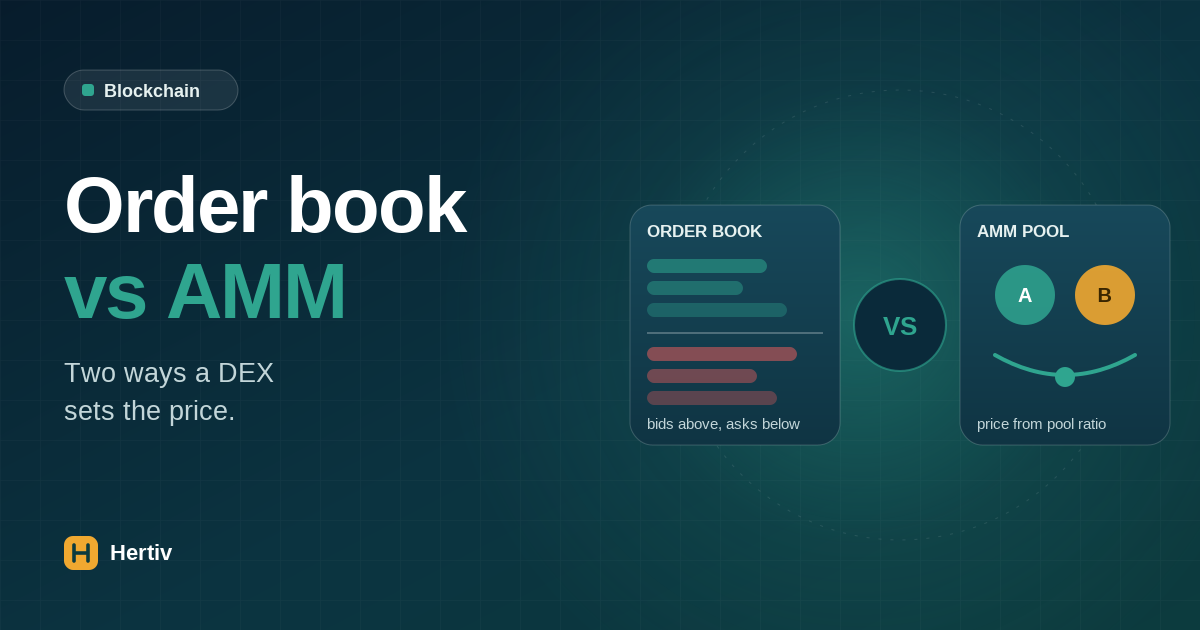
The book has two sides: bids, which are buyers waiting at a price, and asks, which are sellers waiting at a price. The gap between the best bid and the best ask is the spread. When a new order arrives, the matching engine pairs it with the best opposite order, and the trade settles on-chain.
Because every order is visible, traders can see depth: how much is waiting at each price level. That visibility is why order books suit traders who care about price control and large orders. Decentralised exchange development often starts with this model when the goal is a professional trading venue.
What is an AMM DEX?
An automated market maker, or AMM, is a decentralised exchange that prices trades from a liquidity pool instead of an order book. A pool holds two tokens, and a formula sets the price from the ratio of the two balances. Traders swap against the pool, not against other traders.
Anyone can add tokens to a pool and become a liquidity provider, earning a share of the trading fees. The pool always quotes a price, even for tokens with no active buyers or sellers, which is why AMMs made long-tail token trading possible.
The trade-off is price impact: a large trade moves the ratio and worsens the price the trader gets. Small trades barely move it, while large trades can shift it a lot. That effect, plus the fee, is the real cost of using an AMM. See what an AMM is for the basic mechanics.
Order book vs AMM: how do they differ?
The core difference is where the price comes from. An order book price comes from other traders' orders, while an AMM price comes from a formula and the pool's token ratio. That single difference shapes liquidity, cost, speed and who the model suits.
| Aspect | Order book DEX | AMM DEX |
|---|---|---|
| Price source | Other traders' buy and sell orders | Formula and pool token ratio |
| Liquidity source | Market makers posting orders | Liquidity providers funding pools |
| Price control | Limit orders set an exact price | Price moves with each trade |
| Large trades | Cheap on a deep book, costly on a thin one | Costly when the trade is large vs the pool |
| Small or new tokens | Hard to trade without market makers | Always quoted, even with no buyers |
| Speed | Matches as fast as orders arrive | Settles as soon as the swap is submitted |
| Typical fee shape | Maker-taker fee on each trade | Flat fee on each swap |
Order books need market makers to keep the book full, while AMMs need liquidity providers to fund pools. Both models need someone to supply liquidity, but they ask for it in different ways.
Which model gives you a better price?
The better price depends on the size of your trade and the depth behind it. On a deep order book, a small trade crosses a tight spread and costs little. On a thin book, the same trade can move through several price levels and cost more than expected.
On an AMM, the cost is the fee plus price impact. A trade that is small relative to the pool pays almost no impact, while a trade that is a large share of the pool pays a lot. Before you trade, compare the quoted price with the market price elsewhere; the gap is the cost you are paying.
Fees also differ. Order books often charge a maker-taker fee, where makers who add orders pay less than takers who remove them. AMMs usually charge a flat fee on every swap, which goes to liquidity providers. DeFi development teams weigh these fee shapes when they pick a model.
Which model fits which trader?
Order books fit active traders who place limit orders, trade large sizes and want to control the exact price. They also fit markets with professional market makers, such as pairs with high volume and tight spreads.
AMMs fit casual swappers, new tokens and long-tail pairs that could never fill an order book. If you want to swap a token that few people trade, an AMM pool is often the only venue that quotes a price at all.
Many traders use both. They check the order book for large trades on liquid pairs and use an AMM for small swaps or new tokens. The models are tools, not teams to join.
Example (hypothetical): swapping $10,000 of tokens
Example (hypothetical): a trader wants to swap $10,000 of one token for another, and the market price is $100 per token. On an order book with a tight spread, the best ask is $100.20, so $10,000 buys about 99.8 tokens. A 0.1% taker fee adds $10, so the total cost is $10,010 for 99.8 tokens.
On an AMM with a $2,000,000 pool, the same $10,000 trade is 0.5% of the pool, so price impact pushes the effective price to about $100.50. The trader receives about 99.5 tokens, and a 0.3% swap fee adds $30, for a total of $10,030.
The order book wins this trade by about $20, because the book is deep and the spread is tight. If the pool were small or the book were thin, the result could flip. The lesson is to compare the quoted price on each venue before you trade, not to trust a model in general.
What are the common mistakes?
The most common mistake is trading on a thin venue without checking the price. A market order on an empty order book or a large swap in a small pool can both cost far more than the fee suggests. Always check the price you will actually get before you confirm.
- Trading without a slippage limit. A swap with no limit can fill at a far worse price if the pool or book moves while it settles.
- Assuming the fee is the whole cost. Spread and price impact often cost more than the fee, especially on large trades.
- Using an AMM for a large trade. A deep order book often fills a large trade more cheaply than a small pool.
- Ignoring liquidity depth. A venue that looks cheap on one pair can be costly on another, so check depth per pair.
- Leaving limit orders open. A limit order left open on a volatile pair can fill at a price you no longer want.
If you are building a trading venue rather than using one, a crypto exchange development partner can help you pick the model that fits your market and your liquidity plan.
Key takeaways
- Order books price trades from other traders' orders; AMMs price them from a pool ratio and a formula.
- Order books suit limit orders and large trades on deep, liquid pairs.
- AMMs suit small swaps and new tokens, because a pool always quotes a price.
- The real cost is spread or price impact plus the fee, not the fee alone.
- Compare the quoted price on both models before you trade, for your exact size.
Frequently asked questions
What is the main difference between an order book and an AMM?
An order book matches buy and sell orders placed by traders, so the price comes from the orders in the book. An AMM holds tokens in a liquidity pool and sets the price from the ratio of the two balances, so traders swap against the pool rather than against other traders.
Which DEX model is better for beginners?
AMMs are usually simpler for beginners, because you swap at the quoted price without placing orders or reading a book. Order books give more control, but they need you to understand limit orders, spreads and depth. Start with small swaps on an AMM while you learn how prices move.
Are AMM fees higher than order book fees?
Not always. AMMs charge a flat fee per swap, while order books charge maker-taker fees that vary with your order type. The total cost also includes spread on an order book and price impact on an AMM, so the cheaper venue depends on the pair, the size and the depth.
Can a token trade on both models at once?
Yes. Many tokens trade on both an order book DEX and an AMM at the same time. Traders compare the price on each venue and use whichever gives the better fill for that trade, which is why prices across venues usually stay close.
What is slippage on a DEX?
Slippage is the gap between the price you expected and the price you actually got. On an order book it comes from the spread and from moving through price levels; on an AMM it comes from price impact as your trade changes the pool ratio. Setting a slippage limit caps how far the fill can move.
Do order book DEXs need market makers?
Yes, in practice. An order book with no orders is unusable, so someone must post bids and asks to keep it full. That is usually a professional market maker. AMMs avoid this by letting anyone fund a pool, which is why they work for tokens that have no market maker.


