Claude Haiku vs Sonnet: Which Model Fits Your Work?
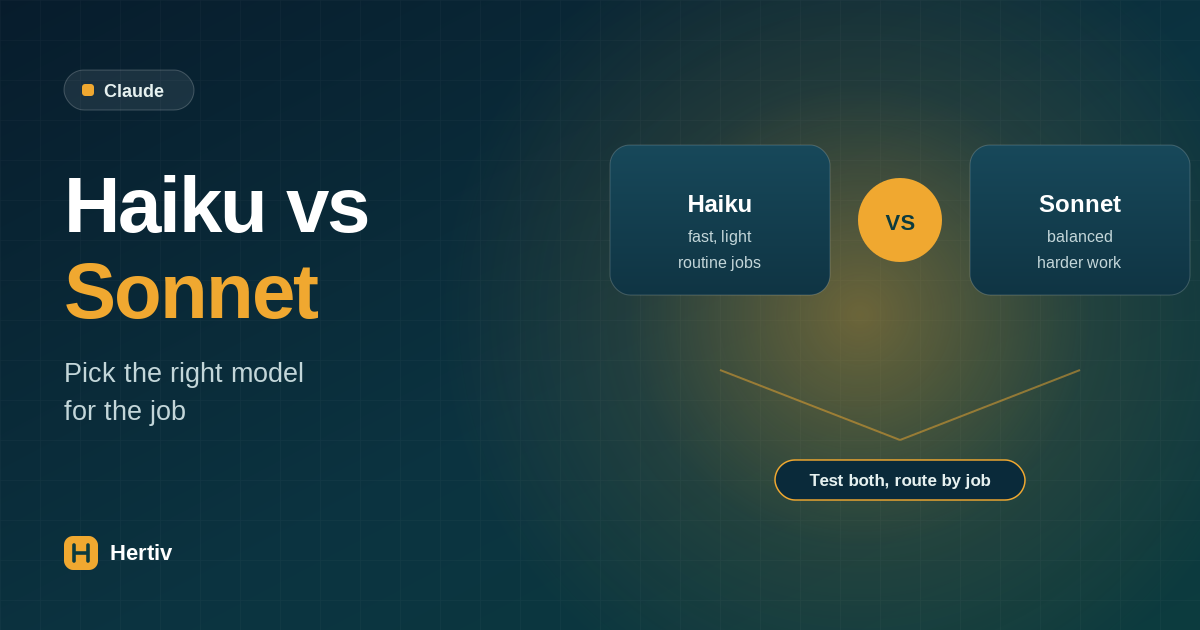
Haiku is Claude's fast, light model and Sonnet is the balanced one. Compare speed, depth and cost, then pick by the job, not by the name.
On this page
Short answer
Claude Haiku and Claude Sonnet are two models in the same family, built for different trade-offs. Haiku is the fast, light model: it answers quickly and costs less per request. Sonnet is the balanced model: it handles longer, harder work with more care, and it is the default choice for most teams.
What is Claude Haiku vs Sonnet?
Claude Haiku vs Sonnet is a choice between speed and depth. Haiku is the smallest model in the Claude family, built to answer fast on straightforward jobs such as classifying text, drafting short replies and summarising short documents. Sonnet is the middle model, built for work that needs more thought, such as writing long documents, reasoning through a problem or working with a large set of files.
Both models understand the same kinds of input: text, images and documents. The difference is what they do with it. Haiku gives a short, direct answer and moves on. Sonnet takes longer, follows more steps, and is more likely to catch a detail or a contradiction in a long document. Neither is a better model in general; each is better for a different kind of job.
Think of it as choosing between a quick check and a careful review. A quick check is right for a routine ticket or a short summary. A careful review is right for a report that will be shared with a client or a decision that is hard to undo. The table below compares them side by side.
| Factor | Haiku | Sonnet |
|---|---|---|
| Speed | Fastest, near-instant replies | Slower, takes more time per answer |
| Depth | Short, direct answers | Longer, more careful answers |
| Best jobs | Sorting, drafting, short summaries | Writing, analysis, long documents |
| Cost per request | Lower | Higher, see vendor site |
| Long documents | Can miss detail | Tracks detail better |
When should you use Haiku?
Use Haiku when the job is routine, high in volume, and easy to check. Sorting support tickets into categories is a good example: each ticket takes seconds, a wrong sort is easy to spot and fix, and the volume is high enough that speed matters more than depth. The same applies to short summaries, quick drafts and simple questions.
Haiku also fits when the answer feeds a system rather than a person. A search tool that needs a short summary of each document, or a triage step that routes a ticket to the right team, does not need a careful essay. It needs a fast, consistent answer, and Haiku gives that at a lower cost per request.
The rule is simple: if a person will check the answer in seconds, Haiku is usually enough. If the answer will be sent to a customer or used to make a decision, check whether the job needs Sonnet instead. How to select the right AI model explains how to weigh speed against depth for any model choice.
When should you use Sonnet?
Use Sonnet when the job is harder, longer or harder to undo. Writing a report, analysing a contract, or working through a long set of documents needs a model that tracks detail across pages and notices contradictions. Sonnet is built for that kind of work, and it is the default choice for most teams because it handles the widest range of jobs well.
Sonnet also fits when the answer is the product. A draft that a customer will read, a summary that a manager will rely on, or an analysis that shapes a decision all deserve the more careful model. The extra time per answer is small compared with the cost of a mistake in the final output.
Sonnet is also the safer pick when you are not sure how hard a job is. Start with Sonnet, measure the results, and move the easy, high-volume jobs to Haiku once you know which ones they are. That order avoids shipping weak answers while you learn. Foundation model vs LLM explains where these models sit in the wider picture.
How to choose between Haiku and Sonnet
Choose between Haiku and Sonnet in five steps, using your own work rather than a benchmark.
- List your top five jobs. Write down the tasks the model will actually do, such as sorting tickets or drafting replies.
- Sort them by risk. Mark each job by what happens if the answer is wrong: a quick fix, or a customer complaint.
- Test both models. Run the same 40 examples through Haiku and Sonnet, and have a person judge which answers are usable.
- Route by job, not by user. Send routine, low-risk jobs to Haiku and harder jobs to Sonnet, using rules in your code.
- Review monthly. Check the split again each month, because the jobs change as teams learn what works.
Keep the test set fixed so the comparison stays honest. A test that changes every week cannot tell you which model is better. How to test AI models covers how to build a test set that stays fair.
Example (hypothetical): testing both models on support tickets
Example (hypothetical): a support team tests both models on 40 real tickets. It asks each model to draft a reply, and a person marks each draft as usable or not. Haiku produces 31 usable drafts out of 40, and Sonnet produces 35 out of 40. The gap is 4 drafts in 40, or about 10%.
The team then looks at the failures. Haiku's misses are mostly short replies that leave out a step, while Sonnet's misses are mostly long replies that need trimming. The team decides to send simple tickets to Haiku and complex ones to Sonnet, and a person reviews every draft before it goes out.
With that split, about half the tickets go to each model. The team saves time on the simple half and keeps quality on the hard half. The test took an afternoon, and the team repeats it each quarter with fresh tickets to check the split still holds.
What are the common mistakes?
The most common mistake is picking one model for everything. Haiku on a hard job gives weak answers that a person must rewrite, and Sonnet on a routine job wastes time and money. Route by job, not by habit.
The second mistake is choosing by price alone. The cheapest model per request is not the cheapest per usable answer if half its drafts need rewriting. Count usable answers, not requests, and include the review time in the cost.
The third mistake is testing on easy examples only. A model that looks perfect on ten simple tickets can fail on the hard ones that matter most. Test on real work, including the awkward cases, and keep the test set fixed so you can compare fairly.
Key takeaways
- Haiku is fast and light; Sonnet is balanced and careful
- Route routine, low-risk jobs to Haiku
- Use Sonnet for long, hard or customer-facing work
- Test both models on your own examples before deciding
- Count usable answers, not requests, when comparing cost
Frequently asked questions
Is Haiku worse than Sonnet?
No. Haiku is a smaller model built for speed, and Sonnet is a balanced model built for depth. Haiku is better for fast, routine jobs, and Sonnet is better for long or hard jobs. The right choice depends on the work, not on the model.
Which Claude model is cheapest?
Haiku costs less per request than Sonnet, because it is a smaller model. The cheapest option per usable answer depends on your work, so test both models and count usable drafts. See vendor site for current pricing.
Can Haiku handle long documents?
Haiku can read long documents, but it is more likely to miss a detail than Sonnet. For a long report or contract, Sonnet is usually the safer choice, because it tracks detail across pages more reliably.
Can I use both models at once?
Yes. Most teams route jobs by type: routine jobs go to Haiku and harder jobs go to Sonnet. The routing rules sit in your code, and a person reviews the output before it reaches a customer.
How do I test which model fits my work?
Take 40 real examples of the job, run them through both models, and have a person mark each answer as usable or not. Keep the test set fixed so you can compare fairly, and repeat the test each quarter.
Does Sonnet replace a human reviewer?
No. Both models can make mistakes, and Sonnet's longer answers still need a human check before they go to a customer. Use the model to draft, and keep a person in charge of the final answer.


