Foundation Model vs LLM: What Is the Difference?
A foundation model is the broad category; a large language model is one type of foundation model. Here is how they differ and when each term applies.
On this page
Short answer
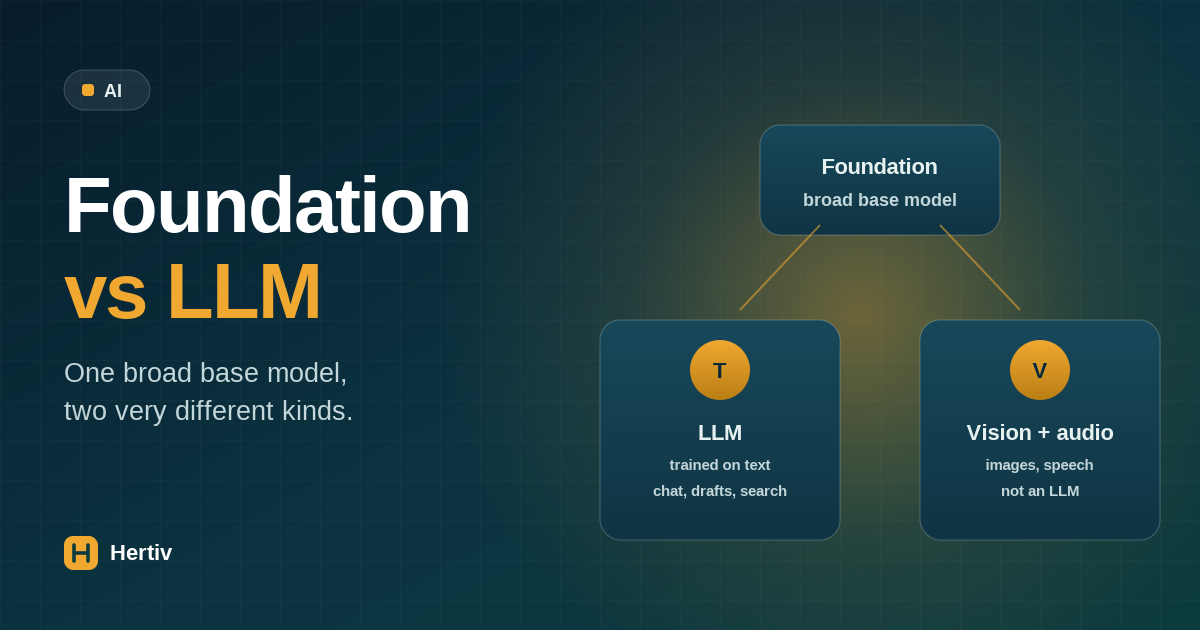
A foundation model is a large model trained on broad data that can be adapted to many tasks. A large language model, or LLM, is a foundation model trained on text. Every LLM is a foundation model, but not every foundation model is an LLM, because some are trained on images, audio or other data instead of text.
What is a foundation model?
A foundation model is a large machine learning model trained on broad, general data and then adapted to specific tasks. The word "foundation" means it is a base: teams build on top of it with fine-tuning, prompting or retrieval, rather than training a new model from scratch for each job.
Foundation models are trained on huge amounts of data with self-supervised learning, where the model learns patterns by predicting missing or next parts of the data. That training is expensive and slow, which is why most teams use a published model and adapt it instead of training their own.
The idea applies across data types. A model trained on images can classify photos, find objects or generate pictures. A model trained on audio can transcribe speech or recognise sounds. A model trained on text is a language model. The shared idea is the same: one broad base, many uses.
Because the base is general, the same model can serve different products. A hospital might adapt it for clinical notes while a retailer adapts it for product search, each adding their own data and checks on top.
What is a large language model?
A large language model is a foundation model trained mainly on text. It learns the patterns of language from books, articles, code and web pages, and it uses those patterns to produce text, answer questions, summarise documents and follow instructions.
LLMs are the best-known kind of foundation model because text is everywhere and the use cases are easy to see: drafting, support answers, search and coding help. When people say "AI model" in a business conversation, they usually mean an LLM.
An LLM works by predicting the next piece of text given what came before, using the patterns it learned during training. At run time, teams shape its behaviour with prompts, examples, retrieved documents and guardrails, rather than retraining it for every new task.
The limits matter too. An LLM can produce confident text that is wrong, it can repeat biases in its training data, and it cannot know facts that appeared after training unless it is connected to fresh sources. That is why production systems add retrieval and human review, as a guide to how to test AI models explains.
Foundation model vs LLM: the key differences
The difference is scope. "Foundation model" describes the training approach and the role of the model, while "LLM" describes what the model was trained on. The table below makes the comparison concrete.
| Aspect | Foundation model | Large language model |
|---|---|---|
| What it means | A broad base model adapted to many tasks | A foundation model trained on text |
| Training data | Text, images, audio, video or mixed data | Text, including books, articles and code |
| Typical output | Depends on the type: text, images, audio | Text, code or structured answers |
| Examples of use | Image generation, speech, vision, text | Chat, drafting, summarising, search |
| How teams adapt it | Fine-tuning, prompting, retrieval | Prompting, retrieval, fine-tuning |
Think of it like this: "foundation model" is the category and "LLM" is one item in it, the same way "vehicle" is the category and "car" is one kind of vehicle. A vision model that labels images is a foundation model but not an LLM, because it does not work with text.
Some newer models are multimodal foundation models: they are trained on text plus images or audio, so they can take a picture and describe it, or take a question and answer with an image. These blur the line, but they are still foundation models first.
When should you say foundation model, and when LLM?
Use "LLM" when the model works with text. If your product drafts emails, answers support tickets or summarises documents, it uses an LLM, and that is the precise term. Using "foundation model" there adds nothing and confuses readers who expect a comparison.
Use "foundation model" when the conversation covers more than text, or when you are talking about the strategy of building on a base model. A company choosing between a vision model, a speech model and a text model is choosing between foundation models, and the general term is the right one.
In vendor documents, watch for the term being used loosely. Some vendors call any large model a foundation model, including models trained for one narrow task. Ask what data the model was trained on and what it was trained to do; the answers tell you more than the label.
For retrieval-based systems, the distinction matters for design. A text system pairs an LLM with a document store, as a guide to what retrieval-augmented generation is explains. A vision system pairs a different foundation model with an image store, and the evaluation looks different too.
How do teams adapt a foundation model?
Teams rarely train a foundation model from scratch. The usual path is to take a published base model and adapt it to one job, which is far cheaper and faster than training.
- Prompting. Write clear instructions and examples so the base model behaves the way the task needs, with no training at all.
- Retrieval. Connect the model to your own documents so answers are grounded in current, trusted sources.
- Fine-tuning. Train the model further on your own examples when you need consistent format, tone or domain knowledge.
- Evaluation. Test the adapted model on a fixed set of real cases and compare it with the base model before launch.
- Guardrails. Add filters, limits and human review for risky outputs, especially where the model can take actions.
Fine-tuning is the most expensive step and the least often needed first. Most support, search and drafting products work well with prompting and retrieval alone. Fine-tuning makes sense when you have many labelled examples and the base model keeps missing the same pattern.
The cost of running a model also depends on size and use. A small model that handles routine questions costs less to run than a large one, which is why many teams route simple tasks to a small model and hard ones to a large model.
Example (hypothetical): one base, two products
Example (hypothetical): a retailer has a support team answering 500 questions a day and a merchandising team that needs product descriptions for 2,000 new items a month. Both teams want help, but they are different jobs.
The support team uses an LLM with retrieval over the help centre. It drafts answers from real articles, and an agent reviews each draft before sending. In testing, 172 of 200 drafted answers are correct, up from 148 before the team added retrieval and a short policy to the prompt.
The merchandising team uses a vision foundation model instead. It reads product photos, identifies colour, material and style, and produces a draft description that a merchandiser edits. It is a foundation model, but it is not an LLM, because its main input is images.
Both products sit on the same idea: a broad base model, adapted with the team's own data and checked by a human. The support team saves about 33 hours a day when the model drafts 500 answers at 2 minutes each instead of 6 minutes each, and the merchandising team cuts description drafting from a day per batch to a few hours.
Common mistakes
The most common mistakes with foundation models are using the terms as if they were the same, training when adaptation would do, and skipping evaluation. Each one wastes time or money.
- Calling every model an LLM. A vision or audio model is a foundation model, not an LLM. Use the precise term.
- Training from scratch. Training a base model costs far more than adapting one, and it is rarely needed for a business product.
- Fine-tuning first. Try prompting and retrieval before fine-tuning; they solve most cases at lower cost.
- No evaluation set. Without fixed test cases, you cannot tell whether a change helped or hurt.
- Trusting output without checks. Models can be confident and wrong, so add retrieval, citations and human review where it matters.
- One model for everything. A small model often handles routine work cheaper; save the large model for hard cases.
If you are choosing between model types for a project, LLMOps vs MLOps explains how the operations around them differ, and that is often where the real work sits.
Key takeaways
- A foundation model is the broad category; an LLM is a foundation model trained on text.
- Every LLM is a foundation model, but not every foundation model is an LLM.
- Teams usually adapt a published base model with prompting, retrieval or fine-tuning.
- Try prompting and retrieval before fine-tuning; they solve most cases at lower cost.
- Use the precise term: LLM for text, foundation model when the conversation covers more.
Frequently asked questions
Is GPT a foundation model or an LLM?
Both. GPT is a large language model, which means it is a foundation model trained on text. The terms describe different things: LLM says what the model was trained on, while foundation model says it is a broad base that teams adapt to many tasks.
Are all AI models foundation models?
No. Many models are trained for one narrow task, such as detecting fraud in one dataset or forecasting demand for one product. Those are task-specific models. A foundation model is trained broadly and then adapted to many tasks, which is a different design.
What is a multimodal foundation model?
A multimodal foundation model is trained on more than one kind of data, such as text plus images or audio. It can take an image and describe it, or answer a question using both a picture and text. These models are still foundation models; they simply handle more than one input type.
Do I need to train my own foundation model?
Almost never. Training a base model from scratch is expensive and slow, and published models already cover most needs. The usual path is to adapt a published model with your own documents, prompts and evaluation set, and to fine-tune only when you have many labelled examples.
How do foundation models differ from traditional machine learning?
Traditional machine learning usually trains a small model for one task on labelled data. Foundation models are trained broadly on large amounts of unlabelled data and then adapted, which means one base can serve many tasks and needs far less labelled data per task.
What should I check before choosing a model?
Check what data it was trained on, what it can and cannot do, how it is licensed, what it costs to run, and how you will evaluate it on your own cases. A model that scores well on a vendor benchmark may still perform poorly on your data, so test it on real examples first.


