Chatbots vs Virtual Assistants: Which One Fits Your Needs?
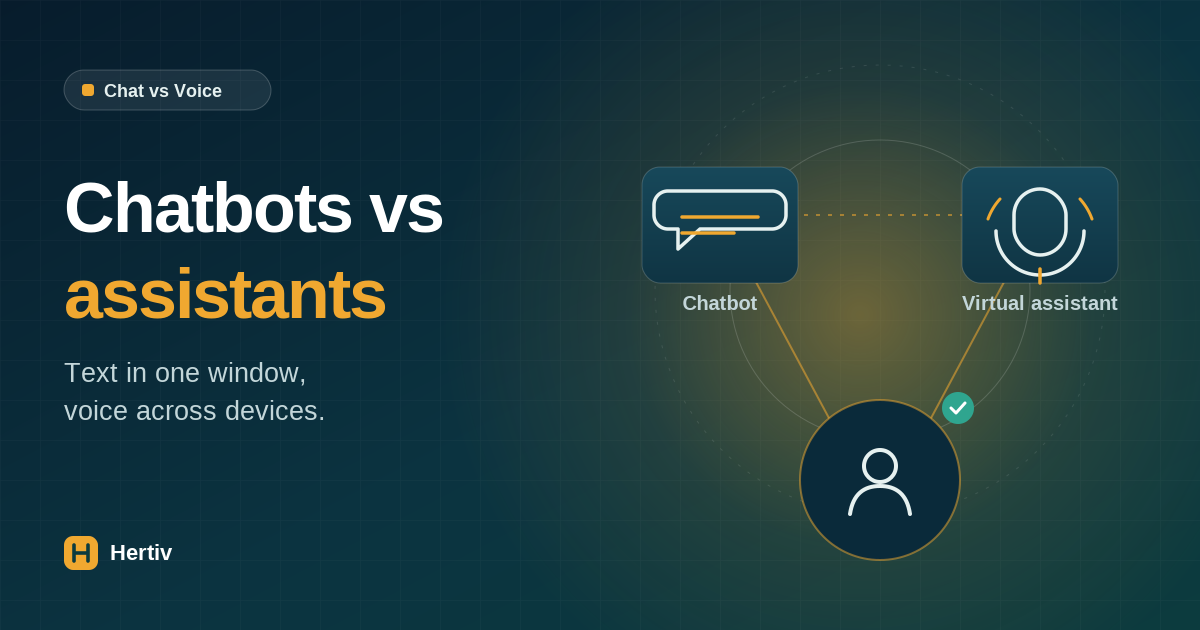
A chatbot answers in a chat window, one job at a time; a virtual assistant works by voice across devices and juggles many tasks. Compare them before you pick one.
On this page
Short answer
A chatbot is a text-based program that answers questions or completes a task inside a chat window, while a virtual assistant is a voice-first helper that works across devices, keeps context between requests and handles many kinds of tasks. Chatbots fit narrow, repeatable jobs; virtual assistants fit personal, hands-free help across the day.
What is the difference between a chatbot and a virtual assistant?
A chatbot is a text-based program that answers questions or completes a task inside a chat window, while a virtual assistant is a voice-first helper that works across devices, keeps context between requests and handles many kinds of tasks. The chatbot lives in one place and does one job; the virtual assistant follows you around and does many.
Think of the chatbot as a counter in a shop: you walk up, ask a question, get an answer and leave. Think of the virtual assistant as a personal helper: it knows your calendar, your messages and your habits, and it can set a reminder, play music, answer a question and order groceries in the same conversation.
| Chatbot | Virtual assistant | |
|---|---|---|
| Main input | Text typed in chat | Voice, sometimes text |
| Where it lives | Website, app or messaging channel | Phone, speaker or car |
| Scope | One task or topic | Many tasks across the day |
| Memory | Usually none between chats | Keeps context and preferences |
| Best for | Support, bookings, FAQs | Reminders, hands-free help, routines |
The line blurs because modern chatbots can remember context and some virtual assistants answer in text. What matters is not the label but the job: a narrow, repeatable question fits a chatbot, and a personal, ongoing set of tasks fits a virtual assistant. The comparison with chatbot vs conversational AI covers the technology behind the chat side.
How does a chatbot work?
A chatbot works by matching what you type to an intent it knows, then running the reply or action tied to that intent. A simple chatbot follows rules and buttons; a modern one uses a language model to understand free text and generate an answer.
A typical flow has four parts:
- It reads your message and works out what you want.
- It pulls the facts it needs from a knowledge base, a booking system or an order database.
- It replies in text, sometimes with buttons or a link.
- If it cannot help, it hands you to a person or offers a different path.
The chatbot's strength is focus. Because it only handles a small set of tasks, its answers can be tested and its failures are easy to spot. Its weakness is the same focus: ask it something outside its scope and it will guess, repeat itself or give up. See what a chatbot is for the full picture.
How does a virtual assistant work?
A virtual assistant works by listening for your voice, turning speech into text, working out what you want, and then acting across your devices and accounts. It keeps your preferences and history, so a request such as 'remind me about the dentist' works without you restating the details.
Under the surface it combines several pieces: speech recognition, language understanding, access to your calendar, messages and music, and routines that chain actions together. Say 'good morning' and it can read your schedule, start the news and turn on the lights, because those pieces are connected.
The assistant's strength is breadth and convenience: hands-free help while you drive, cook or work. Its weakness is that breadth. It must guess what you mean from a short spoken phrase, and a wrong guess can set the wrong alarm or send the wrong message. That is why assistants ask for confirmation on anything that cannot be undone.
When should you choose a chatbot?
Choose a chatbot when the job is narrow, repeatable and tied to one place, such as a website or a messaging channel. Support questions, order tracking, appointment booking and FAQs are the classic cases.
Pick a chatbot when:
- You get the same questions again and again, and the answers are known.
- Customers already come to your website or app, so the chat window is where they are.
- You want every answer tested and consistent, with a clear handoff to a person.
- You need the bot live quickly, without connecting it to calendars and devices.
A chatbot is also the cheaper first step. It needs a knowledge base and a few integrations, not a voice pipeline and a device ecosystem. If the job grows beyond one channel, you can add a voice layer later rather than starting with one.
When should you choose a virtual assistant?
Choose a virtual assistant when the user needs hands-free help across the day, on a phone, a speaker or in a car. Reminders, timers, calls, messages, music and smart-home control are the classic cases.
Pick a virtual assistant when:
- The user is driving, cooking or working with their hands.
- The tasks are personal and ongoing: schedules, reminders, lists and habits.
- The value comes from knowing the user, not from answering one question.
- The product is a device or an app people carry with them all day.
A virtual assistant is the harder build. It needs speech recognition, account connections and routines, and it must handle the long tail of personal requests. If your users do not need hands-free help, that effort buys little. The AI agents vs AI assistants comparison covers a related choice between doing and helping.
Example (hypothetical): a clinic uses both
Example (hypothetical): a small clinic gets 400 appointment questions a month on its website, and its receptionists spend 3 minutes on each one, which is 1,200 minutes, or 20 hours a month.
A chatbot on the website answers the routine questions, such as opening hours, directions and how to reschedule, and handles 300 of the 400, saving 900 minutes, or 15 hours a month. The remaining 100 questions go to reception, which keeps the human touch for anything unusual. Meanwhile the clinic's doctors use a virtual assistant on their phones to set reminders, dictate notes and check the next day's schedule hands-free between patients.
The two tools do not compete. The chatbot serves the public in one channel; the virtual assistant serves the staff across the day. Picking one to replace the other would leave one group worse off.
What are the common mistakes?
The most common chatbot and virtual assistant mistakes come from judging one tool by the other one's job. Pick the tool for the user's situation, and most of the rest follows.
- Calling a chatbot a virtual assistant, or the reverse, and then judging it against the wrong expectations.
- Giving a chatbot an open-ended job it cannot test or bound.
- Building a virtual assistant when users only need answers on a website. The voice pipeline buys nothing there.
- Letting a voice assistant act without confirmation on anything that cannot be undone.
- Forgetting the handoff. A bot with no path to a person frustrates faster than no bot at all.
- Measuring success by how many messages the bot handles, not by whether people got what they needed.
Start from the user's situation, not from the technology. For teams planning either one, AI chatbot development is the place to start.
Key takeaways
- A chatbot answers in text inside one chat window; a virtual assistant works by voice across devices
- Chatbots fit narrow, repeatable jobs such as support, bookings and FAQs
- Virtual assistants fit personal, hands-free tasks such as reminders, calls and routines
- A chatbot's strength is focus and testability; a virtual assistant's is breadth and convenience
- The two can work side by side, serving different people in different situations
- Start from the user's situation, not from the technology label
Frequently asked questions
What is the main difference between a chatbot and a virtual assistant?
A chatbot is a text-based program that answers questions or completes a task inside a chat window. A virtual assistant is a voice-first helper that works across devices, keeps context between requests and handles many kinds of tasks across the day.
Is Siri a chatbot or a virtual assistant?
Siri is a virtual assistant. It works by voice across a phone, watch and speaker, keeps your preferences, and handles reminders, calls, messages and music. A chatbot, by contrast, usually lives in one chat window and handles a narrow set of tasks.
Can a chatbot remember what I said?
Some can, within one conversation or with a user account, but most simple chatbots start fresh each time. A virtual assistant is built to remember: it keeps your preferences, history and routines so it can help without you restating everything.
Which is better for customer support?
A chatbot is usually better for customer support. Support questions are narrow and repeatable, the answers are known, and customers are already on your website or app. A virtual assistant fits personal, hands-free help rather than public support.
Do I need both a chatbot and a virtual assistant?
Only if you serve two different situations. A website chatbot serves the public in one channel, while a virtual assistant serves staff or customers hands-free across the day. Many teams start with the chatbot and add voice help later if users ask for it.
Are chatbots and virtual assistants the same as AI agents?
No, though they overlap. An AI agent takes multi-step actions towards a goal with tools of its own, while a chatbot answers in a chat window and a virtual assistant helps with personal tasks by voice. Some products combine all three.


