Chatbot vs Conversational AI: What Is the Difference?
A chatbot follows set rules and answers fixed questions, while conversational AI understands language and holds a back-and-forth chat. Here is the difference.
On this page
Short answer
A chatbot and conversational AI are not the same thing, even though both answer customers in chat. A chatbot follows set rules and gives fixed answers to questions it was told to expect. Conversational AI understands language, remembers what was said earlier in the chat, and can handle questions it was not given word for word. The choice matters, because the two tools cost different amounts and solve different problems.
What is the difference between a chatbot and conversational AI?
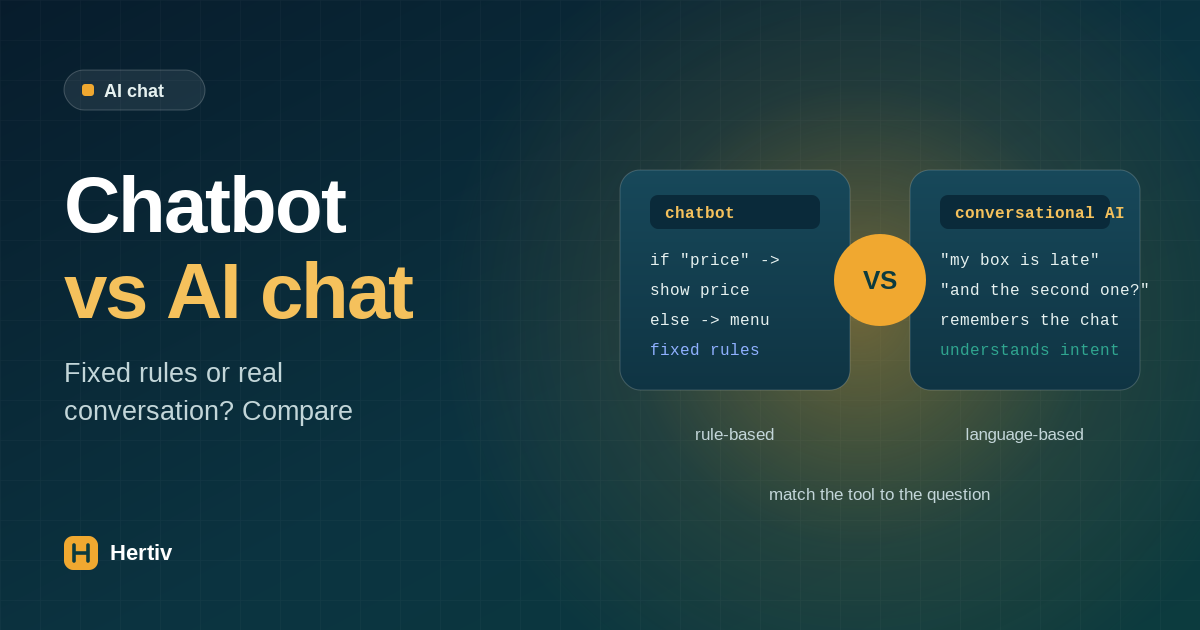
A chatbot is a program that answers messages using rules or buttons, and it gives the same answer every time a matching question arrives. A conversational AI is a program that understands natural language, keeps track of the conversation, and writes answers that fit what the person just said, even when the wording is new.
The difference shows up when a customer asks something unexpected. A rule-based chatbot falls back to a menu or a human, because it only knows the questions it was given. Conversational AI can work out the intent behind new wording, ask a follow-up question, and carry the answer across several turns of chat.
| Feature | Chatbot | Conversational AI |
|---|---|---|
| How it answers | Fixed rules, buttons and keyword matches | Understands language and writes fresh replies |
| New wording | Fails or falls back to a menu | Works out the intent and answers |
| Memory | None, or only the current step | Remembers the chat so far |
| Setup effort | Low, write the rules and answers | Higher, needs training data and testing |
| Best for | FAQs, bookings and simple forms | Support, sales and multi-step tasks |
Many tools sit between the two. A chatbot with a search box can answer from a help centre, and a conversational AI can be limited to a few tasks. A comparison of AI agents and chatbots shows how the same split appears one level up, where agents take actions instead of only answering.
How does a rule-based chatbot work?
A rule-based chatbot works from a decision tree. The team writes the questions it should expect, the answers for each one, and the buttons a visitor can press. When a message arrives, the chatbot matches it to a rule and sends the matching answer, or it shows a menu when nothing matches.
These chatbots are cheap to build and easy to test, because every path is written down in advance. They work well for opening hours, prices, delivery status and booking forms, where the questions repeat and the answers rarely change.
Their limit is clear: they cannot understand a question written in new words. A customer who types "my parcel is late" gets an answer, but one who types "the box still has not arrived and I paid for fast delivery" may get a menu instead. That gap is where teams start looking at conversational AI.
How does conversational AI work?
Conversational AI works from a language model and a set of facts about the business. When a message arrives, it works out what the person wants, checks the facts it was given, and writes a reply in plain language. It also remembers the earlier turns, so a customer can say "and the second one" and the system knows which order they mean.
Because it writes fresh replies, it needs guardrails. The team sets the facts it may use, the topics it must avoid, and the point where it hands over to a human. Without those rules, it may invent an answer instead of saying it does not know.
Testing takes longer than for a rule-based chatbot. The team must try many wordings of the same question, check that the answers stay true to the facts, and watch the first weeks of real chats closely. A guide to using AI in customer service covers the testing and handover habits that keep these systems safe.
When should you choose each one?
Choose a rule-based chatbot when the questions repeat and the answers are fixed. Opening hours, prices, order tracking, booking forms and simple FAQs are the classic cases. The build is fast, the cost is low, and the answers are always the same.
Choose conversational AI when customers ask the same need in many different words, or when a task takes several turns. Returns, troubleshooting, plan changes and product advice are the usual cases, because each one needs the system to ask a question, remember the answer and act on it.
Many teams start with a chatbot and add conversational AI only where the chatbot fails. The chat logs show which questions fall back to a menu or a human, and those are the first tasks worth upgrading. That order keeps the cost low and the improvement visible.
How to choose in five steps
A good choice starts from the chat logs, not from the tool. Read what customers actually ask, count how often each question appears, and note which ones the current answers fail to resolve.
- List the ten most common questions from the last three months of chats.
- Mark which ones have a fixed answer and which ones need a back-and-forth.
- Build a chatbot for the fixed ones first, and measure how many chats it resolves.
- Add conversational AI for the questions that still fall back to a human.
- Review the logs every month and move tasks between the two as patterns change.
Set the handover rule before launch. A customer who has asked the same thing twice, or who sounds unhappy, should reach a human without repeating the whole story. A guide to building an AI proof of concept shows the same small-start habit: test one task, measure it, then grow.
Example (hypothetical): a shop's support chat
Example (hypothetical): an online shop gets 300 support questions a day, and staff spend 5 minutes on each, which is 1,500 minutes, or 25 hours a day. The team adds conversational AI that answers 200 of the 300 questions on its own, leaving 100 for staff.
Staff then spend 100 times 5 minutes, which is 500 minutes, or about 8 hours 20 minutes a day. The team saves about 16 hours 40 minutes a day, and the remaining questions are the ones that genuinely need a person.
The example shows why the split matters. If the team had bought a rule-based chatbot instead, it might have answered only the 80 questions with fixed answers, saving far less time. Matching the tool to the questions is what decides the saving.
Common mistakes
The first mistake is buying conversational AI for a FAQ page. When the questions are fixed and the answers never change, a chatbot costs less, answers faster and never invents a detail. Conversational AI earns its cost only where wording varies or the task takes several turns.
The second mistake is giving the AI facts it cannot check. If it may quote prices, stock or delivery dates, those facts must come from a live source the team controls. An AI that guesses a price will be wrong in front of a customer, and the team will pay for the error.
The third mistake is hiding the human. Customers who cannot reach a person after two failed answers leave angry, and some never come back. A clear "talk to a person" button, kept visible in every chat, costs nothing and saves the hardest cases.
Key takeaways
- A chatbot follows fixed rules; conversational AI understands language and remembers the chat.
- Rule-based chatbots fit fixed FAQs, bookings and order tracking.
- Conversational AI fits returns, troubleshooting and multi-step tasks.
- Start with a chatbot, then upgrade the questions that fall back to a human.
- Always keep a visible handover to a person.
Frequently asked questions
Can a chatbot understand new wording?
A rule-based chatbot cannot. It matches messages to the rules it was given, so new wording falls back to a menu or a human. A chatbot with a search box can do better, but it still answers from fixed help articles rather than writing a fresh reply.
Is conversational AI the same as an AI agent?
No. Conversational AI answers and guides a chat, while an AI agent also takes actions, such as changing a booking or issuing a refund. Many agents use conversational AI to talk to the customer, then act on what the customer asked for.
Which one costs more to run?
Conversational AI costs more, because it needs a language model, training data and more testing. A rule-based chatbot is cheaper to build and run. Teams usually start with a chatbot and add conversational AI only for the tasks that need it.
Do customers prefer one over the other?
Customers prefer whichever resolves their question fastest. A chatbot that answers in seconds beats a slow AI chat, and a conversational AI that solves a return in one chat beats a chatbot that hands over to a human.
Can the two work together?
Yes, and most teams run both. A chatbot handles the fixed questions, and conversational AI takes the ones that need language understanding or several turns. The handover between them should be invisible to the customer.
How do I know which questions need conversational AI?
Read the chat logs. Questions that fall back to a menu or a human, questions asked in many different words, and tasks that take several turns are the signs. Fixed questions with one answer belong in a chatbot.


