Bond Tokenization on Blockchain: How It Works
A tokenized bond is a bond issued and settled as a token on a blockchain. Learn how issuance, coupon payments and trading work, and what still needs a bank.
On this page
Short answer
Bond tokenization puts a bond on a blockchain as a token, so issuance, ownership, interest payments and settlement are recorded on a shared ledger instead of across separate systems. The bond's legal terms still live in a prospectus and the token represents the claim on the issuer. The main gains are faster settlement, smaller denominations and automated coupon payments, while custody, regulation and secondary-market liquidity still need traditional market infrastructure.
What is bond tokenization?
Bond tokenization is the process of issuing a bond as a token on a blockchain, so the record of who owns the bond, what it pays and when it settles lives on a shared ledger, not in separate systems run by intermediaries. The token represents the holder's claim on the issuer under the bond's legal terms, written in a prospectus just as for a conventional bond.
Nothing about the bond itself changes: it still has a face value, a coupon rate, a maturity date and a ranking in the issuer's capital structure. What changes is the plumbing around it. Issuance, transfers, interest payments and redemption can be recorded and partly executed by a smart contract, which cuts the reconciliations between intermediaries.
| Part of the bond | Traditional bond | Tokenized bond |
|---|---|---|
| Ownership record | Depository and registrar | Token balances on a chain |
| Settlement | Usually two business days | Same day in pilot deals |
| Minimum investment | Often large | Can be much smaller |
| Coupon payment | Paying agent distributes | Smart contract can pay directly |
| Trading hours | Market hours, business days | Technically around the clock |
The best-known examples are pilot issues by public institutions. The European Investment Bank issued a 100 million euro two-year digital bond on Ethereum in April 2021. Siemens issued a 60 million euro one-year digital bond in February 2023 on Polygon under Germany's Electronic Securities Act. Hong Kong issued a tokenized green bond of about 800 million Hong Kong dollars in 2023. These deals are covered in our guide to tokenized bond projects.
How does a tokenized bond work?
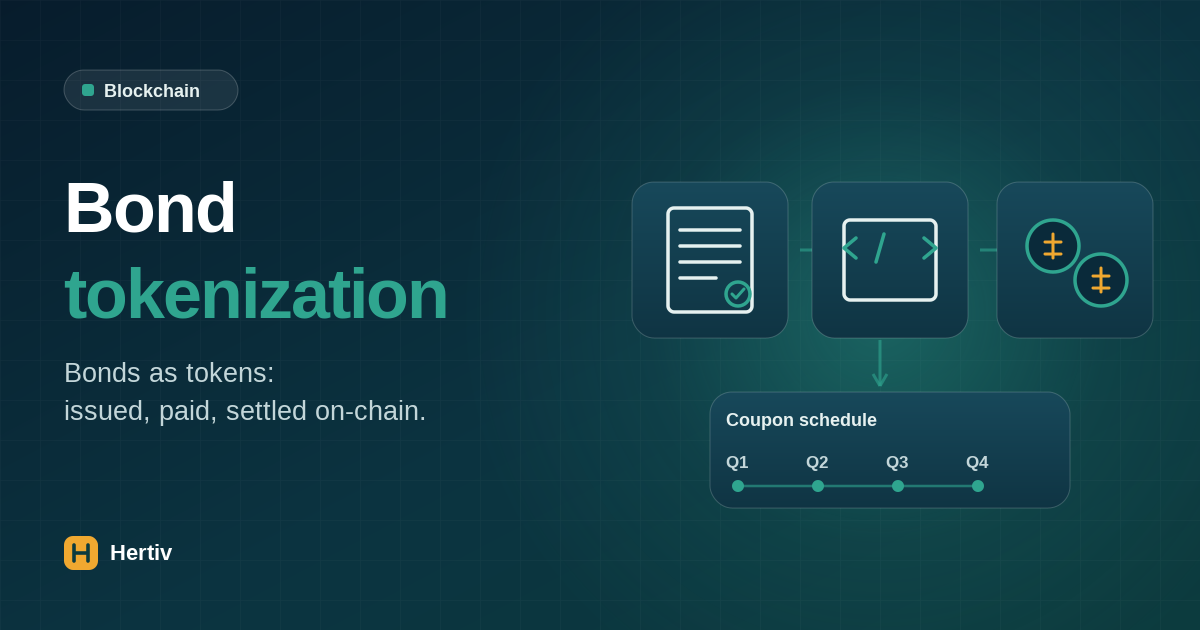
A tokenized bond works by pairing a legal bond issue with a smart contract that tracks ownership and automates the bond's scheduled events. The issuer, or an agent acting for it, creates the token, sets the rules in the contract, and allocates tokens to investors once payment is received.
The usual sequence looks like this:
- Prepare the legal documents. The prospectus and terms are completed first, because the token has no legal standing without them.
- Choose the chain and token standard. The issuer picks a public or permissioned chain and a standard that supports transfer restrictions, since most bonds can only be held by eligible investors.
- Write and audit the smart contract. It records balances, enforces who can hold or transfer the token, and schedules coupon and redemption payments.
- Issue and allocate. Investors pay, usually in fiat or a stablecoin, and receive tokens in their own wallets or a custodian's wallet.
- Service the bond. Coupons are paid on schedule, by the contract or a paying agent, and the principal is repaid at maturity.
- Record trades. Secondary transfers update token balances, and settlement can happen on the same day rather than two days later.
Transfer restrictions are a key design point. A bond token is not a freely tradable coin: the contract checks that the buyer is on an approved list before a transfer completes, which is how issuers meet securities rules while using a blockchain for the record. The background is explained in our guide to how tokenization works.
What changes for issuers?
For issuers, the main change is a shorter chain of intermediaries between the bond and its holders. A traditional issue passes through underwriters, a registrar, a clearing house and a paying agent, each keeping its own record. A tokenized issue keeps one shared record on the chain, so the issuer can see who holds the bond at any time and pay coupons without reconciling several databases.
That can lower the cost of smaller issues. A conventional bond issue carries fixed costs that only make sense above a certain size, which is why most bonds are issued in large denominations. Tokenization lets an issuer split the same bond into smaller units, so a company or a public body can raise a smaller amount or open the issue to a wider group of investors.
The same pattern shows up across asset classes, as our guide to RWA tokenization use cases explains.
Settlement speed is the other practical gain. In pilot deals, trades have settled on the same day instead of two business days later, which frees up cash and reduces the risk that a counterparty fails between trade and settlement. Faster settlement matters most for issuers and investors who trade frequently.
None of this removes the legal work. The issuer still needs a prospectus, legal opinions, a registrar or equivalent, and a way to handle investors who lose access to their wallets. Tokenization changes the record-keeping and the payment rails; it does not change the duty to pay.
What changes for investors?
For investors, the main change is smaller denominations and a clearer view of their holding. A tokenized bond can be split into units of, say, 1,000 euros or dollars, so an investor who could not buy a whole bond can buy a fraction of one. The token balance in their wallet is the record of ownership, visible at any time without waiting for a statement.
Transparency also improves. Because transfers and payments are recorded on a shared ledger, an investor can check that a coupon was paid and to whom, rather than relying on a chain of intermediaries to pass the money along. That does not remove risk: the investor still bears the issuer's credit risk, and the token is only as good as the legal claim behind it.
Secondary trading is the part that is still catching up. Most tokenized bonds so far have traded rarely, because there are few buyers and sellers and few regulated venues that list them. An investor should check before buying whether there is a realistic way to sell, and what it costs, rather than assuming the token will trade like a listed bond.
Custody is the other question to settle. Holding tokens in a personal wallet means the investor is responsible for the keys; holding them with a custodian means trusting that custodian. For most institutional investors, a regulated custodian is the practical choice, and the cost of custody should be part of the decision.
How are coupon payments handled?
Coupon payments on a tokenized bond are usually handled by the smart contract, which knows the payment dates, the coupon rate and the list of holders at the record date. On each payment date the contract calculates what each holder is owed and sends it, or instructs a paying agent to send it, without anyone having to compile a list of holders by hand.
The payment itself can travel in two ways. In some pilots, coupons are paid in a stablecoin or another on-chain asset, so the whole payment stays on the chain. In others, such as the Siemens issue, payments are made through bank accounts in the usual way, and only the ownership record lives on the chain. The second approach is more common today, because most investors and tax systems still expect fiat payments.
Record dates still matter. A holder is only entitled to a coupon if they held the token on the record date, so a trade just before that date can shift the payment from seller to buyer. The contract enforces this automatically, which removes the manual work of checking who owned what on the day.
Tax and withholding are not automated away. The issuer still has to apply the right withholding rules for each holder's jurisdiction, and the payment rail has to support that. Teams planning a tokenized issue should settle the tax treatment with advisers before choosing how coupons are paid.
Example (hypothetical): a company issues a tokenized bond
Example (hypothetical): a mid-sized manufacturer wants to raise 10 million euros for a new plant and decides to issue a tokenized bond instead of a bank loan. The bond has a five-year term and a 5% annual coupon, paid quarterly.
The company mints 10,000 tokens at 1,000 euros each, so the full issue is 10 million euros. Each token pays 5% of 1,000 euros a year, which is 50 euros per token per year, or 12.50 euros per token each quarter. If an investor holds 40 tokens, they receive 2,000 euros a year in coupons, paid as 500 euros every quarter.
Suppose 400 investors buy the issue, holding 25 tokens each on average. Every quarter the smart contract pays out 125,000 euros in total: 10,000 tokens times 12.50 euros. The contract reads the holder list on the record date, so an investor who sold 10 tokens the day before the record date receives 125 euros less that quarter, and the buyer receives 125 euros more.
Settlement is the other visible difference. When an investor sells 25 tokens to another investor, the transfer and payment settle on the same day, instead of two business days later. Over the five-year life of the bond the company pays 2.5 million euros in coupons in total, which is 500,000 euros a year, and repays the 10 million euros of principal at maturity.
What are the common mistakes?
The most common mistakes in bond tokenization come from treating the token as the whole product and forgetting the legal and market parts around it.
- Assuming the token is the legal title everywhere. In some jurisdictions a token can be the bond; in others it is only a record of a claim held elsewhere. Check the local law before issuing.
- Skipping transfer restrictions. A token that anyone can buy will breach securities rules. The contract must check eligibility before a transfer completes.
- No plan for secondary trading. Issuing is the easy part. Without a venue and willing buyers, holders cannot sell, and the bond trades at a discount.
- Ignoring custody. Lost keys, a failed custodian or an unclear recovery process can lock investors out of their holding.
- Automating coupons before tax is settled. Withholding rules differ by holder and jurisdiction, and a contract that pays the wrong amount creates a tax problem.
- Choosing a chain for fashion, not fit. Fees, finality, privacy and the availability of regulated custodians matter more than which chain is talked about most.
Key takeaways
- A tokenized bond is a bond recorded as a token; the legal terms still live in a prospectus
- Issuance, transfers and coupon payments can be recorded and partly automated on-chain
- Smaller denominations and same-day settlement are the main practical gains so far
- Secondary trading and custody are still the weakest parts of most tokenized issues
- Transfer restrictions and tax treatment must be settled before the token is issued
Frequently asked questions
What is the difference between a tokenized bond and a regular bond?
The bond itself is the same: a loan to the issuer with a coupon and a maturity date. The difference is the record-keeping. A regular bond is recorded by a central securities depository and a registrar, while a tokenized bond is recorded as tokens on a blockchain, which can make settlement faster and denominations smaller.
Do tokenized bonds settle faster?
In pilot deals, yes: trades have settled on the same day instead of two business days later. But that depends on the payment leg. If the cash still moves through bank accounts, settlement is only as fast as the banking rail, even when the token transfer is instant.
Can anyone buy a tokenized bond?
Usually no. Most tokenized bonds are securities, so only eligible or professional investors can hold them. The smart contract normally checks that a buyer is on an approved list before a transfer completes, and issuers must follow the securities rules of each jurisdiction where they offer the bond.
How do investors receive coupon payments?
The smart contract calculates what each holder is owed on the payment date and either sends it in a stablecoin or instructs a paying agent to send it through bank accounts. The holder must own the token on the record date to receive that quarter's coupon.
What happens if an investor loses their wallet keys?
It depends on the setup. With a regulated custodian, the custodian can usually recover access. With a personal wallet, recovery depends on whether the issuer or a registrar can reissue the tokens, which is why the legal documents should cover key loss before the issue.
Are tokenized bonds traded on exchanges?
Some are listed on regulated digital-asset venues, but trading is still thin compared with conventional bond markets. Most tokenized bonds so far have traded rarely, so investors should check whether there is a realistic way to sell before buying.


