Blockchain Startup Ideas Worth Building First
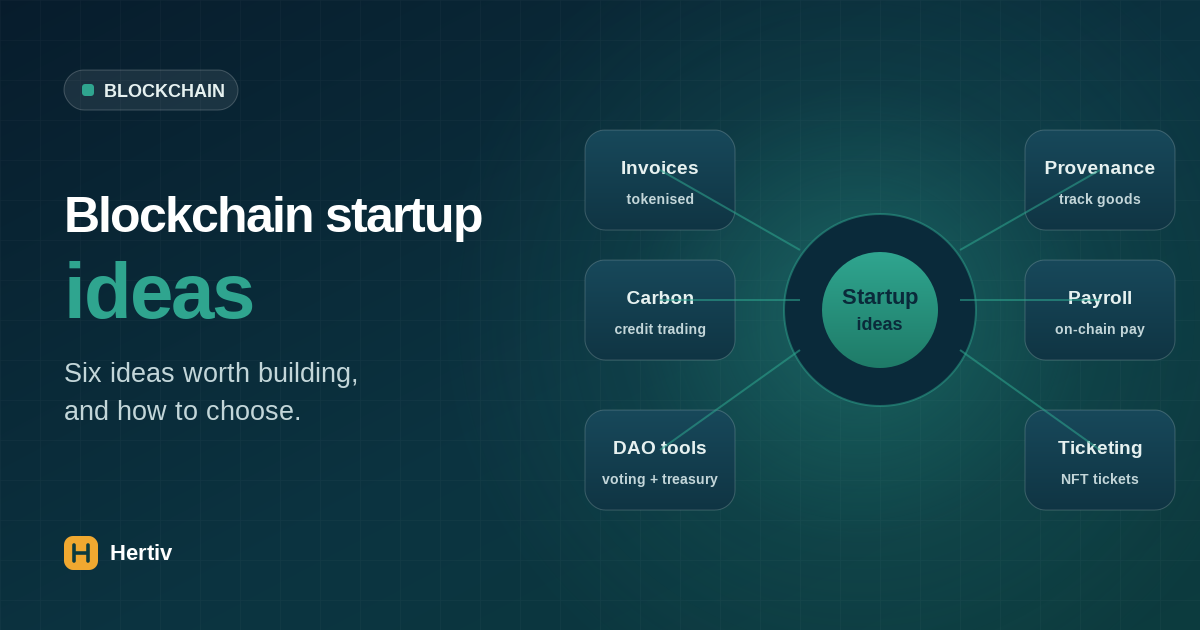
Six blockchain startup ideas with real demand: tokenised invoices, supply-chain provenance, carbon credits, on-chain payroll, DAO tooling and NFT ticketing.
On this page
Short answer
Blockchain startups work best when the chain solves a real problem, such as proving where a product came from or settling a payment without a middleman. The six ideas below were picked because each one has a clear customer, a clear pain and a way to charge for the service. Each one can start small with one customer type before it grows.
Which blockchain startup ideas are worth building first?
The ideas worth building first are the ones where a customer already pays to fix the problem by hand. If a business already spends money on audits, paperwork or slow settlement, a blockchain product that cuts that cost has a buyer from day one.
Use this table to shortlist. Effort assumes a small team and a first version for one customer type.
| Idea | Customer | Problem it solves | Effort |
|---|---|---|---|
| Tokenised invoice financing | Small suppliers | Slow payment for invoices | Medium |
| Supply-chain provenance | Food and luxury brands | Proving where goods came from | Medium |
| Carbon credit trading | Companies offsetting emissions | Trust in credits | High |
| On-chain payroll | Remote teams | Slow cross-border pay | Medium |
| DAO governance toolkit | DAOs and communities | Messy voting and treasury | Low to medium |
| NFT ticketing | Event organisers | Fake tickets and resale | Medium |
Start with one row, not six. A single idea shipped to ten real customers teaches you more than six ideas sketched on paper.
<h3>1. Tokenised invoice financing: best for small suppliers</h3>
Small suppliers often wait 60 or 90 days to be paid for an invoice, which starves them of cash. A tokenised invoice platform turns an unpaid invoice into a token that an investor can buy, so the supplier gets paid sooner and the investor earns a return.
The chain matters here because it proves the invoice is real and has not been sold twice. That proof is what makes investors willing to fund it. DeFi startup ideas cover the lending side of this market in more detail.
- Pros: clear customer pain, revenue from fees, real demand from suppliers.
- Cons: needs legal review, depends on investor supply, regulated in many places.
2. Supply-chain provenance: best for food and luxury brands
Brands that sell food, wine or luxury goods need to prove where each item came from. A provenance product records each step of the journey on chain, from farm or factory to shelf, so a customer can scan a code and see the history.
The hard part is not the chain; it is getting suppliers to record data honestly. Start with one brand and one product line, and prove the data flow works before you scale.
- Pros: clear value for premium brands, simple story, works with existing labels.
- Cons: depends on supplier data, slow sales cycles, needs hardware or labelling.
<h3>3. Carbon credit trading: best for companies offsetting emissions</h3>
Companies buy carbon credits to offset their emissions, but the market is hard to trust: the same credit can be sold twice, and its quality is hard to check. A trading platform that records each credit on chain, with its source and retirement, makes the market easier to trust.
This is a harder idea to start because it needs registries, auditors and regulators to accept the records. It suits a team that already knows the carbon market rather than a team learning it from scratch.
- Pros: growing demand, clear trust problem, fees on every trade.
- Cons: heavy regulation, needs registry partners, slow to launch.
4. On-chain payroll: best for remote teams
Remote teams with members in many countries wait days for pay and lose money on fees and exchange rates. An on-chain payroll product pays staff in stablecoins, which arrive in minutes and convert to local currency at the point of use.
The product needs tax and reporting tools, since staff still owe tax in their own country. A payroll tool that handles the paperwork is worth far more than one that only moves money. Enterprise blockchain startup ideas include payroll as one of the practical use cases for larger teams.
- Pros: clear pain for remote teams, recurring revenue, fast settlement.
- Cons: tax rules vary by country, needs fiat off-ramps, trust is hard to earn.
<h3>5. DAO governance toolkit: best for DAOs and communities</h3>
DAOs vote on spending, hiring and strategy, but their tools are scattered: votes in one place, treasury in another, discussion in a third. A toolkit that brings voting, treasury and discussion into one dashboard saves every DAO hours a week.
This is the lightest idea on the list. It needs no token of its own and no regulated activity, so a small team can ship a first version fast and learn from real DAOs.
- Pros: fast to build, no regulated activity, many DAOs need it.
- Cons: DAOs are price-sensitive, many tools already exist, churn is high.
6. NFT ticketing: best for event organisers
Event organisers lose money to fake tickets and to resale they cannot control. An NFT ticket is a unique token that proves the ticket is real, and its rules can limit resale prices or give the organiser a share of each resale.
The product must work for fans who know nothing about crypto. If buying a ticket needs a wallet setup and a token purchase, most fans will give up. The winning version hides the chain behind a normal checkout. Blockchain basics explain the token model behind it.
- Pros: clear fraud problem, resale revenue for organisers, easy demo.
- Cons: needs fan-friendly checkout, depends on venue partners, thin margins.
How to choose a blockchain startup idea in 5 steps
Pick an idea with a checklist, not with enthusiasm for the technology. These five steps keep the choice tied to a real customer.
- Find a customer who already pays. If nobody pays to fix the problem today, you will have to teach the market as well as build the product.
- Check that the chain is needed. If a database would solve the problem, build a database product instead.
- Talk to ten buyers before you build. Ten conversations tell you more than any market report.
- Price the first version. A product that charges from day one survives longer than one that plans to charge later.
- Check the rules. Finance, carbon and payroll are regulated, so get legal advice before you launch.
Write the answers down. An idea that passes all five steps is worth building; one that fails two of them is worth dropping early.
Common mistakes
The most common mistake is building a blockchain product for a problem a database would solve. A chain adds cost, complexity and regulation, so it only earns its place when trust between strangers is the core problem.
Another mistake is launching a token before the product works. A token adds legal risk and distracts the team from the customers who actually pay. Build the product first and decide about a token later, if ever.
A third mistake is targeting everyone. A provenance product for food, luxury and pharma is really three products, and a team that tries to serve all three serves none of them well. Pick one customer and one product line.
Finally, do not ignore the off-chain work. Data entry, customer support and legal review are most of the job in every idea above, and a team that budgets only for code will run out of money halfway.
Key takeaways
- Pick an idea where a customer already pays to fix the problem.
- The chain must solve a trust problem, not just add technology.
- Start with one customer type and one product line.
- Charge from day one and check the rules before launch.
- Budget for off-chain work: data, support and legal review.
Frequently asked questions
What is the best blockchain startup idea?
The best idea depends on your team. Tokenised invoice financing suits teams that know finance, provenance suits teams that know supply chains, and DAO tooling suits small teams that want a fast first launch.
Do blockchain startups need a token?
No. Most of the ideas above work without a token of their own. A token adds legal risk and distraction, so build the product first and decide about a token only if it adds real value.
How much does it cost to start a blockchain startup?
A first version can be built by a small team in three to six months. The larger costs are legal review, audits and customer acquisition, which often exceed the build cost in the first year.
Are blockchain startups still worth building?
Yes, where the chain solves a real trust problem. Provenance, settlement and ticketing all have paying customers today. Ideas that use a chain only because it is fashionable rarely survive, so tie the idea to a customer who already pays.
What skills does a blockchain startup team need?
It needs smart contract skills, back-end skills and, above all, knowledge of the customer's industry. A team that knows finance or supply chains will beat a team that only knows the technology.
How do blockchain startups make money?
Most charge fees on transactions, subscriptions for the software, or a share of the value they move. The model should be clear before you build, not something you work out after launch.


