DeFi Startup Ideas Worth Building First
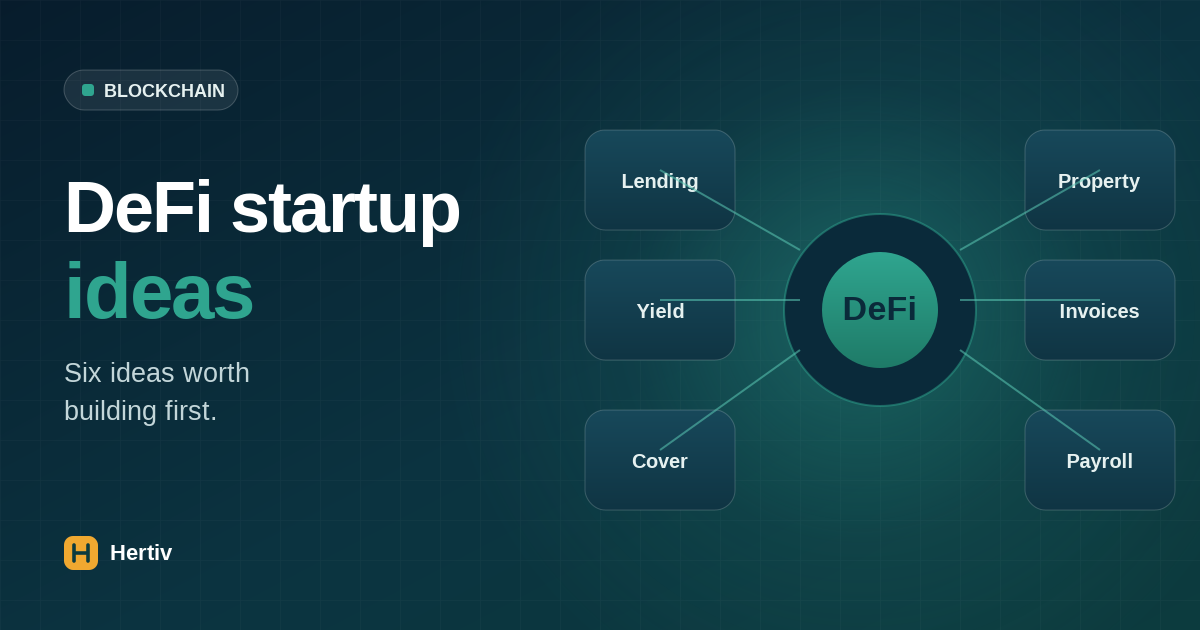
Six DeFi startup ideas for founders: small-business lending, tokenized property income, yield aggregation, invoice finance, contract cover and stablecoin payroll.
On this page
Short answer
Decentralised finance startups build financial services that run on public blockchains instead of banks. The six ideas below are the ones with the clearest paying customer and the simplest first version: each one solves a problem a business already pays to fix, and each one can start small with one asset type and one user group.
Which DeFi startup ideas are worth building first?
The DeFi startup ideas worth building first are the ones where a real business already pays for a slow or costly service, and a smart contract can do the same job faster. Lending, payments and financing are the strongest starting points, because the customer and the revenue are easy to name.
Use this comparison to shortlist. Start with one asset type and one user group, not with a platform that tries to do everything.
| Idea | Who pays | Hardest part | Best for |
|---|---|---|---|
| Small-business lending | Borrowers and lenders | Credit checks | Teams with lending experience |
| Tokenized property income | Property investors | Legal setup | Teams with real-estate partners |
| Yield aggregation | Savers and funds | Security | Teams with smart-contract skills |
| Invoice financing | Small suppliers | Fraud checks | Teams with trade-finance contacts |
| Smart contract cover | DeFi users | Risk pricing | Teams with insurance knowledge |
| Stablecoin payroll | Remote employers | Compliance | Teams with payroll experience |
Pick the idea where you already know the customer. A team that has worked in lending will build a lending product faster than a team learning lending from scratch, and the same holds for every idea on this list.
1. Small-business lending: best for teams with lending experience
1. Small-business lending: best for teams with lending experience
A DeFi lending product for small businesses lets firms borrow against crypto collateral or tokenized invoices, with terms set by a smart contract instead of a loan officer. The borrower locks collateral, the contract releases the loan, and repayments run on a fixed schedule the borrower can see in advance.
The first version can be simple: one collateral type, one loan size range, and a small group of known borrowers. The hard part is not the contract but the credit check, because the team needs a way to judge who will repay. Teams with lending experience have a real edge here.
Pros: clear paying customers on both sides; revenue from interest and fees; a small pilot proves the model fast.
Cons: credit checks are hard without a bank; bad loans hurt fast; rules differ by country and change often.
2. Tokenized property income: best for teams with real-estate partners
2. Tokenized property income: best for teams with real-estate partners
Tokenized property income turns a share of a rental property into a token that pays its holder a share of the rent. Investors buy small slices instead of whole buildings, and the property manager sends the rent through a contract that splits it between token holders.
The product needs a property partner and a lawyer more than it needs new technology, because the token is only as good as the legal claim behind it. A team with a property firm as a partner can start with one building and a small investor group.
Pros: investors understand the product at once; rent gives a real cash flow; one building is enough to start.
Cons: legal setup is slow and costly; property deals take months; selling tokens later needs a market.
3. Yield aggregation: best for teams with smart-contract skills
3. Yield aggregation: best for teams with smart-contract skills
A yield aggregator moves user funds between lending and staking protocols to find the best return, and takes a small fee for doing it. Users deposit once, and the product handles the rest: choosing protocols, moving funds, and compounding the returns.
The risk is security. The product holds user funds and talks to other protocols, so a bug in any part can lose money. Teams that build this need strong audit habits and a slow rollout, starting with small limits and a public bug bounty.
Pros: simple idea users grasp quickly; fees scale with deposits; no need for off-chain partners.
Cons: security risk is high; returns fall when markets cool; audits are costly and slow.
4. Invoice financing: best for teams with trade-finance contacts
4. Invoice financing: best for teams with trade-finance contacts
Invoice financing lets small suppliers get paid early by selling an invoice as a token to investors, who collect the full amount when the buyer pays. The supplier gets cash in days instead of months, and the investor earns a fee for the wait.
The first version needs a small group of trusted suppliers and buyers, because the main risk is a fake invoice or a buyer who never pays. A team with trade-finance contacts can check invoices against real orders before they are tokenized.
Pros: suppliers feel the pain daily; short loan terms limit the risk; real invoices are easy to verify with partners.
Cons: fraud checks need real work; buyer payment delays hurt; scaling needs many supplier relationships.
5. Smart contract cover: best for teams with insurance knowledge
5. Smart contract cover: best for teams with insurance knowledge
Smart contract cover pays users when a protocol they use is hacked or fails. Users pay a small premium for a chosen protocol and time period, and a claim pays out when a defined event happens, such as a loss of funds from a known exploit.
The hard part is pricing the risk. The team needs data on past hacks and a clear rule for what counts as a covered event, or claims will be argued one by one. Teams with insurance knowledge can set those rules before launch instead of learning them from disputes.
Pros: DeFi users know the risk first-hand; premiums are a steady income; the product is fully on-chain.
Cons: pricing risk is hard without data; one large hack can drain the pool; claim rules invite arguments.
6. Stablecoin payroll: best for teams with payroll experience
6. Stablecoin payroll: best for teams with payroll experience
Stablecoin payroll pays remote workers in a dollar-pegged token instead of through bank wires, so the money arrives in minutes and the fees stay low. Employers fund the payroll once, and the product splits it between workers on a fixed schedule.
The first version can serve one kind of employer, such as a startup with contractors in several countries. The team needs to handle tax reporting, exchange to local money, and the rules for paying workers in each country, which is why payroll experience matters more than blockchain skill.
Pros: remote teams feel the pain of slow wires; payments are fast and cheap; employers pay a monthly fee.
Cons: tax and labour rules differ by country; workers need a way to spend the tokens; price swings in the token worry staff.
How to choose a DeFi startup idea
Choose the idea where you know the customer, the rules and the risk, not the idea that sounds biggest. A good first idea has a paying customer you can name, a problem you can describe in one sentence, and a first version you can build in months.
- Name the payer. Write down who pays, what they pay for, and what they pay today. If you cannot name the payer, the idea is not ready.
- Check the rules. Look at the financial rules in your target country before building, and get a lawyer to review the plan.
- Pick one asset and one user group. A lending product for one collateral type beats a platform for everything.
- Price the risk. Work out what happens if the worst case hits, and set limits that keep the business alive.
- Run a small pilot. Start with a few known users and real money at small scale, then grow only when the pilot works.
For the broader context on how DeFi works, see what is DeFi.
For the build and cost side, see the DeFi development guide.
The cost side is covered in the DeFi development cost breakdown.
What are the common mistakes?
The most common DeFi startup mistakes are building a platform instead of a product, ignoring the rules, and launching with limits that are too large.
- Building a platform first. A platform with no users is a cost. Build one product for one group first.
- Ignoring the rules. Financial rules apply even when the product is on-chain. Get legal advice early.
- Skipping audits. A smart contract that holds money needs an audit before it holds real funds.
- Trusting the market. Yields and token prices change fast, so the business plan must work when they fall.
- No plan for failure. Decide in advance what happens when a loan defaults or a protocol is hacked.
Key takeaways
- The best DeFi ideas solve a payment or financing problem a business already has
- Start with one asset type and one user group, not a platform
- Legal setup and risk pricing matter more than the smart contract
- A small paid pilot proves the idea before the team scales it
- Keep limits small until audits and real usage prove the product works
Frequently asked questions
What is a DeFi startup?
A DeFi startup is a company that builds financial services on public blockchains, such as lending, payments or trading, without a bank in the middle. Smart contracts hold the rules and the funds, while the startup builds the product, finds the users and handles support and compliance.
Do DeFi startups need a licence?
It depends on the country and the product. Lending, taking deposits and selling investment products are regulated in most countries, and a token that behaves like a security brings securities rules with it. Founders should get legal advice for their target country before launch.
How do DeFi startups make money?
Most DeFi startups earn fees: a share of interest on loans, a fee on each trade or payment, or a monthly fee for a service such as payroll. Some also earn from token sales, but fees from real use are the income that lasts when markets cool.
What skills does a DeFi startup team need?
A DeFi team needs smart-contract skills, product skills and knowledge of the financial rules in its market. The mix depends on the idea: lending needs credit knowledge, payroll needs tax knowledge, and cover needs insurance knowledge. One person rarely has all three.
How much does it cost to start a DeFi startup?
Cost depends on scope, audits and legal advice, and there is no single number. A small first version with one contract and one user group costs far less than a full platform, and an audit alone can cost as much as the build. The cost breakdown linked in this article shows how teams work the number out.
What is the biggest risk for a DeFi startup?
The biggest risks are a smart-contract bug and a legal problem, and both can end the business. A bug can drain user funds in minutes, while a missing licence can shut the product down. Small pilot limits, audits and early legal advice are the standard ways teams manage both.


