DeFi Development Cost Breakdown: What You Pay For
DeFi development costs come from scope, smart contract work, security audits and running the product after launch. Here is how each part of the budget works.
On this page
Short answer
DeFi development costs break down into product scope, smart contract development, security audits, front-end and back-end work, testing, and running costs after launch. Smart contracts and audits usually take the largest share because mistakes in DeFi code can lose user funds, so a realistic budget plans for audit time and fixes, not just the first build.
What does DeFi development cost cover?
DeFi development cost is the total spend to design, build, test and run a decentralised finance product, such as a lending app, a swap, or a staking service. It covers far more than writing smart contracts.
The cost depends on what the product does. A simple staking page costs far less than a lending protocol with liquidations, price feeds and governance, because each feature adds contract logic, tests and audit time.
Prices vary by team and region, so check the vendor site for current rates. This article explains where the money goes, so you can judge any quote you receive.
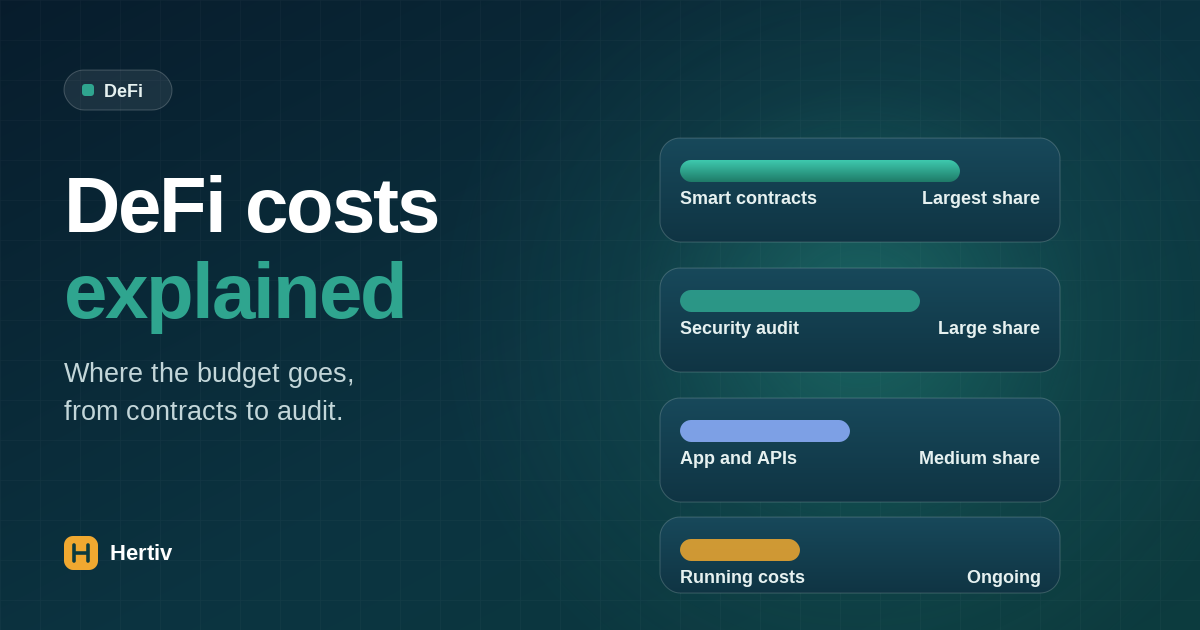
| Cost area | What it includes | Share of budget |
|---|---|---|
| Product design | Flows, screens, token model | Small |
| Smart contracts | Core logic, tests, deployment | Large |
| Security audit | External review and fixes | Large |
| Front end and back end | App, APIs, indexers, dashboards | Medium |
| Testing and launch | Testnet, bug bounty, rollout | Medium |
| Running costs | Hosting, nodes, monitoring, support | Ongoing |
How does product scope set the price?
Scope is the biggest driver of DeFi cost because every feature is a contract change. A swap with one pool is a small job; a lending market with collateral rules, interest rates, liquidations and rewards is a large one.
Each feature also adds test cases. A lending rule that works in normal markets can fail when prices move fast, so testers must cover edge cases that a simple app never faces.
Start with the smallest version that proves the idea. A first release that handles one asset pair and one core action lets you test demand before paying for the full feature set.
What does smart contract development cost?
Smart contract work is the core of a DeFi build. Developers write the contracts, write tests for them, deploy to a test network, and fix what the tests find.
Good contract code takes longer than ordinary back-end code because the code cannot be patched easily once it is live. A bug found after launch can mean migrating users and funds, so teams spend more time on review and testing up front.
Contracts also need supporting pieces: price feeds, access controls, upgrade paths and emergency pause functions. Each of these is small on its own, but together they add real time to the build.
Why do security audits cost so much?
A security audit is an outside review of your contracts by specialists who look for flaws an attacker could use. It is expensive because it needs rare skills and because the stakes are high: a missed flaw can drain a protocol.
Audit cost grows with the size of the code and how new the logic is. A fork of a well-known protocol costs less to audit than a brand-new design, because auditors already understand the base code.
Plan for more than the audit fee. Auditors find issues, and your team must fix them and pay for a re-check. A budget that skips the fix-and-recheck round is not a real budget. See our guide to how to create DeFi dApps for the steps that come before an audit.
What does the front end and back end cost?
Users never see the contracts; they see the app. The front end covers wallet connection, transaction screens, balances and error states, while the back end covers APIs, indexers that read chain data, and dashboards.
Indexers deserve attention in the budget. Reading live data from a chain is slow without an indexer, so most DeFi apps pay for one or build one, and that work is easy to forget when scoping.
Design also matters more in DeFi than in many apps. Users must understand what a transaction will do before they sign it, so clear screens and warnings are part of the product, not decoration.
Wallet connection also adds work that first-time builders often miss. Users connect with different wallets, switch networks by mistake, and reject transactions halfway through. The app must handle each of these cases with a clear message, or users will think the product is broken when the wallet is the problem.
Example (hypothetical): a lending app budget
Example (hypothetical): a startup plans a lending app for one chain with two assets, deposit and borrow actions, and a simple interest model. The team works in three parts.
Smart contract work takes 6 weeks at 2 developers, which is 480 hours. At a planning rate of $70 an hour, that is $33,600. Front-end and back-end work takes 5 weeks at 2 developers, or 400 hours, which is $28,000.
The security audit is priced at $30,000, plus 2 weeks of fixes at 1 developer, or 80 hours, which is $5,600. Design, testing and launch take 3 weeks at 1 developer, or 120 hours, which is $8,400.
The total is $33,600 + $28,000 + $30,000 + $5,600 + $8,400 = $105,600. A 15% reserve for surprises adds $15,840, bringing the planning budget to $121,440. These are planning numbers, not a quote, and real rates vary by team and region.
What are the running costs after launch?
Launch is not the end of spending. A live DeFi product pays for node access, hosting, monitoring, and someone to watch for problems around the clock.
Monitoring is the most important running cost. Price feeds can fail, a market can move fast, and a contract can behave in ways tests never showed. Teams that skip monitoring find out about problems from users, which is the worst way to learn.
Upgrades also cost money. Even a small change needs testing, a new audit review and a careful rollout, so set aside a monthly budget for maintenance rather than treating launch as finished.
Common mistakes
The most common mistake is budgeting for the build and forgetting the audit. Teams that run out of money before the audit either launch unaudited, which risks user funds, or delay launch while they raise more money.
The second mistake is copying a famous protocol and assuming the cost is the same. A fork still needs review, testing and an audit, and changing even one rule can create new risks.
The third mistake is skipping the reserve. DeFi builds always find surprises in testing or audit, and a budget with no reserve forces cuts in the worst place: security.
The fourth mistake is treating running costs as optional. A product with no monitoring and no maintenance budget will fail quietly, and users will leave before the team notices.
Key takeaways
- DeFi costs cover scope, contracts, audits, the app, testing and running the product.
- Smart contracts and audits take the largest share because mistakes can lose funds.
- Scope drives cost: each feature adds contract logic, tests and audit time.
- Always budget for audit fixes and a re-check, not just the audit fee.
- Running costs include node access, hosting, monitoring and maintenance.
- Keep a reserve of around 15% for surprises found in testing or audit.
Frequently asked questions
How much does it cost to build a DeFi app?
There is no fixed price because cost depends on scope, chain and team rates. A simple staking app costs far less than a lending protocol, so get quotes against a written scope and check the vendor site for current rates before you commit.
What is the most expensive part of DeFi development?
Smart contract work and security audits usually take the largest share of the budget. Contracts need careful code and thorough tests, and audits need specialists whose review protects user funds from attack.
Do I need a security audit for a small DeFi app?
Yes, if the app holds user funds. Even a small pool is a target for attackers, and an audit is the main way to catch flaws before they are found and used against your users.
Can I reduce DeFi development costs?
Start with the smallest version that proves the idea, reuse well-tested contract patterns, and fix audit findings in one round. Cutting the audit or the tests is the wrong place to save.
What running costs should I plan for?
Plan for node access, hosting, monitoring, support and maintenance after launch. Monitoring matters most, because price feeds and markets can fail at any hour and need someone watching who can act fast.
How long does DeFi development take?
A small product can take two to three months, while a lending protocol with audits can take six months or more. Audit scheduling alone often adds several weeks to the timeline.


