Enterprise Blockchain Startup Ideas Worth Building
Enterprise blockchain startup ideas for large companies: supply chain, trade finance, identity, carbon credits, audits and spare parts, with what each needs to work.
On this page
Short answer
Enterprise blockchain startup ideas are business ideas that use a shared ledger to solve a problem a large company already pays to fix: proving where goods came from, settling trade documents faster, or keeping audit records that nobody can alter after the fact. The ideas below are the ones with a clear enterprise buyer and a problem a database alone handles badly.
Which enterprise blockchain startup ideas are worth building?
The enterprise blockchain startup ideas worth building first are the ones where several companies need to trust the same record, and none of them wants the others to control it. If one company owns the database, the others have to trust that company. A shared ledger removes that problem, and that is the whole reason to use a blockchain.
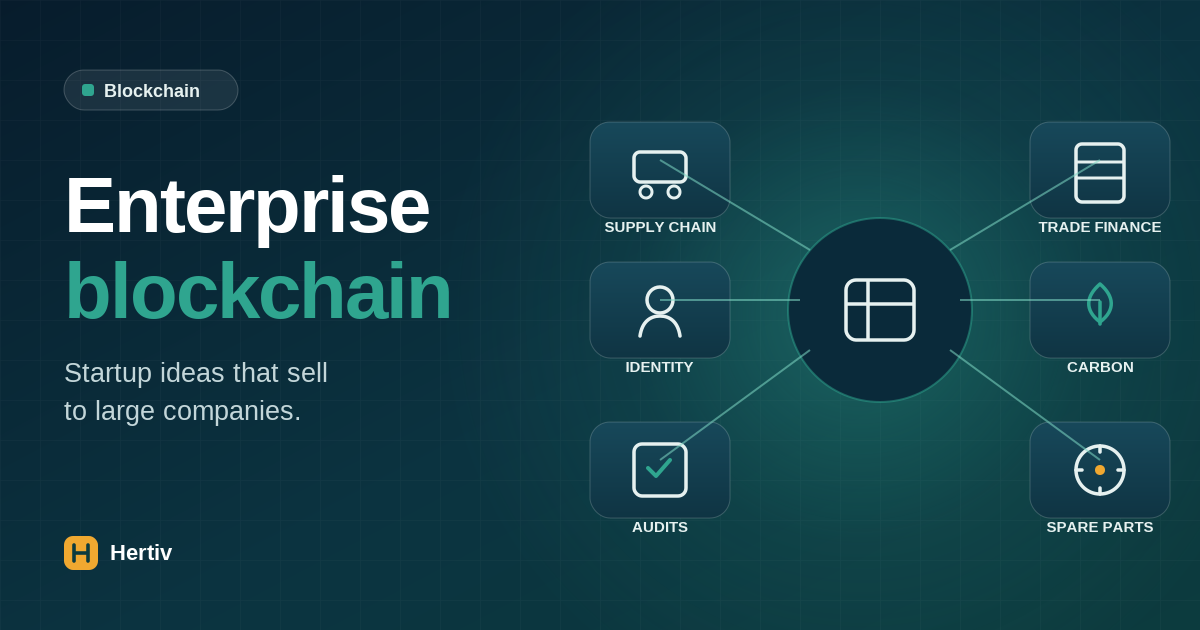
Use this comparison to shortlist. Difficulty assumes a small team with a working smart contract or ledger app and one pilot customer.
| Idea | Problem it solves | Who pays | Difficulty |
|---|---|---|---|
| Supply chain provenance | Proving where goods came from | Manufacturers, retailers | Medium |
| Trade finance | Slow, paper-based trade documents | Banks, exporters | High |
| Digital identity | Checking staff and partner credentials | Large employers | Medium |
| Carbon credit tracking | Double-counted carbon credits | Energy and industrial firms | High |
| Audit records | Records that can be altered later | Regulated companies | Medium |
| Spare parts tracking | Fake parts in maintenance | Airlines, factories | Medium |
Pick one row and one buyer. A provenance product for one industry, such as food or pharmaceuticals, is a business. A general blockchain platform for every enterprise is a pitch deck.
1. Supply chain provenance: best for proving where goods came from
1. Supply chain provenance: best for proving where goods came from
Supply chain provenance records each step a product takes, from raw material to finished goods, on a ledger that every party in the chain can read but no single party can rewrite. A retailer can check a shipment's history in seconds instead of phoning suppliers and waiting for documents.
The hard part is getting suppliers to record data honestly and on time. The ledger proves the record was not changed, but it cannot prove the data entered was true. That is why pilots usually start with one product line and a small group of suppliers who already work closely together.
Pros: recalls are faster and narrower; buyers can check origin claims; suppliers share one record instead of many spreadsheets.
Cons: needs supplier adoption; data entry stays a human problem; integration with existing warehouse systems takes time.
2. Trade finance: best for faster trade documents
2. Trade finance: best for faster trade documents
Trade finance on a ledger digitises documents such as invoices, bills of lading and letters of credit, so banks and exporters can check and approve them without passing paper between offices. Each document is recorded once, and every party sees the same version.
The hard part is regulation and bank adoption. Trade finance is a heavily regulated business, and a startup needs banks as partners, not just customers. Pilots usually run with one bank and one trade route before anyone talks about scale.
Pros: fewer duplicate and forged documents; faster payment cycles; one shared record for banks, exporters and shippers.
Cons: needs bank partners; regulation varies by country; long sales cycles with financial institutions.
3. Digital identity: best for checking staff and partner credentials
3. Digital identity: best for checking staff and partner credentials
Digital identity on a ledger lets a company issue credentials, such as training certificates or contractor approvals, that the holder can present anywhere without the issuer being called each time. A site manager can check a contractor's certificate on a phone, even offline, and trust it because the issuer signed it.
The hard part is getting issuers on board. A credential is only useful if employers recognise the issuer, so the startup must sign up training bodies, regulators or large employers first. Without recognised issuers, the wallet is empty.
Pros: instant credential checks; less paperwork at site gates; workers keep their own records when they change jobs.
Cons: needs recognised issuers; privacy rules apply to personal data; employers must change onboarding habits.
4. Carbon credit tracking: best for stopping double-counted credits
4. Carbon credit tracking: best for stopping double-counted credits
Carbon credit tracking records each credit on a ledger from issue to retirement, so the same credit cannot be sold twice or claimed by two buyers. A company buying credits to offset emissions can check the full history of the credit it buys.
The hard part is that the ledger is only as good as the registry behind it. Credits must be verified by a recognised standard before they are recorded, and the startup must work with registries and auditors rather than replacing them.
Pros: double-counting becomes visible; buyers can verify credit history; audits are faster with one shared record.
Cons: depends on registries and standards; the market is still forming; buyers need education on how credits work.
5. Audit records: best for records nobody can alter later
5. Audit records: best for records nobody can alter later
Audit records on a ledger give regulated companies a tamper-evident log of who did what and when, from financial entries to safety inspections. Auditors can check the log without asking the company to produce it, because the record is shared and time-stamped.
The hard part is fitting into existing audit practice. Auditors follow standards and methods that change slowly, so the startup must map its log to what auditors already ask for, rather than expecting auditors to change for the product.
Pros: tamper-evident history; faster audit preparation; disputes are settled from one shared record.
Cons: must fit audit standards; data privacy rules limit what can be shared; legacy systems need integration work.
6. Spare parts tracking: best for stopping fake parts in maintenance
6. Spare parts tracking: best for stopping fake parts in maintenance
Spare parts tracking records each part's origin, certificates and service history on a ledger, so a maintenance team can check whether a part is genuine before fitting it. This matters most where a fake part can cause real harm, such as aviation, energy and heavy machinery.
The hard part is linking the physical part to its record. A tag or serial number can be copied, so the startup needs tamper-evident tags and a process for checking them at each handover, which is a logistics problem as much as a software one.
Pros: fake parts are easier to spot; maintenance history follows the part; recalls target only affected parts.
Cons: tags add cost and process; needs manufacturers and repair shops to record data; works best for high-value parts.
How to choose an enterprise blockchain startup idea
Choose an enterprise blockchain startup idea by the buyer and the proof, not by the technology. The ledger is the easy part; distribution and trust decide whether the business works.
- Pick one buyer who already pays for the problem, such as a manufacturer losing money to fake parts.
- Check that several companies need to trust the same record, which is the test for whether a ledger helps at all.
- Find one pilot partner willing to use the product in real work, not just in a demo.
- Map the regulation in your target industry before writing a contract, especially for finance and carbon markets.
- Build the simplest version that proves the record is shared and trusted, then add features from pilot feedback.
For the tokenization side of enterprise ideas, see tokenization startup ideas to compare which asset ideas fit the same buyers.
For examples of blockchain companies already selling to enterprises, see blockchain startups to watch.
What are the common mistakes?
The most common enterprise blockchain startup mistakes are building a platform before finding a buyer, and assuming the ledger fixes bad data.
- No real buyer. A general platform with no pilot customer is a demo, not a business.
- Ignoring the data problem. A ledger proves a record was not changed, not that it was true when entered.
- Skipping regulation. Finance, carbon and identity products all sit inside regulated areas.
- Building for every industry. Each industry has its own buyers, standards and sales cycle.
- Overpromising on cost. Integration with legacy systems and onboarding partners cost more than the ledger itself.
Key takeaways
- Pick the idea where several companies must trust one shared record
- Start with one buyer and one pilot, not a platform for every industry
- The ledger proves a record was not changed, not that it was true when entered
- Regulation and partner onboarding come before the smart contract
- A narrow pilot with real users beats a broad launch with none
Frequently asked questions
What is the best enterprise blockchain startup idea for a first product?
Supply chain provenance for one product line is usually the simplest, because the buyer is clear, the problem is visible, and the pilot can run with a few suppliers. Start with one industry, such as food or pharmaceuticals, and prove the record is shared and trusted before widening the scope.
Do enterprise blockchain startups need their own chain?
No. Almost all of them build on an existing chain or a permissioned ledger and focus on the application and the onboarding. Building a new chain adds security work, cost and a cold start on users, with no benefit for most ideas.
How do enterprise blockchain startups make money?
Common models are a subscription per company or per site, a fee per transaction or record, and paid integration work for the pilot. The ledger itself is rarely the revenue; the service and the network of participants are.
Why do so many enterprise blockchain pilots fail?
Most fail on adoption, not on technology. Suppliers do not enter data, buyers do not change their process, or the pilot has no owner inside the customer. A pilot needs a named owner, a clear workflow and a reason for each party to take part.
Is blockchain still worth building on for enterprises?
Yes, where several companies need to trust the same record and none of them should control it. The speculative wave has faded, which is good news: the ideas left are the ones with buyers, budgets and measurable problems.
How long does an enterprise blockchain pilot take?
A small pilot with one buyer and a few partners usually takes a few months from first meeting to live use, because most of the time goes to agreements, data mapping and onboarding rather than code. Plan for the commercial work, not just the build.


