Tokenization Startup Ideas Worth Building First
Six tokenization startup ideas, from real estate and funds to carbon credits and invoices. Compare the asset, the buyer and the hardest part of each one.
On this page
Short answer
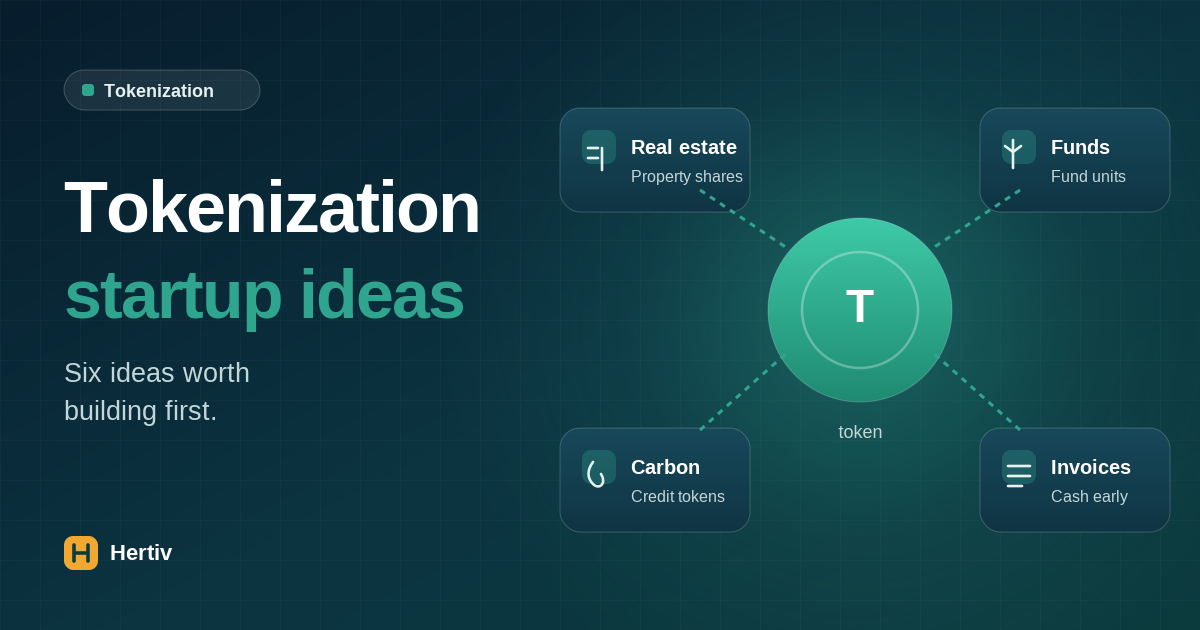
Tokenization startup ideas worth building first include tokenized real estate, tokenized funds, carbon credit tokens, invoice tokenization, loyalty tokenization and fractional collectibles. Each turns a hard-to-trade asset into tokens that can be bought, sold or split into small pieces. The best choice depends on who buys the token and which rules apply in your market.
Which tokenization startup ideas are worth building?
The tokenization startup ideas worth building first are tokenized real estate, tokenized funds, carbon credit tokenization, invoice tokenization, loyalty tokenization and fractional collectibles. Each one turns something hard to trade into a digital token that can be bought, sold or split into small pieces.
Tokenization works best where the asset is valuable, hard to divide, or slow to trade today. If an asset is already easy to buy and sell in small amounts, tokenizing it adds cost without adding much value.
| Startup idea | Asset tokenized | Main buyer | Hardest part |
|---|---|---|---|
| Tokenized real estate | Property shares | Small investors | Property law |
| Tokenized funds | Fund units | Investors and managers | Fund rules |
| Carbon credit tokens | Verified credits | Companies offsetting emissions | Credit quality |
| Invoice tokenization | Unpaid invoices | Small businesses | Buyer default |
| Loyalty tokenization | Reward points | Brands and shoppers | Keeping points useful |
| Fractional collectibles | Art and rare items | Collectors | Storage and trust |
Pick the idea where you already know the buyers and the rules. A token is easy to mint; finding people who want to trade it, and staying inside the law, is the real work.
Tokenized real estate: best for small investors
1. Tokenized real estate: best for small investors
A tokenized real estate startup lets people buy small shares of a property instead of needing enough money for a whole building. Each token stands for a share of the property, and holders can receive rent or sell their share without waiting for the whole property to sell.
The hard part is the law. Property ownership, rental income and investor protection all sit under rules that differ by country, so the startup needs lawyers who know property and securities law before it mints its first token.
Pros
- Opens property investing to people with small amounts
- Shares can trade without selling the whole building
- Rent can be paid out automatically to token holders
Cons
- Property law is slow and differs by country
- Finding buyers for the tokens takes time
- Valuation and upkeep still need real-world work
For the wider picture, see RWA tokenization use cases and where real estate fits among them.
Tokenized funds: best for fund managers and investors
2. Tokenized funds: best for fund managers and investors
A tokenized fund startup turns fund units into tokens that can be bought, sold and settled faster than paper-based fund shares. Investors can enter or exit a fund without the days of paperwork that traditional funds often need.
The startup usually works with existing fund managers rather than replacing them. The manager keeps choosing investments, while the token layer handles subscriptions, redemptions and record-keeping.
Pros
- Faster settlement for investors entering or leaving a fund
- Clear, shared records of who owns what
- Lower minimums can widen the investor base
Cons
- Fund rules are strict and differ by market
- Needs licensed partners to operate
- Investors still judge the fund on returns, not the token
Carbon credit tokens: best for companies offsetting emissions
3. Carbon credit tokens: best for companies offsetting emissions
A carbon credit tokenization startup turns verified carbon credits into tokens that companies can buy, hold and retire on chain. Each token stands for one credit, and retiring it is recorded publicly so the same credit cannot be sold twice.
Quality is the whole business. A credit is only worth buying if the project behind it really removed or avoided emissions, so the startup must check projects carefully and work with recognised registries.
Pros
- Public records stop the same credit being sold twice
- Small buyers can offset in small amounts
- Retirement is easy to prove to customers and auditors
Cons
- Bad credits damage trust fast
- Registries and standards differ by region
- Demand moves with climate policy and company budgets
For a related build, carbon credit tokenization describes how these platforms are put together.
Invoice tokenization: best for small businesses waiting to be paid
4. Invoice tokenization: best for small businesses waiting to be paid
An invoice tokenization startup lets small businesses sell unpaid invoices as tokens to investors, who pay now and collect when the invoice is due. The business gets cash weeks earlier, and the investor earns a fee for waiting.
The risk sits with the invoice buyer. If the customer who owes the money does not pay, the investor loses, so the startup must check invoices, buyers and payment history before any token is sold.
Pros
- Small businesses get cash without a bank loan
- Investors earn returns on short-term paper
- Tokens make small invoices worth trading
Cons
- Buyer default is the main risk and hard to price
- Fraudulent invoices must be caught early
- Needs volume before fees cover running costs
Loyalty tokenization: best for brands with repeat customers
5. Loyalty tokenization: best for brands with repeat customers
A loyalty tokenization startup turns reward points into tokens that customers can earn, hold, trade or spend across brands. Points stop being trapped inside one app and start behaving like a small currency customers actually use.
The design matters more than the token. If points are easy to earn and hard to spend, customers stop caring; if they are too easy to spend, the brand gives away margin. The startup must tune earning and spending rates with each brand.
Pros
- Points become tradable instead of expiring unused
- Brands can share rewards across partners
- Customers see a clear value for their loyalty
Cons
- Poorly tuned rates destroy the economics fast
- Needs several brands to be useful
- Accounting and tax treatment of points varies
Fractional collectibles: best for collectors priced out of whole items
6. Fractional collectibles: best for collectors priced out of whole items
A fractional collectibles startup lets many people own shares of one rare item, such as a painting, a vintage car or a signed sports shirt. Each token stands for a share, and the item is stored and insured by the platform while holders trade their shares.
Trust is the product. Holders cannot see the item every day, so the startup must prove the item exists, is genuine, is stored safely and is insured, and it must say clearly how a sale of the whole item would be decided.
Pros
- Collectors can own part of items they could never buy whole
- Shares can trade while the item stays in storage
- Storage and insurance are handled by the platform
Cons
- Authentication and storage costs are high
- Thin trading can leave holders stuck
- Deciding when to sell the whole item causes disputes
How to choose a tokenization startup idea
Choose the idea where you can reach buyers and meet the rules, not the one with the biggest headline market. A narrow idea with real buyers beats a broad one with none.
- Talk to ten buyers first. If you cannot name ten people who would buy the token, the idea is not ready.
- Check the rules early. Ask a lawyer whether the token is a security in your market before you build anything.
- Pick one asset class. Real estate, funds and carbon credits each need different partners, so focus on one.
- Prove the asset is real. Valuation, storage, insurance and audit must be sorted before the first sale.
- Plan the exit. Holders need a way to sell, so line up buyers or a market before you mint.
Run a small pilot with one asset and a handful of buyers. If the pilot trades and settles cleanly, you have a business; if it does not, you have learned cheaply.
What are the common mistakes?
The most common mistakes are tokenizing an asset nobody wants to trade, ignoring the law, and assuming the token alone creates a market.
- Tokenizing the wrong asset. If the asset is already easy to trade in small amounts, a token adds cost without value.
- Skipping legal advice. Securities rules differ by country, and a token that looks fine in one market can be illegal in another.
- No buyers lined up. Minting tokens without buyers leaves holders with something they cannot sell.
- Weak asset checks. One fake invoice or bad carbon credit can end a young platform.
- Overpromising returns. Tokens do not make a bad asset good, and promising returns invites trouble.
Tokenization is a tool for making hard assets easier to trade. The startups that last are the ones that pick a real trading problem, meet the rules, and prove the asset is genuine. RWA tokenization covers the platform side if you decide to build one.
Key takeaways
- Tokenization works best where an asset is valuable, hard to divide or slow to trade
- Real estate and funds suit small investors, but need lawyers who know the rules
- Carbon credits live or die on quality: one bad credit damages trust fast
- Invoice tokenization gives small businesses cash early but carries default risk
- Pick one asset class, find ten buyers, and check the law before building
- A token does not create a market: buyers and an exit path must come first
Frequently asked questions
What is tokenization in simple terms?
Tokenization turns an asset, such as a property share, a fund unit or a carbon credit, into a digital token on a blockchain. The token records who owns what and can be bought, sold or split into smaller pieces. The asset itself still exists in the real world; the token is the record of ownership.
Do tokenization startups need a licence?
Often, yes. Tokens that behave like investments usually fall under securities rules, which differ by country. A startup should get legal advice on its exact token and market before minting, since the rules for real estate, funds and carbon credits are not the same.
Which tokenization idea is easiest to start?
Loyalty tokenization is often the simplest, because it works with brands and customers rather than regulated investments. Real estate and funds carry heavier legal work. The easiest idea for you is the one where you already know the buyers and the partners.
How do tokenized real estate platforms make money?
They usually charge fees for listing a property, for each trade of tokens, and for managing rent payouts. Some also charge an annual management fee. The exact fee shape is on each platform's own site, so compare a few before choosing one.
Can I tokenize any asset?
In theory, many assets can be tokenized, but only some are worth it. An asset is a good candidate if it is valuable, hard to divide, or slow to trade today. If it is already easy to buy and sell in small amounts, tokenizing it adds cost without much benefit.
What happens if nobody buys the tokens?
Holders are left with tokens they cannot sell, which is the most common failure for tokenization startups. That is why lining up buyers or a trading market before minting matters more than the token design. A small pilot with real buyers is the safest way to test demand.


