Blockchain Regulatory Compliance: A Guide for Enterprises
Enterprises using blockchain must meet licensing, money-laundering, data and audit rules that differ by country. This guide covers the checks to run first.
On this page
Short answer
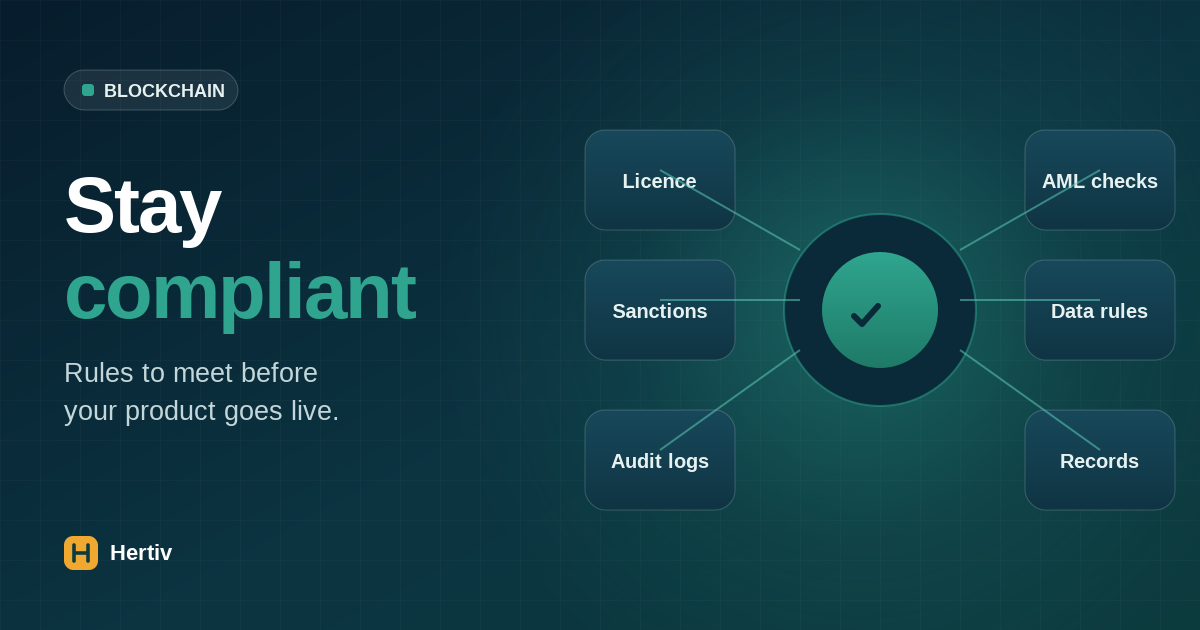
Blockchain regulatory compliance for enterprises means meeting the laws that apply to a blockchain product before it serves customers, including licensing, anti-money-laundering checks, sanctions screening, data protection and record-keeping. The rules depend on what the product does and where its users live, so a token, a payment service and a supply-chain ledger face different duties. Teams that map the rules early avoid rebuilding the product after launch.
What is blockchain regulatory compliance?
Blockchain regulatory compliance is the work of making a blockchain product follow the laws that apply to it, in every country where it has users. It covers which licences the product needs, how it checks who its users are, how it reports suspicious activity, and how long it keeps records. A product that ignores these rules can be fined, blocked or shut down, even if the technology works well.
The rules do not come from one place. Financial regulators cover tokens and payments, data regulators cover personal information, and sanctions rules cover who the product may serve. A supply-chain ledger that never touches money faces far fewer duties than a product that moves value between people.
Compliance is not a document written once. It is a set of checks built into the product: who can join, what they can do, what gets logged, and who reviews the logs. The team that builds the product and the team that runs compliance need to work together from the first design, not after launch.
Which rules apply to an enterprise blockchain product?
Which rules apply depends on what the product does, what it moves, and where its users are. A payment token and a document ledger are treated very differently, even when they use the same blockchain.
| Rule area | What it covers | Applies when |
|---|---|---|
| Securities law | Whether a token counts as a security | Tokens are sold to investors |
| Licensing | Permission to run the service | The product holds or moves money |
| Anti-money-laundering | Identity checks and reporting | Users move value through the product |
| Sanctions | Blocked people and countries | Any user can send or receive value |
| Data protection | Personal data on or off chain | The product stores user data |
| Consumer protection | Clear terms and fair treatment | The product serves the public |
In the European Union, the Markets in Crypto-Assets rules set out how crypto products are licensed and supervised, and every member state applies them through its own regulator. Other countries have their own frameworks, and some have none at all, which does not mean the product is free of rules: general financial, data and consumer laws still apply. For the EU framework specifically, see what the MiCA regulation is.
Do you need a licence, and which one?
Whether you need a licence depends on the service, not the technology. A product that holds customer money, exchanges one asset for another, or lets people pay each other usually needs a licence or registration in each country where it operates. A private ledger shared between known business partners usually does not.
The first step is to describe the product in plain words: who uses it, what value moves, who holds the money, and where the users live. A lawyer then matches that description to the rules in each country. Teams that skip this step often build a product that cannot legally serve the customers it was built for.
Licensing takes time. Applications ask for business plans, risk policies, key staff, security audits and proof of funds, and regulators can take months to answer. Plan the licence work alongside the build, not after it, so the launch date does not slip while the application waits. A comparison of frameworks helps here: see MiCA vs global crypto rules.
How do anti-money-laundering and sanctions checks work?
Anti-money-laundering checks mean knowing who your users are and watching what they do. The standard steps are identity verification at sign-up, screening names against sanctions lists, watching transactions for unusual patterns, and reporting activity that looks like crime. The product must keep records of all of this so a regulator can inspect them later.
On a blockchain, these checks are harder than in a bank, because anyone can create a wallet address without giving a name. That is why most regulated products put the checks at the point where users join: the product verifies identity before it lets a person deposit, trade or withdraw. Anonymous use and regulated use do not mix.
Sanctions screening must run every time a user joins and every time a payment is made, because lists change often. The product should also block transactions to addresses that are known to belong to sanctioned persons or to services that hide the source of funds. For token products, the checks also cover who may buy and resell, which is where stablecoin rules often come into play.
How do data protection and audit records work on a blockchain?
Data protection is the hardest part of blockchain compliance, because a blockchain is designed to keep data forever while privacy law gives people the right to have their data deleted. The standard answer is to keep personal data off the chain and store only a fingerprint, such as a hash, on it. The fingerprint proves a record existed without revealing who it belongs to.
Audit records must show who did what and when, in a form a regulator can read. The blockchain itself keeps a record of transactions, but the product also needs logs of identity checks, approvals, rejected transactions and access by staff. Those logs should be stored separately from the chain, with access controls and a retention period the team can explain.
Key management is part of the same picture. If the product holds customer keys, losing them means losing customer money, so the team needs clear rules for who can touch keys, how they are backed up, and what happens when a staff member leaves. For the security side, see data security and compliance.
How do teams build a compliance plan, step by step?
Teams build a compliance plan by mapping the rules first, then building the checks into the product, then testing them before launch.
- Describe the product in plain words. Who uses it, what value moves, who holds the money, and where the users live.
- Get legal advice for each country. A lawyer confirms which licences, registrations and rules apply, and which do not.
- Design the checks into the product. Identity verification, sanctions screening, transaction monitoring and record-keeping should be part of the build, not added later.
- Write the policies. Short, dated documents that say who does what, how often, and who reviews the work.
- Test with real scenarios. Try a sanctioned name, a large transaction and a data deletion request, and check that the product handles each one correctly.
- Plan ongoing monitoring. Rules change, so assign someone to track new laws and update the product when they change.
A compliance plan that lives in a drawer does not help. The plan should name the people who run each check, how often they run it, and what happens when a check fails.
Example (hypothetical): a cross-border payment product
Example (hypothetical): a company plans a blockchain payment product for small exporters in three countries. It will hold customer funds while a payment settles, so it needs a payment licence in each country, and its users will move value, so it needs identity checks and sanctions screening.
The team starts by listing the rules in each country and finds that two of them require a licence application that takes about six months. It builds the identity check into sign-up, so a user cannot deposit until their documents are verified.
It also adds a daily screening run: 500 new users a month, at about 2 minutes of review each, means 500 x 2 = 1,000 minutes, or about 17 hours of review work a month, which the team plans for in advance.
Before launch, the team tests three scenarios: a user on a sanctions list, a payment twice the usual size, and a customer asking for their data to be deleted. The first two are blocked and flagged, and the third is handled by deleting the off-chain record while the on-chain hash stays. The product launches with those checks working, instead of adding them after the first regulator letter arrives.
What are the common mistakes?
The most common compliance mistakes are treating the rules as an afterthought, assuming one country's rules cover everywhere, and keeping personal data on the chain.
- Starting the build before the legal check. A product built for the wrong licence is rebuilt, not fixed.
- Assuming one licence covers all countries. Most licences are national, so each new country needs its own check.
- Putting personal data on the chain. Names and documents on a public ledger cannot be deleted when the law requires it.
- Screening once at sign-up. Sanctions lists change, so screening must run on every transaction, not just once.
- No record of decisions. If a regulator asks why a transaction was allowed, the team needs a log, not a memory.
- Treating compliance as a launch task. Rules change after launch, so someone must own the updates.
Key takeaways
- Compliance depends on what the product does and where its users live
- Licence applications take months, so start them alongside the build
- Identity checks and sanctions screening belong at sign-up, not after
- Keep personal data off the chain and store only a hash
- Test sanctions, large payments and deletion requests before launch
- Assign an owner for tracking rule changes after launch
Frequently asked questions
Does every blockchain product need a licence?
No. A licence is usually needed when the product holds or moves money, exchanges assets, or serves the public with financial services. A private ledger shared between known business partners, with no money moving, usually needs no financial licence, though data and contract law still apply. A lawyer should confirm this for each country.
What is the difference between MiCA and other crypto rules?
MiCA is the European Union framework for crypto assets, covering licensing, stablecoins and consumer protection across member states. Other countries have their own rules, and some have no crypto-specific framework at all. A product serving users in several regions must meet each region's rules, not just the strictest one.
Can a blockchain product comply with data deletion laws?
Yes, if personal data is kept off the chain. The usual design stores personal data in a normal database and puts only a hash, a fingerprint of the record, on the chain. When a user asks for deletion, the team deletes the off-chain record, and the hash no longer points to anything readable.
How long do records need to be kept?
It depends on the country and the rule, and there is no single answer. Anti-money-laundering records are commonly kept for five years after a customer leaves, while tax records have their own periods. The compliance plan should name a retention period for each record type and a way to delete records when the period ends.
Who is responsible for compliance in a small team?
Someone must own it, even in a team of five. The owner tracks rule changes, runs the checks, keeps the policies current and answers regulator questions. In very small teams, the owner is often a founder working with an outside lawyer. Leaving it unowned is the fastest way to miss a rule change.
What happens if a product breaks the rules?
The outcome ranges from a warning to a fine, a forced shutdown, or a ban on serving customers in that country. Regulators also publish enforcement actions, which damages trust with partners and customers. Fixing a product after an enforcement action costs far more than building the checks in from the start.


