Blockchain Layers Explained: From Layer 0 to Layer 3
Blockchains are built in layers, from the networks that connect chains to the apps people use. Here is what each layer does, and how the layers fit together.
On this page
Short answer
Blockchain layers describe the stack that makes a blockchain work: layer 0 networks connect separate chains, layer 1 is the base chain that records transactions, layer 2 scales that base chain, and layer 3 is the application layer where wallets, games and exchanges live. Each layer solves a different problem, and a chain you use every day usually runs on all of them at once.
What are blockchain layers?
Blockchain layers are the stack of systems that turn a single chain into something people can actually use. Each layer has one job, and the layers stack: the layer below provides security and settlement, the layer above provides speed and a usable interface.
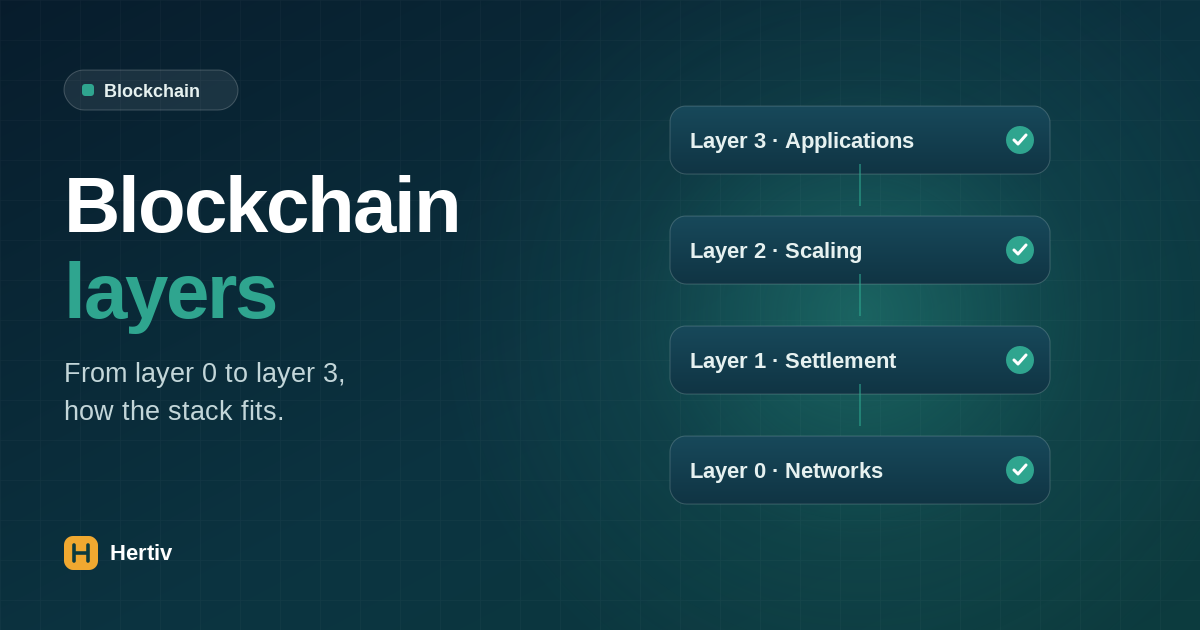
The four layers are usually numbered from the bottom up. Layer 0 is the network that connects chains. Layer 1 is the base chain itself. Layer 2 scales the base chain. Layer 3 is the applications people touch.
| Layer | What it does | Examples | Who uses it |
|---|---|---|---|
| Layer 0 | Connects separate chains | Cosmos, Polkadot | Chain builders |
| Layer 1 | Records and settles transactions | Bitcoin, Ethereum, Solana | Everyone |
| Layer 2 | Scales the base chain | Arbitrum, Optimism, Lightning | Apps and users |
| Layer 3 | Applications and interfaces | Wallets, games, exchanges | End users |
The layers matter because no single chain does everything well. A base chain that is secure and decentralised is usually slow, so the layers above it add speed without giving up the security of the base.
What does layer 0 do?
Layer 0 is the infrastructure that lets separate blockchains talk to each other. It provides the networking, consensus and messaging that chains use to pass assets and data between them, so a token or a message created on one chain can be used on another.
Two well-known layer 0 systems take different approaches. Cosmos gives each chain its own sovereignty and connects them with a messaging protocol, so chains keep their own rules and validators. Polkadot runs a shared relay chain that provides security to the chains connected to it, so smaller chains borrow security instead of building their own validator set.
Layer 0 matters most to teams building a new chain. If you are building an application, you usually pick a layer 1 or layer 2 and never touch layer 0 directly. The choice still affects you, because it decides which other chains your users can reach and how easily assets move between them.
What does layer 1 do?
Layer 1 is the base blockchain: the network of nodes that agrees on the order of transactions, records them in blocks, and settles them. Bitcoin, Ethereum and Solana are layer 1 chains. Everything above them depends on the security and finality of this layer.
A layer 1 chain is defined by its consensus rules and its trade-offs. Bitcoin prioritises security and simplicity, with a small block size and slow finality. Ethereum prioritises programmability, running smart contracts that other layers build on. Solana prioritises throughput, processing many transactions per second at the cost of heavier hardware requirements for validators.
The key property of layer 1 is that it is the source of truth. When a layer 2 system claims a transaction happened, the claim is only as strong as the layer 1 record it points to. That is why scaling work happens above layer 1 rather than by weakening it. For the comparison between the first two layers, layer 1 vs layer 2 explains the trade-offs in more detail.
What does layer 2 do?
Layer 2 scales a layer 1 chain by doing most of the work off the base chain and posting a compact proof or summary back to it. Users get faster, cheaper transactions, and the base chain still guarantees the result.
The main patterns are rollups, channels and sidechains. A rollup batches many transactions, executes them off-chain, and posts the result to layer 1: optimistic rollups assume the result is correct unless challenged, while zero-knowledge rollups post a cryptographic proof. A payment channel lets two parties transact privately and settle only the final balance on-chain. A sidechain runs its own consensus and connects to layer 1 through a bridge.
Layer 2 is where most everyday activity now happens on Ethereum. Exchanges, games and payment apps run on rollups because the fees are a fraction of layer 1 fees, while the settlement still lands on Ethereum. The trade-off is added complexity: bridges, sequencers and exit rules that users and developers have to understand. What is layer 2 covers the main scaling patterns in depth.
What does layer 3 do?
Layer 3 is the application layer: the wallets, exchanges, games, marketplaces and business tools that people actually use. It sits on top of layer 1 and layer 2 and turns the underlying chains into products with interfaces, accounts and customer support.
Layer 3 also includes application-specific chains, sometimes called app-chains. A game or an exchange can run its own chain tuned for its own workload — fast blocks, low fees, custom rules — while settling value on a layer 1 or layer 2 below. This gives the application control over its own performance and costs, at the price of running its own infrastructure.
For most users, layer 3 is the only layer they ever see. They open a wallet, swap a token or play a game, and the layers below are invisible. That invisibility is the point: each layer hides the complexity of the one below it. Layer 3 blockchain explains the application layer and app-chains in more detail.
Example: one payment across all four layers
Example (hypothetical): a player buys a game item for $12. The game is a layer 3 application running its own app-chain, and the item is priced in a stablecoin.
The player confirms the purchase in the game wallet. The app-chain records the trade, then batches it with 499 other player transactions and posts one summary to a layer 2 rollup. The rollup executes the batch and posts its proof to the Ethereum layer 1, where the transaction settles. The stablecoin itself moved on the layer 1, while the game logic ran on the layers above.
The fee arithmetic shows why the layers exist. If settling directly on layer 1 cost $4 per transaction, 500 separate settlements would cost $2,000. Batched through the rollup, one settlement costs $4, so each player's share is $4 divided by 500, or $0.008. The player pays a fraction of a cent in settlement fees instead of $4, and the base chain still guarantees the result.
Meanwhile the layer 0 connection lets the player move the item to a marketplace on a different chain, if the game supports it. Each layer did one job, and the user only saw a button that said buy.
What are the common mistakes?
The most common mistakes are treating the layers as competing products, picking a layer for the wrong reason, and ignoring the bridge between layers.
- Treating layers as rivals. Layer 2 does not replace layer 1; it depends on it. Judge each layer by the job it does.
- Picking on fees alone. The cheapest layer is not the best if it has weak security, a small validator set or no exit path.
- Ignoring the bridge. Moving assets between layers means trusting a bridge or a sequencer. Read how it works before you move value.
- Assuming layer 3 is safe because layer 1 is. A secure base chain does not make an application safe; smart contract bugs live at layer 3.
- Building on a layer you do not need. A simple application may not need its own app-chain; start on an existing layer 2.
- Forgetting finality. Different layers confirm at different speeds. Know when a transaction is truly final before you act on it.
Key takeaways
- Layer 0 connects chains; layer 1 settles; layer 2 scales; layer 3 serves users
- Each layer solves one problem and depends on the layer below for security
- Rollups batch many transactions into one layer 1 settlement, which is where the fee saving comes from
- Bridges and sequencers are the trust points between layers — read how they work
- A secure base chain does not make an application safe; bugs live at layer 3
Frequently asked questions
What is the difference between layer 1 and layer 2?
Layer 1 is the base blockchain that records and settles transactions with its own consensus, such as Bitcoin or Ethereum. Layer 2 runs on top of a layer 1 and does most of the work off-chain, posting a summary or proof back to layer 1. Layer 2 is faster and cheaper because it batches work.
Is layer 0 the same as layer 1?
No. Layer 0 is the infrastructure that connects separate blockchains, such as Cosmos or Polkadot, so assets and messages can move between chains. Layer 1 is a single base chain, such as Bitcoin or Ethereum. A layer 1 chain can exist without layer 0, but layer 0 is what makes chains interoperable.
Do I need to understand layers to use crypto?
Not in detail. Most users only touch layer 3 applications such as wallets and exchanges, and the layers below are invisible. Understanding the layers helps when you choose where to hold assets, because it tells you where a transaction settles and what the risks of each layer are.
Are sidechains the same as layer 2?
They are related but not identical. A sidechain runs its own consensus and connects to layer 1 through a bridge, so it does not inherit layer 1 security. A rollup posts proofs to layer 1 and does inherit its security. Both sit above layer 1, but the security guarantee is different, which is why the distinction matters.
What is an app-chain?
An app-chain is a blockchain built for one application, such as a game or an exchange, usually at layer 3. It gives the application control over block speed, fees and rules, while settling value on a layer 1 or layer 2 below. The trade-off is that the application team runs its own infrastructure.
Which layer should a new project build on?
Start on an existing layer 2 if your users need low fees and fast transactions, or directly on a layer 1 if you need maximum security and composability with other apps. Only consider your own chain or app-chain once you have real users and a clear reason the shared layers cannot meet your needs.


