How Blockchain Is Used in Sales
Blockchain in sales records deals, automates payments and proves what was agreed. Learn where it fits, what smart contracts change, and how to start small.
On this page
Short answer
Blockchain in sales means using a shared, tamper-resistant record to track deals, automate payments and prove what was agreed between buyer and seller. It fits best where several parties need to trust the same record, such as channel sales, high-value equipment deals and cross-border trade.
What is blockchain in sales?
Blockchain in sales is the use of a shared ledger to record sales agreements, deliveries and payments so that every party sees the same facts. Instead of each company keeping its own copy of a deal in a separate system, the key facts sit on a ledger that no single party can rewrite.
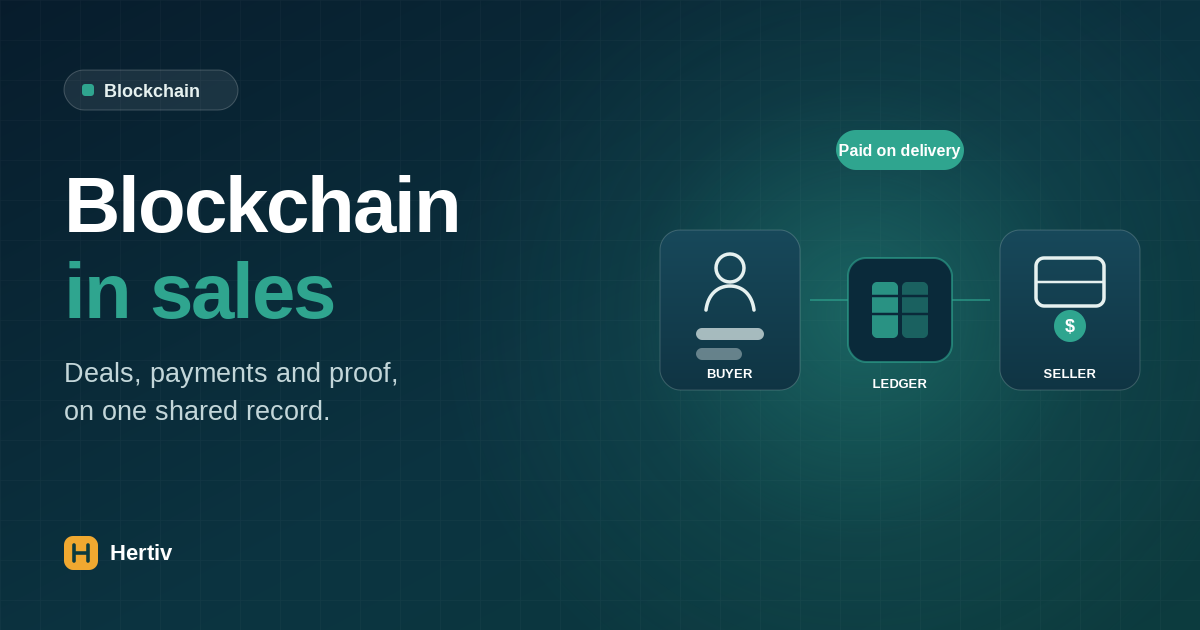
The record typically covers the order, the agreed price, the delivery confirmation and the payment. When a delivery is confirmed, a smart contract can release payment automatically, which removes the delay and the disputes that come from matching invoices across systems.
It is not a replacement for a CRM. The CRM still holds leads, conversations and forecasts. The blockchain holds the facts that two or more parties must agree on, such as what was delivered and when payment is due.
Where does blockchain fit in the sales process?
Blockchain fits the parts of sales where trust between parties is the problem, not the parts where a single team works alone. The table below shows where it helps and where it does not.
| Sales step | Blockchain role | Value |
|---|---|---|
| Quoting and agreement | Records the agreed price and terms | Neither side can change the deal later |
| Delivery confirmation | Logs delivery against the order | Proof that goods arrived as agreed |
| Invoicing and payment | Smart contract releases payment on delivery | Faster payment, fewer disputes |
| Channel and partner sales | Shared record of who sold what | Fair commission splits |
| Lead generation | Little or none | Keep this in the CRM |
| Forecasting | Little or none | Keep this in the CRM |
The pattern is clear: blockchain helps after a deal is agreed, when money and goods change hands. It does not help with finding customers or deciding what to sell them. Teams that start with the delivery and payment steps see value first.
How do smart contracts change sales deals?
Smart contracts change sales deals by turning the payment terms into code that runs when the agreed condition is met. A contract can say that when delivery is confirmed on the ledger, the payment moves from the buyer to the seller without anyone sending an invoice or chasing it.
This matters most for deals with milestones. A supplier can be paid in parts as each shipment is confirmed, instead of waiting for the whole order to finish. A channel partner can be paid its commission the moment the end customer pays, instead of waiting for a monthly reconciliation.
The contract needs a trusted source for the delivery fact. That source is usually an oracle, a system that reports real-world events to the chain, or a signed confirmation from the buyer. If the delivery fact is wrong, the payment still runs, so the confirmation step deserves more care than the contract code.
Smart contracts also make the terms visible. Both sides can read the same rules before signing, which cuts the back-and-forth over payment timing. The retail angle is similar, as smart contracts in retail shows for stores and suppliers.
What are the limits of blockchain in sales?
The limits of blockchain in sales are cost, speed, privacy and the fact that a ledger cannot fix a bad sales process. A team that adopts it for the wrong step gets the cost without the benefit.
Recording every sales event on a public chain costs fees and exposes deal data. Most sales use cases run on a private or permissioned ledger, where only the parties to a deal can see it. That keeps the data private but adds setup and maintenance work.
Speed is another limit. A ledger confirms records in seconds or minutes, not milliseconds, so it suits deal settlement and not real-time pricing. And a shared record does not help if the two sides disagree about what was delivered; it only proves what was recorded.
Finally, blockchain does not replace the commercial work. It will not find buyers, negotiate terms or fix a product that customers do not want. The sales team still does that, and the ledger only records the outcome.
How do you start using blockchain in sales?
You start using blockchain in sales by picking one deal type where payment disputes are common, then recording that deal type on a ledger with one partner before expanding.
- Pick one painful deal type. Choose the deals where payment is slow or disputed, such as cross-border orders or channel sales.
- Agree the record with one partner. Decide together what facts go on the ledger: order, price, delivery proof and payment terms.
- Build the smallest version. Record deals and release payment on delivery confirmation. Do not add token rewards or loyalty features yet.
- Connect the CRM. Push deal facts from the CRM to the ledger and pull payment status back, so the sales team keeps working in one place.
- Measure the result. Track days to payment, dispute count and reconciliation time before and after, and expand only if the numbers improve.
A pilot with one partner and one deal type takes weeks, not months, and it answers the only question that matters: does the shared record make payment faster and disputes rarer. The banking sector has run similar pilots, as blockchain in banking describes for settlement between institutions.
Example: a parts supplier settles invoices on chain
Example (hypothetical): a parts supplier sells to 40 distributors. Each order is worth about 5,000 dollars, and payment takes 45 days on average because each distributor matches the invoice against its own records before paying. About 1 in 10 invoices is disputed, and each dispute takes 3 hours of staff time to resolve.
The supplier and its five largest distributors agree to record orders on a shared ledger. When a shipment is confirmed, a smart contract releases payment after 7 days unless the distributor flags a problem. The other 35 distributors keep the old process.
With the five distributors, payment time falls from 45 days to 7 days. Those five buy 200 orders a month, so 200 times 5,000 dollars, or 1,000,000 dollars a month, now arrives 38 days earlier. Disputes on those orders fall from 1 in 10 to 1 in 50, which saves 200 times 0.08, or 16 disputes a month, at 3 hours each, or 48 hours of staff time a month.
The supplier then invites the next ten distributors onto the ledger. The lesson is that the gain comes from the payment delay and the dispute time, not from the technology itself, and it only appears once a real partner agrees to use the shared record.
What are the common mistakes?
The most common blockchain in sales mistakes are recording everything on chain, choosing a public chain for private deal data, and expecting the ledger to fix a broken sales process.
- Putting every sales event on chain. Leads, calls and notes belong in the CRM. Only the facts both parties must agree on belong on the ledger.
- Using a public chain for deal data. Competitors can read public ledgers, so private deal terms need a permissioned ledger or off-chain storage.
- Automating a disputed process. If buyers and sellers already disagree about delivery, a smart contract will only automate the disagreement.
- No plan for the delivery fact. A contract that pays on delivery needs a reliable way to confirm delivery, or it pays on bad data.
- Building before a partner agrees. A ledger with one party is a database. The value appears only when a counterparty uses it too.
For the build itself, blockchain development covers the ledger, contract and integration choices.
Logistics teams can see a parallel use case in blockchain in logistics.
Key takeaways
- Blockchain in sales records the facts both parties must agree on, not the whole sales process
- Smart contracts release payment when delivery is confirmed, which cuts payment delays
- Start with one deal type and one partner, and measure days to payment and disputes
- Private deal terms need a permissioned ledger; public chains expose them
- A ledger with one party is a database; the value needs a counterparty
Frequently asked questions
Do I need cryptocurrency to use blockchain in sales?
No. Most sales use cases run on a private or permissioned ledger and settle payment in normal currency. The ledger records the deal and the payment fact; the money itself can move through a bank.
How is blockchain in sales different from a shared spreadsheet?
A shared spreadsheet can be edited by anyone with access, and there is no agreed history of changes. A ledger gives every party the same record, and past entries cannot be rewritten without the other parties seeing it.
Can smart contracts handle partial deliveries?
Yes. A contract can release payment in parts as each shipment is confirmed, which suits large orders that arrive in several deliveries. The delivery fact for each part must be confirmed separately.
What data should stay off the chain?
Keep prices and terms that competitors must not see off a public chain, and keep personal data off any chain. Store the private details in your own systems and record only a reference and a proof on the ledger.
How long does a sales blockchain pilot take?
A pilot with one partner and one deal type usually takes a few weeks to a few months, depending on how much CRM and payment integration is needed. The long part is agreeing the record and the terms, not writing the contract.
Does blockchain replace invoicing?
Not entirely. The ledger can replace the matching and chasing that follows an invoice, because both sides already agree on the facts. You may still need an invoice document for tax and accounting, generated from the same agreed record.


