Why Should Logistics Businesses Adopt Blockchain?
Blockchain gives every shipment a shared record all parties can trust, cutting disputes and paperwork. Here is where it helps and how to start.
On this page
Short answer
Blockchain helps logistics because a shipment passes through many independent companies, and each one keeps its own records. A shared record that no single party can rewrite gives everyone the same facts about where goods are, who handled them and what was agreed, so disputes are settled from evidence instead of competing spreadsheets.
What is blockchain in logistics?
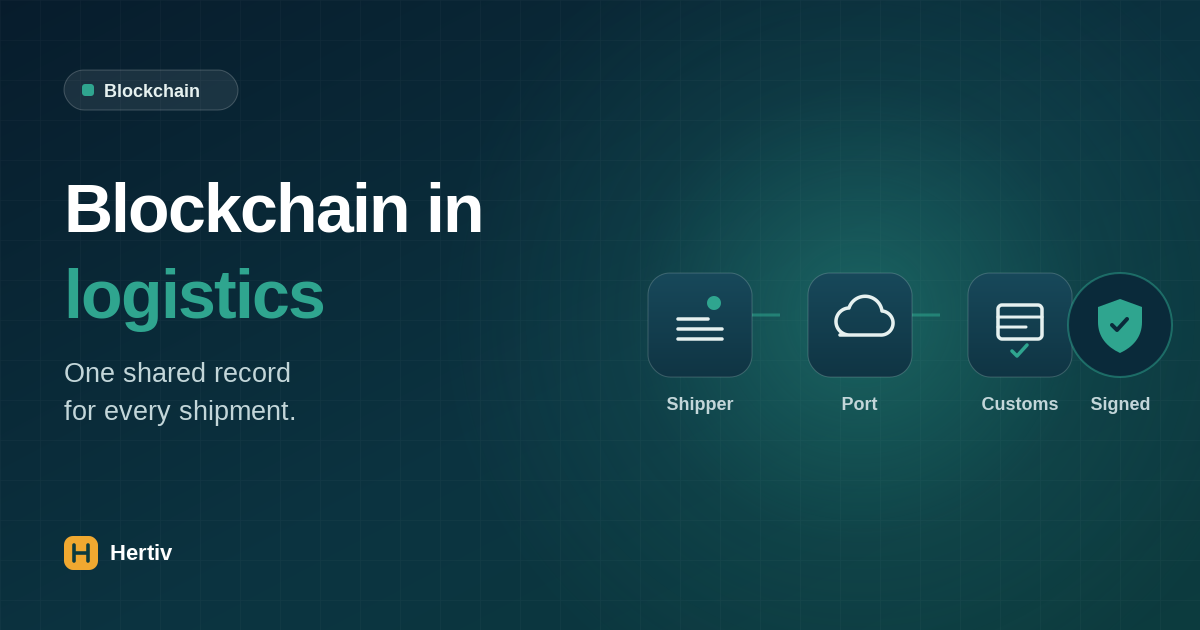
Blockchain in logistics is a shared digital record that every party in a shipment can read and add to, but no single party can rewrite after the fact. Each entry is grouped into a block, linked to the one before it and copied across the network, so the history of a shipment stays the same for the shipper, the carrier, the port and the customer.
The record usually holds handover events, documents and status changes rather than the goods themselves. A container leaving a factory, clearing customs and arriving at a warehouse each create an entry with a time, a location and the party that signed it off.
| Record entry | Who records it | What it proves |
|---|---|---|
| Goods collected | Carrier | When and where the shipment started |
| Customs cleared | Customs broker | Duties paid and documents accepted |
| Port departure | Shipping line | Vessel, date and container number |
| Temperature reading | Sensor or warehouse | Cold chain stayed within limits |
| Delivery signed | Receiver | Goods arrived in the agreed state |
Because the record is shared, a dispute about a late delivery or a damaged pallet starts from the same facts instead of four different spreadsheets. That shared starting point is the main reason logistics teams look at blockchain at all, and it is the idea behind enterprise blockchain work in supply chains.
Why does logistics need a shared record?
Logistics is a chain of handoffs between companies that do not share systems. A single container can pass through a manufacturer, a freight forwarder, a shipping line, a port, customs and a trucking firm, and each one keeps its own records in its own format.
That fragmentation causes four everyday problems:
- Status chasing. Staff spend hours on phone and email asking where a shipment is.
- Invoice disputes. The invoice, the delivery note and the contract disagree, so payment waits.
- Damage arguments. Nobody can prove where goods were when damage happened.
- Border delays. Customs paperwork must match across systems that were never built to talk to each other.
A shared record does not remove the handoffs, but it removes the argument about what happened at each one. When every party signs the same entry, the question changes from whose record is right to what to do next, which is a change that matters for logistics and supply chain teams.
Where does blockchain help most in logistics?
Blockchain helps most where several independent parties must trust the same facts and where a paper trail is slow or easy to dispute. It helps least where one company controls the whole chain and a normal database would do the same job for less effort.
| Use case | Problem it solves | Who benefits |
|---|---|---|
| Proof of delivery | Arguments over whether goods arrived | Shipper and receiver |
| Customs documents | Paperwork that must match across borders | Broker, customs and importer |
| Cold-chain logs | Temperature breaks nobody can place in time | Food and pharma shippers |
| Invoice reconciliation | Invoices that disagree with delivery notes | Finance teams on both sides |
| Product recalls | Finding affected batches across many sellers | Manufacturers and retailers |
| Trade finance | Banks waiting on paper proof of shipment | Exporters and their banks |
Proof of delivery and customs paperwork are the usual starting points because they are document-heavy and dispute-prone. Cold-chain logging matters where a temperature break can spoil a whole load and nobody can agree when it happened.
What does adoption actually involve?
Adoption starts with one lane and a small group of partners, not with a whole network. Pick a route where disputes are frequent, documents are paper-based and the partners are willing to share data.
- Map the handoffs. List every party, document and system on one lane.
- Agree what each party records. Define the entries, the signatures and the data each party can see.
- Choose the network. Pick a permissioned network or a shared ledger service that fits the partners.
- Connect existing systems. Link the transport and warehouse software so entries are created automatically.
- Run in parallel. Keep the old process running for one full shipping cycle and compare.
- Settle governance. Agree who pays for the network, who owns the data and who can join later.
Most pilots fail on governance, not on technology. Decide up front who can join, who can see which entries and what happens when a party leaves. That is the part of blockchain development that teams most often underestimate.
Example: a forwarder on one busy lane
Example (hypothetical): a freight forwarder moves 400 containers a month on one lane and spends 120 staff hours a month chasing delivery status and reconciling invoices. Each disputed invoice takes about 3 hours to resolve, and the team handles 20 disputes a month.
After six months on a shared record, status chasing falls to 30 hours a month and disputes fall to 5 a month. That saves 90 hours of chasing plus 15 fewer disputes at 3 hours each, which is 45 hours, or 135 hours a month in total. The pilot cost is spread over the first year, so the forwarder judges it on time saved and fewer late-payment penalties, not on the technology alone.
The numbers only work because the lane was chosen for its disputes. On a quiet lane with few problems, the same pilot would save far less and look like a poor use of money.
What are the common mistakes?
The most common mistakes in logistics blockchain projects are starting too big, sharing the wrong data and expecting the technology to fix a broken process.
- Starting with the whole network. A pilot on every lane at once has too many partners and no clear owner.
- Sharing sensitive commercial data. Prices and margins should stay private, even on a shared ledger.
- Replacing data entry with nothing. A shared record of bad data is still bad data.
- No plan for partners who refuse. If a key carrier will not join, the record has a gap in the middle.
- Measuring transactions, not outcomes. Counting entries on the ledger says nothing about disputes resolved.
How to start without overcommitting
You start by picking one lane with frequent disputes and three partners willing to share data. A small pilot that answers one question is worth more than a large programme that answers none.
- Pick one lane. Choose a route where disputes are frequent and documents are paper-based.
- Get three partners to agree. A shipper, a carrier and a broker are enough to prove the idea.
- Set one success measure. Use dispute time or invoice reconciliation time, not ledger entries.
- Run one full cycle. Compare the pilot lane with a similar lane on the old process.
- Decide, then extend. Extend the pilot, change the design or stop, based on the result.
If the pilot does not cut dispute time, the answer is to fix the process first, not to buy more technology. And where the problem is prediction or routing rather than shared records, AI agents in logistics may be the better tool for the job.
Key takeaways
- A shared record gives every party the same facts about a shipment, so disputes start from evidence
- Proof of delivery, customs documents and cold-chain logs are the strongest first use cases
- Start with one lane and a few willing partners, not with the whole network
- Governance decides success: who joins, who sees what, and who pays
- Measure dispute time and reconciliation time, not transactions on the ledger
Frequently asked questions
Does blockchain replace a transport management system?
No. A transport management system plans routes, books capacity and manages fleets, while blockchain records what happened. The two work together: the management system runs the operation and the shared record proves what each party did.
How much does a logistics blockchain pilot cost?
Costs vary with the number of partners and the systems that must connect. A small pilot on one lane with three partners is far cheaper than a network-wide rollout, which is why pilots are the usual starting point.
Do all partners need to use the same software?
No. Partners keep their own systems and connect through an integration layer that writes entries to the shared record. What must be shared is the data format and the rules about who signs what.
Is blockchain useful for a small logistics business?
It can be, if the business works with partners who dispute deliveries or paperwork. A small firm on a single lane gains the same shared facts as a large one, but it should join an existing network rather than build its own.
What happens if a partner refuses to join?
The record has a gap on that leg of the journey, so the pilot should be designed around partners who will join. In practice, the partners who cause the most disputes are the ones with the most to gain from joining.
Does blockchain work for domestic trucking as well as shipping?
Yes. The same idea applies to any chain of handoffs: collection, line-haul, cross-dock and final delivery each create a signed entry. Domestic lanes are often a good pilot because the partners are fewer and easier to gather.


