How Blockchain Protects Healthcare Data: A Clear Guide
Blockchain can record who touched a health record and when, while the record itself stays in a secured database. Learn how the pieces fit and what to check first.
On this page
Short answer
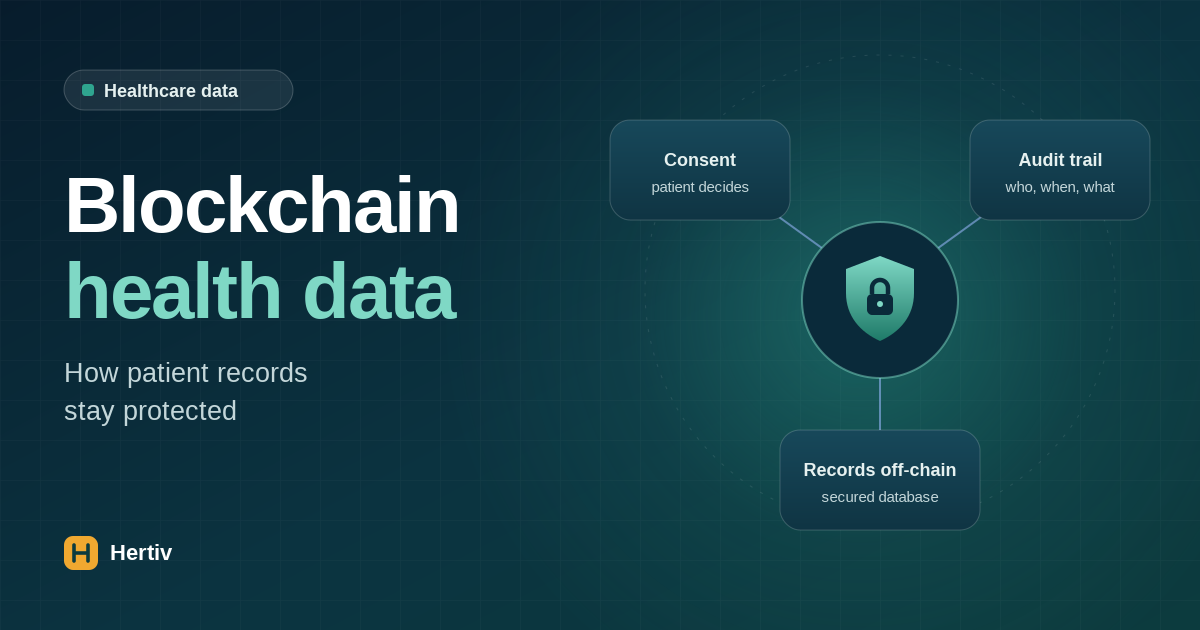
Blockchain protects healthcare data by keeping a tamper-evident record of every access and change, while the medical data itself usually stays off the chain in a secured database. Smart contracts can enforce patient consent, so a record is shared only when the patient has agreed. The chain proves what happened and when; it does not replace encryption, access controls or good security practice.
How does blockchain protect healthcare data?
Blockchain protects healthcare data by keeping a tamper-evident record of every access and change, while the medical data itself usually stays off the chain in a secured database. Each new entry links to the one before it, so changing an old entry would break the chain and show up at once.
That record answers three questions a hospital needs: who saw a record, when they saw it, and whether it changed since. The table below shows the main techniques and what each one does.
| Technique | What it does | What it protects |
|---|---|---|
| Hashing | Turns a record into a short fingerprint | Proves the record has not changed |
| Encryption | Scrambles data so only key holders can read it | Privacy if storage is breached |
| Consent contracts | Small programs that record patient consent | Sharing only with permission |
| Access logs | Every read and write is recorded in order | Audit trail after an incident |
| Off-chain storage | Records stay in a secured database | Deletion and correction rights |
The chain is a record-keeper, not a vault. It proves what happened, but the data still needs encryption and access controls, and a project that promises protection from the chain alone is missing the point. Smart contract basics explain the code that enforces the rules.
What stays on the chain, and what stays off it?
Almost no medical data belongs on a chain. Health records are large, they change often, and in many countries the law gives patients the right to have data deleted, which a chain cannot do once an entry is written. Good projects keep only small proofs on the chain: a hash of a record, a consent decision, or a timestamp.
The record itself stays in a secured database or a hospital system, and the chain holds a fingerprint that proves the record has not changed. When someone opens a record, the system checks the fingerprint against the chain, and a mismatch raises an alert.
This split is the core design choice in every healthcare blockchain project. A team that gets it right can use the chain for trust while keeping the data where it can be managed, corrected and deleted under the law.
How do patients control consent?
Consent works best as a smart contract: a small program on the chain that records what a patient agreed to, for whom, and for how long. A researcher or a second clinic can only read the record when the contract says the consent is still valid.
The patient can change the consent, and the change is written as a new entry, so the old decision stays visible as history. That history matters for audits: a hospital can show not only the current consent, but every consent that came before it.
Consent also needs a clear screen for the patient. A contract is only as good as the choice it records, so the patient must see in plain words what they agree to, and be able to change it without calling the hospital.
How does an audit trail help after a breach?
After a breach, the first question is what was seen and by whom. An audit trail on a chain gives a list that cannot be quietly edited, so investigators can trust it even when the breached system cannot be trusted. That shortens the investigation and gives patients a clear account.
The trail also helps before a breach. Unusual access, a record opened at 3 a.m., or hundreds of records opened by one account, shows up in the log, and a monitoring team can act on it. The chain makes the log harder to hide, but a team still has to watch it.
A trail is only useful if someone reads it. A project that writes logs nobody reviews has spent money on a record, not on protection, so the monitoring habit matters more than the chain itself.
How to judge a healthcare blockchain project in five steps
Judge a project by its data rules, not by its claims about the chain. A sound project can say exactly what sits on the chain, what sits off it, and how a patient deletes or corrects their data.
- Ask what data sits on the chain, and what stays off it.
- Ask how a patient gives, changes and withdraws consent.
- Ask how a record is deleted or corrected when the law requires it.
- Ask who can read the audit trail, and who watches it.
- Ask for a pilot result on real records, not only a demo.
If the team cannot answer the first three questions in plain words, the project is not ready. Clear answers here are worth more than any claim about the chain's speed or size.
Example (hypothetical): a hospital pilot
Example (hypothetical): a hospital runs a pilot across two clinics with 5,000 patient records each, or 10,000 records in total. Every access writes an entry to the chain, and the pilot logs 200 access events a day.
Reviewing each event by hand takes 5 minutes, so 200 events take 1,000 minutes, or about 17 hours a day, more than two full working days. The team adds simple rules that flag only unusual access, which cuts the list to 20 events a day.
Reviewing 20 events takes 100 minutes, or about 1 hour and 40 minutes a day. The chain did not reduce the number of events; the rules did. The pilot shows that a chain is useful only when someone watches what it records.
What are the common mistakes?
The most common mistake is putting medical data on the chain. Records are large, they change, and deletion rights make on-chain storage a legal problem. Keep proofs on the chain and records off it.
The second mistake is treating the chain as a security system. A chain records what happened; it does not stop a stolen password or a mis-set permission. Encryption, access controls and staff training still do the heavy work. How health systems share data today shows what the chain has to fit into.
The third mistake is skipping the consent design. A project that cannot show how a patient withdraws consent will fail its first audit, whatever the chain does. Design consent first, and build the chain around it. Tokenization in healthcare shows a related pattern where the on-chain record and the off-chain asset must stay in step.
Key takeaways
- The chain records access; the data stays off-chain in a secured database
- Only small proofs belong on the chain: hashes, consent decisions, timestamps
- Consent works best as a smart contract the patient can change
- An audit trail helps only if a team watches it
- Judge a project by its data rules, not by its claims about the chain
Frequently asked questions
What is blockchain in healthcare?
Blockchain in healthcare is a shared, tamper-evident record of who accessed or changed a health record and when. The medical data itself usually stays in a secured database, while the chain holds small proofs such as hashes and consent decisions.
Does blockchain store patient records?
No, not in a sound design. Records are large, they change, and patients often have a right to deletion, which a chain cannot do. Good projects store records off-chain and keep only a fingerprint on the chain.
How does blockchain handle patient consent?
Consent is recorded as a smart contract that states what the patient agreed to, for whom, and for how long. The patient can change it, and the change is written as a new entry, so the full history stays visible for audits.
Can blockchain stop a data breach?
No. A chain records what happened; it does not stop a stolen password or a mis-set permission. Encryption, access controls and staff training still do the heavy work, and the chain adds a trustworthy record of the event.
What should a hospital check before a pilot?
Check what sits on the chain, how consent is given and withdrawn, how records are deleted when the law requires it, and who watches the audit trail. Ask for a pilot result on real records, not only a demo.
Is blockchain widely used in hospitals today?
Use is still limited to pilots and specific uses such as consent records and audit trails. Most hospitals still share data through existing systems, and blockchain projects usually sit alongside them rather than replacing them.


