RWA Tokenization in Healthcare: How It Works and Where It Helps
RWA tokenization turns real healthcare assets into digital tokens on a blockchain. This guide explains how it works, where it helps, and what to check first.
On this page
Short answer
RWA tokenization in healthcare means recording ownership or rights in a real healthcare asset, such as medical equipment or hospital receivables, as digital tokens on a blockchain. It can make large assets divisible, easier to transfer, and simpler to track, but it still needs clear legal paperwork, data protection, and a licensed setup.
What is RWA tokenization in healthcare?
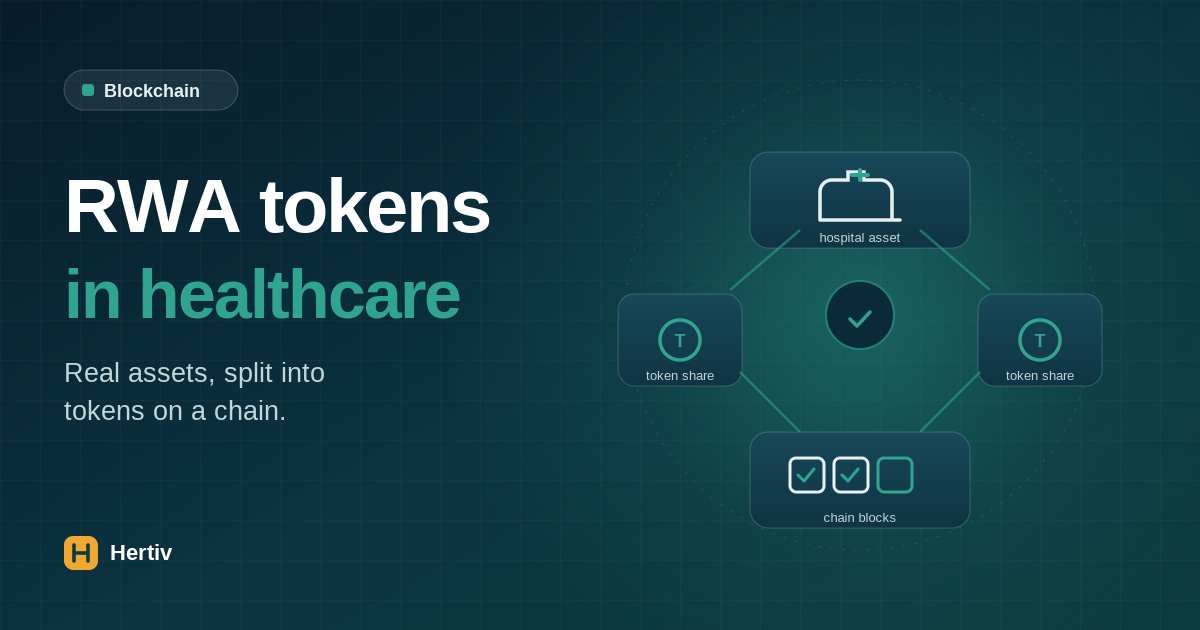
RWA tokenization in healthcare is the process of recording ownership or rights in a real healthcare asset as digital tokens on a blockchain. The asset stays in the real world, while the token represents a defined share, claim, or right tied to it.
The assets involved are usually things a hospital or clinic already owns or is owed: medical equipment, a hospital building, unpaid invoices from insurers, or a share of a research project. Tokenization does not change what the asset is. It changes how ownership is recorded, split, and transferred.
Each token is a record on a shared ledger. A hospital might split the value of a scanner into 10,000 tokens, so several funders can each hold a share. Transfers, payouts, and ownership history are then visible on the ledger instead of sitting in separate spreadsheets.
| Healthcare asset | What gets tokenized | Why it fits |
|---|---|---|
| Medical equipment | Ownership share in a device | High cost, shared use across sites |
| Hospital receivables | Right to future payments | Predictable cash flow from insurers |
| Hospital property | Share in a building or ward | Large value, long holding period |
| Research funding | Share of a funded programme | Many small funders, clear milestones |
| Pharma supply | Batch ownership and custody | Traceability from factory to pharmacy |
Tokenization is not the same as selling the asset. The token is only as good as the legal agreement behind it, and the asset still needs someone to maintain, insure, and operate it. For the wider picture, see how tokenization works.
How does tokenization work for a healthcare asset?
Tokenization works by pairing a legal agreement with a smart contract, so the token and the real-world claim stay linked from issue to payout.
A workable sequence looks like this:
- Define the asset and the claim. State exactly what the token represents: a share of ownership, a right to income, or a right to use.
- Set up the legal wrapper. A company or trust holds the asset and issues tokens under the relevant securities and healthcare rules.
- Value and verify the asset. An independent party checks the asset exists, its condition, and its value before any token is sold.
- Issue tokens on a chain. A smart contract mints the tokens, records who holds them, and enforces transfer rules.
- Manage income and reporting. Rent, fees, or repayments flow to token holders, and ownership changes are recorded on the ledger.
Patient data should never sit on a public chain. Tokens can point to records held in a compliant system, but names, diagnoses, and treatment details belong off-chain behind access controls. That separation is one of the first things a legal review should confirm.
Where can tokenization help in healthcare?
Tokenization can help in healthcare where assets are expensive, shared across sites, or funded by many small contributors.
Equipment funding is the clearest case. A scanner or surgical robot can cost more than a small hospital can fund alone. Splitting ownership into tokens lets several clinics, funds, or suppliers share the cost and the income from its use.
Receivables are another fit. Hospitals often wait weeks for insurer payments. Tokens tied to verified invoices can give a hospital earlier access to cash, with the token holder receiving the payment when the insurer settles.
Supply chains benefit from traceability rather than funding. A token or on-chain record for a batch of medicine can show each handoff from factory to pharmacy, which helps spot counterfeit or diverted stock.
Research funding is a slower, newer use. A programme with clear milestones can raise money from many small funders, with tokens recording each share and payouts tied to agreed results. This is still early, and it needs careful legal design. The general pattern is the same as in other sectors, as shown in RWA tokenization use cases.
What rules and risks should teams plan for?
The main risks in healthcare tokenization are legal status, patient privacy, and the quality of the asset behind the token.
- Securities rules. A token that promises income usually counts as a security in most jurisdictions, so the offer needs a licensed structure and proper disclosures.
- Patient privacy. Health records are protected by strict rules in most countries. Token designs must keep personal data off-chain and limit who can link a token to a patient.
- Asset risk. A token is worthless if the equipment breaks, the invoice is disputed, or the building loses value. Verification and insurance matter more than the technology.
- Market risk. A token can be hard to sell if few buyers want it. Teams should not promise easy exits they cannot guarantee.
- Smart contract risk. A bug in the contract can freeze funds or misdirect payouts. Independent review of the contract code is a basic step.
These risks do not make tokenization unusable. They mean the legal and compliance work comes first, and the blockchain part comes second. A partner for blockchain development can help design the contract, but the legal wrapper needs a lawyer who knows healthcare and securities rules.
Example: a hospital equipment pool
Example (hypothetical): three clinics in one region want to share a mobile imaging unit that costs $2,000,000. None of them can fund it alone, and each expects to use it on different days.
The clinics set up a holding company that buys and owns the unit. The company issues 20,000 tokens at $100 each, so the full value is covered: 20,000 x $100 = $2,000,000. Each clinic buys 5,000 tokens for $500,000, and a local health fund buys the remaining 5,000 tokens for $500,000.
The unit earns $40,000 a month from scans. After $12,000 in running costs, $28,000 is left to distribute. Each token is worth $28,000 / 20,000 = $1.40 a month, so a clinic holding 5,000 tokens receives $7,000 a month.
If one clinic later needs cash, it can sell some of its tokens to another buyer instead of selling the whole unit. The unit keeps working, the patients keep their appointments, and only the ownership record changes.
What are the common mistakes?
The most common healthcare tokenization mistakes are treating the token as the asset, ignoring privacy rules, and promising returns the asset cannot support.
- Token first, paperwork later. A token without a valid legal claim is a record of nothing. The agreement comes before the mint.
- Putting patient data on-chain. Health data on a public ledger cannot be deleted and is visible to anyone. Keep it off-chain.
- Overstating income. Projected returns are guesses. Show the assumptions and the downside, not only the best case.
- Skipping the exit plan. Token holders need to know how they sell, who can buy, and what happens if the asset is sold.
- Ignoring the operator. Someone must maintain, insure, and schedule the asset. Token holders do not do that work.
How to start a healthcare tokenization pilot
You start a healthcare tokenization pilot by picking one well-understood asset, getting legal sign-off, and testing the full flow with a small group.
- Pick one asset. Choose something with clear ownership, a known value, and a simple income stream, such as one device or one batch of invoices.
- Get legal advice early. Confirm the token structure, the disclosures, and the data rules before writing any code.
- Verify and value the asset. Use an independent check so token holders trust the numbers.
- Build the contract and the off-chain systems. The smart contract handles tokens and payouts; patient and operational data stays in compliant systems.
- Run a small pilot. Issue tokens to a known group, process one payout cycle, and record what breaks.
- Review and decide. Only widen the offer once the pilot shows the legal, operational, and payout steps all work.
A pilot is a test, not a launch. Keep the first group small, keep the asset simple, and keep patient data out of the design entirely.
Key takeaways
- Tokenization records ownership or rights in a healthcare asset as digital tokens, with the asset itself staying in the real world
- Equipment funding, receivables, and supply traceability are the most practical healthcare uses today
- Patient data must stay off-chain; only ownership and payout records belong on the ledger
- A token that promises income usually counts as a security and needs a licensed legal structure
- Start with one simple asset, legal sign-off, and a small pilot before widening any offer
Frequently asked questions
Is RWA tokenization legal in healthcare?
It can be, when the offer follows securities rules and healthcare data rules in the relevant jurisdiction. A token that promises income usually needs a licensed structure and proper disclosures, and patient data must stay off-chain. Get legal advice before issuing any token.
What healthcare assets can be tokenized?
The most practical ones are medical equipment, hospital receivables, hospital property, and research funding with clear milestones. The asset needs clear ownership, a known value, and a simple income or usage stream to tokenize well.
Does tokenization put patient data on the blockchain?
It should not. Tokens can record ownership and payouts, but names, diagnoses, and treatment details belong in compliant systems off-chain. Any design that puts patient data on a public ledger is a serious privacy risk.
How do token holders get paid?
Income from the asset, such as equipment fees or invoice settlements, is collected by the holding company and distributed to token holders, usually in proportion to the tokens they hold. The payout rules should be written into the legal agreement, not only the smart contract.
Can a small clinic use tokenization?
Yes, as part of a shared pool, but the legal and setup costs are real. A small clinic is better off joining a well-structured pool run by a larger operator than building its own token offer from scratch.
What is the biggest risk for healthcare tokenization?
The biggest risk is a gap between the token and the legal claim behind it. If the paperwork does not hold up, the token has no value, whatever the technology does. Asset quality, insurance, and honest income projections matter just as much.


