Interoperability in Healthcare: How Systems Share Patient Data
Interoperability lets health systems exchange patient data so clinicians see the full record. Here is how it works, which standards matter, and how teams build it.
On this page
Short answer
Interoperability in healthcare is the ability of different health systems to exchange patient data and use it. It lets a clinician see the full record even when the data was created in another hospital, clinic or app.
What is interoperability in healthcare?
Interoperability in healthcare is the ability of different health systems to exchange patient data and use it, so a clinician sees the full record even when the data was created in another hospital, clinic or app. It covers the technical connection, the shared data format and the rules that say who may see what.
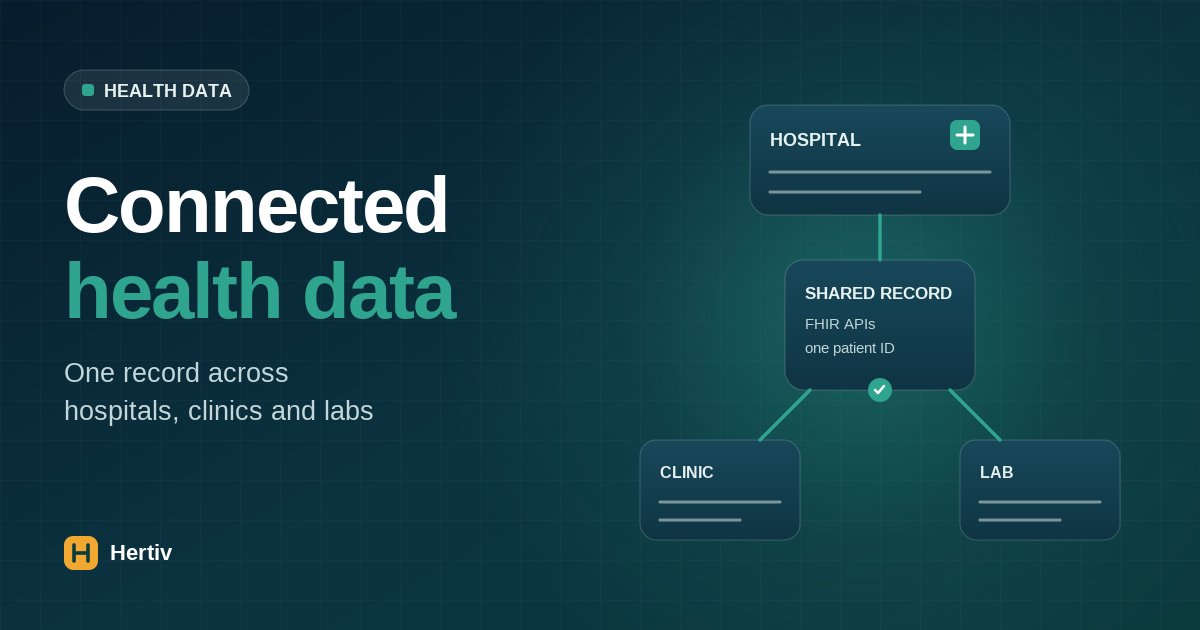
Without it, each system holds a fragment: the hospital has the admission notes, the clinic has the prescriptions, and the lab has the results, but nobody sees the whole picture. With it, the pieces join into one record that follows the patient.
| Standard | What it covers | Used for |
|---|---|---|
| FHIR | Modern API-based data exchange | Apps, portals, new integrations |
| HL7 v2 | Message-based exchange | Lab results, admissions, orders |
| DICOM | Medical imaging | Scans, X-rays, image archives |
| CDA documents | Clinical summaries | Discharge notes, referrals |
| Terminologies | Shared codes for terms | Diagnoses, drugs, lab tests |
Why does interoperability matter for patients?
Interoperability matters because care is rarely delivered in one place. A patient may see a GP, a specialist, a hospital and a pharmacy in the same month, and each one needs to know what the others did. Without shared data, tests are repeated, drugs clash, and allergies are missed.
The cost is measured in time and risk. A clinician who cannot see a recent scan orders it again. A pharmacist who cannot see a new prescription cannot warn about an interaction. A patient who carries paper records between clinics is doing the job the systems should do.
Shared data also helps the patient directly. A portal that shows lab results, prescriptions and appointments in one place lets people follow their own care, spot errors and arrive at appointments prepared. Telehealth apps face the same sharing problem, as telemedicine apps show.
How do health systems exchange data?
Health systems exchange data in three main ways, and most real deployments use all three. Messages carry events such as admissions and lab results between systems that already know each other. Documents carry summaries, such as a discharge note, from one organisation to another. APIs let an app ask a specific system for a specific record, such as a patient's medication list.
Modern integrations favour APIs built on FHIR, because an app can request one resource at a time and get a structured answer. Older systems still rely on HL7 v2 messages, which work well for high-volume flows such as lab results but are harder to use for a single patient lookup.
Imaging has its own standard, DICOM, because scans are large files with their own viewing needs. A shared image archive lets a clinician in one hospital view a scan taken in another, without copying files by hand. Hospital systems that hold these records are covered in ERP in healthcare.
What makes healthcare data hard to share?
Healthcare data is hard to share for three reasons: the data is messy, the systems are old, and the rules are strict. Patient records use different codes for the same diagnosis, free-text notes that a computer cannot parse, and fields that each vendor defined differently.
Many hospital systems are decades old and were built to work alone. Connecting them means mapping each field to a shared standard, cleaning duplicate patient records, and testing every message flow before it goes live. Connecting them is part of healthcare software development.
Then there is consent. Health data is sensitive, so the rules say who may see it, for what purpose, and for how long. A system that shares data freely without those controls breaks the law and loses patient trust, which is why access rules are part of the design, not an add-on.
How do teams build interoperability in practice?
Teams build interoperability by starting with one patient journey and one data flow, not by connecting everything at once. A common first step is sharing lab results between a hospital and its clinics, because the data is structured and the benefit is immediate.
- Pick one journey. Choose a flow where missing data causes real harm, such as discharge summaries or lab results.
- Map the data. Match each field to a shared standard and agree the codes for diagnoses, drugs and tests.
- Fix patient identity. Merge duplicate records so the same person is one patient in every system.
- Build the connection. Start with one interface, test it with real messages, and watch it in production.
- Add access rules. Decide who may see what, log every access, and give patients a way to see their own record.
- Expand step by step. Add one flow at a time, and keep a test set that catches regressions.
Example (hypothetical): a regional hospital shares lab results
Example (hypothetical): a regional hospital with 300 beds runs its own lab, while 12 nearby clinics order tests and wait for results by phone. The hospital decides to share results through a FHIR API, so each clinic can see results in its own system within minutes of the lab finishing them.
The team starts by mapping the lab's test codes to a shared terminology, so a result means the same thing in every clinic. It merges 400 duplicate patient records found during the clean-up, then builds the API with access rules: a clinic sees only its own patients, and every access is logged.
In the first three months, the clinics stop calling the lab for results, and the hospital counts 1,200 fewer phone calls a month. The next step is sharing discharge summaries, using the same patient identity work and the same access rules.
What are the common mistakes?
The most common mistakes in healthcare interoperability are connecting systems without mapping the data, ignoring patient identity, and treating consent as paperwork.
- No data mapping. Two systems that exchange messages without agreeing the codes will share data nobody can use.
- Duplicate patient records. The same person under two records splits the history and can hide an allergy.
- Consent as an afterthought. Access rules and logging must be designed in, not added after a complaint.
- Big-bang integration. Connecting every system at once stalls, while one working flow teaches the team.
- No testing with real data. A test with clean sample data hides the messy records that break the live flow.
Key takeaways
- Care is spread across many systems, so shared data prevents repeated tests and missed risks
- FHIR APIs are the modern route; HL7 v2 and DICOM still carry most volume
- Messy data, old systems and strict consent rules make sharing hard
- Start with one patient journey and one data flow
- Patient identity and access rules must be designed in from the start
Frequently asked questions
What is FHIR in healthcare?
FHIR is a standard for exchanging health data through modern web APIs. It defines resources such as patients, observations and medications, so an app can request a specific record and get a structured answer. It is the standard most new health apps and portals are built on.
Why can't hospitals just share data already?
Most hospital systems were built to work alone, with their own codes and formats, so a record in one system does not mean the same thing in another. Connecting them means mapping fields to shared standards, merging duplicate patient records and adding access rules, which takes time and testing.
Is patient data safe when systems share it?
Sharing is only safe with access rules, audit logs and consent. A well-built system lets a clinic see only its own patients, logs every access, and lets patients view their record. The rules differ by country, so teams must check the local law before connecting systems.
What is the difference between HL7 v2 and FHIR?
HL7 v2 is a message standard used for high-volume flows such as lab results and admissions between systems that already know each other. FHIR is a newer API standard that lets an app request a single record on demand. Most hospitals run both, with FHIR for new apps and HL7 v2 for existing flows.
Who owns a patient's health data?
Ownership rules differ by country, but in practice the patient has the right to access their record and to know who has seen it. Hospitals and clinics hold the data as custodians, and sharing it needs a legal basis, such as treatment, consent or a formal agreement between organisations.
How long does a healthcare interoperability project take?
A single data flow, such as sharing lab results, can take a few months once the data is mapped and the patient records are cleaned. A full programme across many systems and organisations takes longer, usually measured in years, because each new flow needs mapping, testing and access rules.


