Bitcoin Halving: What It Is and Why It Matters
The Bitcoin halving cuts the new bitcoin paid to miners in half every 210,000 blocks, about every four years, and the next one is expected around April 2028.
On this page
Short answer
The Bitcoin halving is a programmed event that cuts the new bitcoin paid to miners for each block in half, once every 210,000 blocks, which works out to about every four years. The most recent halving, in April 2024, cut the reward from 6.25 to 3.125 bitcoin per block, and the next is expected around April 2028.
What is the Bitcoin halving?
The Bitcoin halving is a programmed event built into Bitcoin that cuts the block reward in half every 210,000 blocks. The block reward is the new bitcoin paid to the miner that adds a block to the chain, and it started at 50 bitcoin per block in 2009.
The halving is not a vote, a software update or a committee decision. It is a rule in the code: when the block height reaches a multiple of 210,000, the reward halves. Because blocks arrive about every ten minutes, a halving lands roughly every four years.
| Halving | Date | Block height | Reward after |
|---|---|---|---|
| First | 28 November 2012 | 210,000 | 25 BTC |
| Second | 9 July 2016 | 420,000 | 12.5 BTC |
| Third | 11 May 2020 | 630,000 | 6.25 BTC |
| Fourth | 20 April 2024 | 840,000 | 3.125 BTC |
| Fifth (expected) | Around April 2028 | 1,050,000 | 1.5625 BTC |
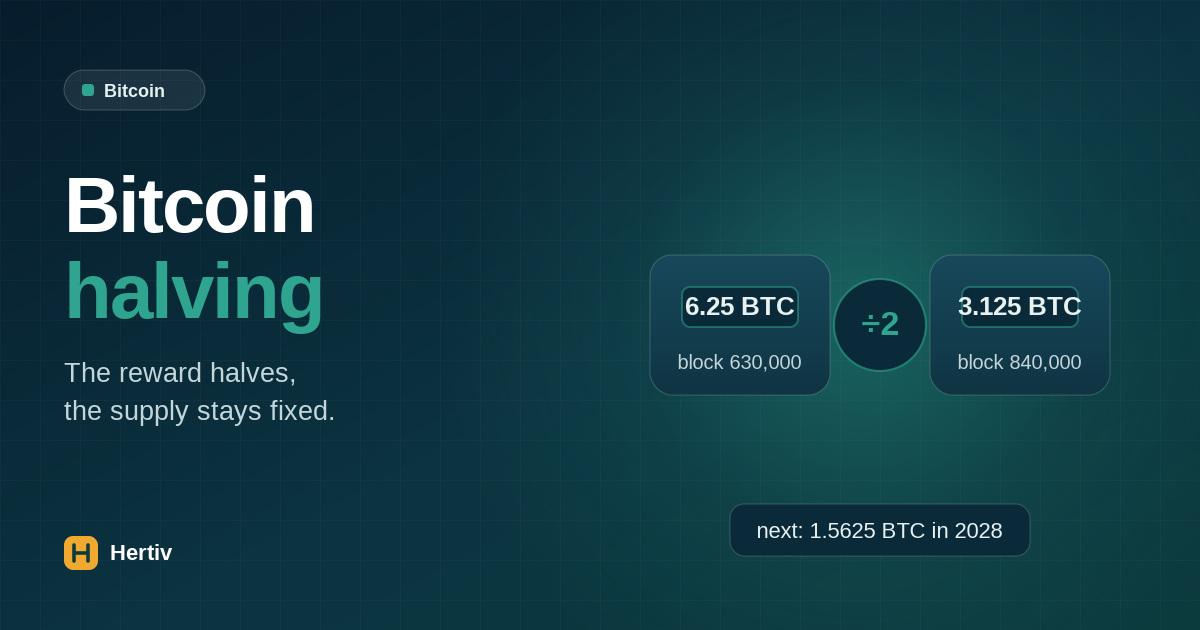
Four halvings have taken the reward from 50 to 3.125 bitcoin per block. The fifth, at block 1,050,000, will cut it to 1.5625 bitcoin.
Why does the reward halve?
The reward halves because Bitcoin has a fixed supply of 21 million coins, and the halving is the mechanism that spreads that supply over more than a century. Each halving slows the rate at which new coins enter circulation, so the supply grows more slowly over time.
The design also answers a practical question: how do you pay miners to secure the network before fees alone can do it? Early on, the block reward was the main payment, and it was large because few people held bitcoin. As the network grew, the reward could shrink, and fees were expected to take over a larger share of miner income.
That handover is gradual. Today, miners earn the 3.125 bitcoin subsidy plus the transaction fees attached to the payments in each block. The subsidy keeps halving until it reaches zero, around the year 2140, after which fees are the only miner income.
What does a halving mean for miners?
For miners, a halving cuts the new bitcoin they earn per block in half overnight, while their costs stay the same. A miner that earned 6.25 bitcoin per block before April 2024 earns 3.125 after it, for the same electricity and hardware.
Miners respond in a few ways. Efficient miners with cheap power keep running and take a larger share of the network. Less efficient miners switch off machines, sell hardware, or move to cheaper power. Some miners also earn more from fees when blocks are full, which softens the cut.
The practical effect is consolidation. After each halving, the share of mining done by the most efficient operators grows, and the network hash rate usually dips, then recovers as the remaining miners expand or new hardware arrives.
What does a halving mean for supply?
For supply, a halving cuts the flow of new bitcoin in half. With about 144 blocks a day, the April 2024 halving cut new supply from about 900 bitcoin a day to about 450. The 2028 halving will cut it again, to about 225 a day.
That matters because the total supply is fixed at 21 million. By the time of the fourth halving, about 19.7 million bitcoin had already been mined, leaving only a small share still to come. Each halving makes the remaining supply arrive more slowly.
It is worth keeping the size of the effect in proportion. A halving changes the flow of new coins, not the stock of coins already held. The stock is far larger than the flow, so the direct effect on supply is small in the short term and grows in importance only over years.
What happens at the next halving?
The next halving is expected around April 2028, when the chain reaches block 1,050,000. The reward will fall from 3.125 to 1.5625 bitcoin per block, and new supply will fall from about 450 to about 225 bitcoin a day.
The date is an estimate, not a fixture. Halvings are triggered by block height, and the calendar date moves with block times. If blocks arrive faster than ten minutes on average, the halving comes earlier; if they arrive slower, it comes later. Miners and holders can watch the block height to track the approach, since the height is public and the target block is fixed.
Nothing else changes at the halving. The rules for transactions, the block size and the fee market all stay the same. The only change is the subsidy paid to the miner of each new block.
Example (hypothetical): a miner plans for the 2028 halving
Example (hypothetical): a small mining business holds about 1 percent of the network hash rate. At the current rate of about 450 new bitcoin a day, it earns about 4.5 bitcoin a day in subsidy, before fees. That is 1 percent of 450.
After the 2028 halving, new supply falls to about 225 bitcoin a day, so the same 1 percent share earns about 2.25 bitcoin a day in subsidy. If the business wants the same bitcoin income, it needs to double its share of the network, earn more in fees, or cut its power cost per unit of computing power.
The plan writes itself from that arithmetic. The business checks its power contract, prices newer hardware, and decides whether to expand, hold steady, or wind down before the halving arrives, rather than reacting to it on the day.
What are the common mistakes?
Most mistakes about the halving come from treating it as a price event instead of a supply schedule. The halving is a known, dated rule, and markets have months to prepare for it. Treating it as a surprise leads to bad timing and bad decisions.
- Expecting the price to move on the halving day itself
- Confusing the block reward with the total miner income, which includes fees
- Assuming the halving date is fixed, when it moves with block times
- Forgetting that the subsidy falls to zero around 2140, leaving fees as the only income
- Buying mining hardware right before a halving without checking the payback period after it
- Reading past halving cycles as a promise about the next one
For how Bitcoin scales beyond the base chain, Bitcoin Layer 2 explains the networks built on top of it.
The Taproot upgrade changed how Bitcoin transactions work; see the Bitcoin Taproot upgrade for what it changed.
Key takeaways
- The halving cuts the block reward in half every 210,000 blocks, about every four years.
- Four halvings have cut the reward from 50 to 3.125 bitcoin per block.
- The next halving is expected around April 2028, at block 1,050,000.
- Miners earn the subsidy plus fees, and fees matter more after each halving.
- The fixed 21 million supply is what the halving schedule enforces.
Frequently asked questions
When was the last Bitcoin halving?
The most recent halving was on 20 April 2024, at block 840,000. It cut the block reward from 6.25 to 3.125 bitcoin per block, and the next halving is expected around April 2028 at block 1,050,000.
When is the next Bitcoin halving?
The next halving is expected around April 2028, at block 1,050,000, when the reward will fall from 3.125 to 1.5625 bitcoin per block. The exact date moves with block times.
Does the halving change Bitcoin transaction fees?
No, not directly. Fees are set by demand for block space, not by the subsidy. After a halving, fees become a larger share of miner income, which is why full blocks matter more.
How many bitcoins are left to mine?
About 19.7 million of the 21 million cap had been mined by the April 2024 halving. The rest will arrive slowly, with the last fraction mined around the year 2140.
Do halvings make Bitcoin more valuable?
A halving cuts the flow of new coins, which can support the price over time, but it does not guarantee anything. Demand, fees, regulation and the wider market all matter more than the schedule alone.
What happens when the block reward reaches zero?
Around 2140 the subsidy ends and miners will earn only transaction fees. Whether that is enough to secure the network depends on fee demand at the time, which nobody can know today.


