Bitcoin Taproot Upgrade: What Changed and Why It Matters
Taproot activated on Bitcoin in November 2021 and changed how complex transactions work, bringing Schnorr signatures, smarter scripting and better privacy.
On this page
Short answer
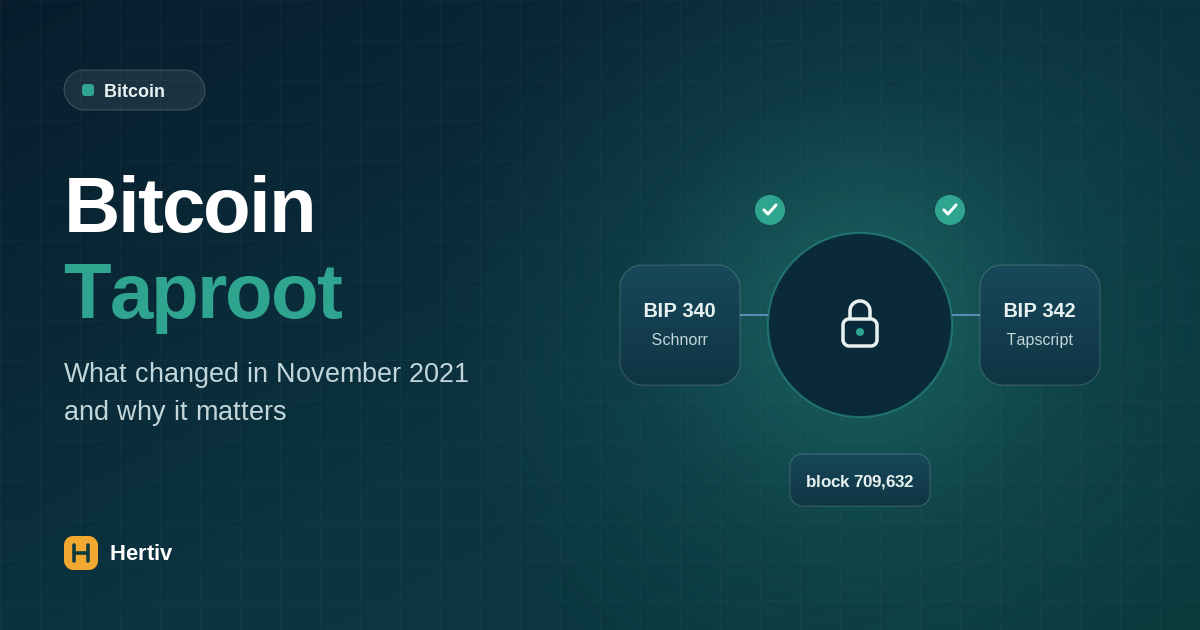
The Bitcoin Taproot upgrade is a soft fork that activated on 14 November 2021 at block 709,632. It bundles three proposals, Schnorr signatures, Taproot outputs and Tapscript, which together make complex transactions cheaper, more private and easier to build.
What is the Bitcoin Taproot upgrade?
The Bitcoin Taproot upgrade is a soft fork, a backwards-compatible change to Bitcoin's rules, that activated on 14 November 2021 at block 709,632. It is the first major protocol upgrade since SegWit in 2017, and it changes how Bitcoin handles signatures and spending conditions.
Taproot is actually three proposals that shipped together. BIP 340 adds Schnorr signatures, a new signature scheme. BIP 341 defines Pay-to-Taproot, a new output type with addresses that start with bc1p. BIP 342 adds Tapscript, an updated scripting language for those outputs.
The idea behind Taproot is simple: a complex transaction, such as a multi-signature wallet spend, should look like an ordinary payment on the public ledger. Before Taproot, the spending conditions were visible. After Taproot, they usually stay hidden unless they are needed.
Taproot was proposed by Bitcoin Core developer Greg Maxwell in January 2018, merged into Bitcoin Core in October 2020, and activated through a process called Speedy Trial, in which miners signalled support until 90% of blocks in a retarget period backed the change.
What are the three parts of Taproot?
The three parts of Taproot each solve a different problem, and they only work well together. Schnorr signatures make signing more efficient, Taproot outputs hide spending conditions, and Tapscript gives developers a cleaner language for writing them.
| Proposal | What it adds | Main benefit |
|---|---|---|
| BIP 340: Schnorr | Schnorr signatures replace ECDSA for Taproot outputs | Smaller, faster signatures that can be combined |
| BIP 341: Taproot | Pay-to-Taproot outputs and Merkle trees of scripts | Complex spends look like simple payments |
| BIP 342: Tapscript | Updated scripting language for Taproot paths | Cleaner rules and room for future upgrades |
Schnorr signatures are the foundation. Unlike the older ECDSA scheme, Schnorr signatures can be added together, so several signatures become one. That property is what lets a group of signers produce a single signature that looks exactly like one person's signature.
How do Schnorr signatures help?
Schnorr signatures help Bitcoin by making signatures smaller, faster to verify and combinable. A Schnorr signature is 64 bytes, and because the scheme is linear, multiple public keys and signatures can be combined into one key and one signature.
The practical effect is visible in multi-signature wallets. Before Taproot, a three-of-five multi-signature spend published three signatures and revealed the wallet's structure on chain. With Schnorr and a scheme called MuSig2, the same spend can publish one signature, which costs less in fees and reveals nothing about how many people signed.
There is also a privacy benefit for ordinary users. Since a cooperative multi-signature spend looks identical to a single-key spend, an observer cannot tell from the transaction alone whether one person or a group authorised it.
Schnorr signatures also remove a long-standing problem called signature malleability for Taproot outputs, which makes it easier to build protocols on top of Bitcoin that depend on transaction IDs staying fixed.
How does Taproot hide spending conditions?
Taproot hides spending conditions with a Merkle tree of scripts, known as MAST. A Taproot output commits to a single internal key and, optionally, a tree of alternative scripts, such as a time-locked backup or a different multi-signature rule.
When the output is spent, only one path is revealed. If everyone cooperates, the output is spent with the key path: a single signature, with no script published at all. If cooperation fails, the spender reveals one script from the tree plus a short proof of its position, and the other branches stay hidden.
This matters because it keeps the common case cheap and private. A wallet with a normal path, a recovery path and an inheritance path pays the cost of a simple payment when the normal path is used, and nobody on the network learns that the other paths exist.
For a broader view of how Bitcoin scales beyond the base layer, see what is Bitcoin Layer 2, which covers the networks built on top of these primitives.
What is Tapscript and what does it change?
Tapscript is the updated scripting language that applies when a Taproot output is spent through a script path. It replaces some of Bitcoin Script's older rules with cleaner ones and adds new operations, most notably CHECKSIGADD, which makes multi-signature checks simpler to write.
Tapscript also removes the old size limit on individual scripts. That change had an unexpected result: in 2023, the Ordinals protocol used it to store data, such as images, in the witness part of a transaction, which created a new wave of Bitcoin-based collectibles and renewed debate about what the network is for.
For developers, Tapscript adds room for future upgrades through OP_SUCCESS opcodes, which let new rules be introduced as soft forks without breaking old software. Taproot was designed so the next upgrade would be easier than the last one.
The upgrade did not change Bitcoin's supply, its block time or its consensus rules for ordinary payments. Old wallets and nodes keep working, which is the point of a soft fork: new rules are stricter, so old software still accepts the blocks new software produces.
What does Taproot mean for users and developers?
For users, Taproot mostly means lower fees on complex transactions and better privacy by default. A multi-signature wallet spend, a Lightning channel close or a time-locked contract now costs less data and reveals less about how the wallet is set up.
For developers, Taproot opened the door to more capable Bitcoin applications. Smart contracts that were awkward or expensive before, such as discreet log contracts and more flexible multi-signature setups, became practical to build, and the new scripting rules made them easier to reason about.
Adoption has been gradual rather than instant. Wallets, exchanges and custody providers added Taproot support over the years after activation, and the share of Taproot outputs on the network grew slowly as the tooling caught up. A protocol upgrade only helps when the software people actually use supports it.
Developers building on the second layer should also read top Bitcoin Layer 2 solutions, since most Taproot-powered applications live there rather than on the base chain.
Example (hypothetical): a company wallet moves to Taproot
Example (hypothetical): a small company holds its treasury in a three-of-five multi-signature wallet, with five directors each holding a key. Before Taproot, every spend published three signatures and revealed the wallet's structure, and each spend cost more in fees because of the extra data.
The company moves to a Taproot wallet. The five directors agree on a combined key, so the normal spend path is a single signature from that key. The wallet also commits to a backup script path that lets any three directors spend after a 30-day time lock, in case the combined key is lost.
In the normal case, a payment now looks like any other single-key payment: one signature, no script published, and no observer can tell it is a company wallet. If the combined key is ever lost, the directors use the backup script path instead, revealing only that one script and its proof.
The numbers are small but real. A three-signature spend carries roughly three times the signature data of a one-signature spend, so the Taproot version uses less block space and pays a lower fee for the same payment. The privacy gain, hiding the wallet structure, is the larger benefit.
What are the common mistakes?
The most common Taproot mistakes are assuming every wallet supports it, treating Taproot addresses as identical to older SegWit addresses, and expecting the upgrade to change Bitcoin's fees or speed on its own.
- Sending to an unsupported wallet. Some older wallets cannot spend from Taproot addresses, so check support before moving funds.
- Confusing address types. Taproot addresses start with bc1p, while SegWit addresses start with bc1q. They are different output types with different rules.
- Expecting instant fee drops. Taproot lowers fees for complex transactions, not for simple payments, which were already cheap in data terms.
- Ignoring the Ordinals debate. Taproot's script-size change enabled data inscriptions, which some users welcome and others see as spam. Know where your team stands before building on it.
- Skipping key management. A combined key is still a single point of failure for the normal path, so backup paths and recovery plans matter more, not less.
For the collectibles side of the Taproot story, what are Bitcoin Ordinals explains how inscriptions use the new script rules.
Key takeaways
- Taproot activated on 14 November 2021 at block 709,632 as a soft fork
- It bundles three proposals: Schnorr signatures, Taproot outputs and Tapscript
- A cooperative multi-signature spend looks like a single-key payment
- Only the script path used is revealed; the other branches stay hidden
- Adoption was gradual, because wallets and exchanges had to add support
Frequently asked questions
Is Taproot a hard fork?
No. Taproot is a soft fork, which means it tightens the rules in a backwards-compatible way. Old nodes still accept blocks produced under the new rules, so the network did not split and nobody was forced to upgrade at activation.
What is the difference between Taproot and SegWit?
SegWit, activated in 2017, changed how transaction data is stored and fixed transaction malleability. Taproot, activated in 2021, builds on SegWit by adding Schnorr signatures, a new output type and an updated scripting language for more private and flexible transactions.
Do Taproot addresses start with bc1p?
Yes. Pay-to-Taproot addresses start with bc1p, while SegWit version 0 addresses start with bc1q. The prefix tells wallets which spending rules apply, so sending to the wrong address type can fail or, in the worst case, strand funds.
Does Taproot make Bitcoin transactions cheaper?
It makes complex transactions cheaper in data terms, because a multi-signature spend can publish one signature instead of several. Simple payments see little change, since they were already a single signature before Taproot.
What is MAST in Taproot?
MAST, or Merkleized Alternative Script Trees, is the structure that lets a Taproot output commit to several alternative spending scripts in a single hash. Only the script actually used is revealed when the output is spent, so the other conditions stay private.
Can I still use my old Bitcoin wallet after Taproot?
Yes. Taproot did not break existing wallets, addresses or transactions. Older wallets keep working exactly as before, and you only need Taproot support if you want to receive or spend from Taproot addresses.


