What Banking in the Metaverse Means for Customers
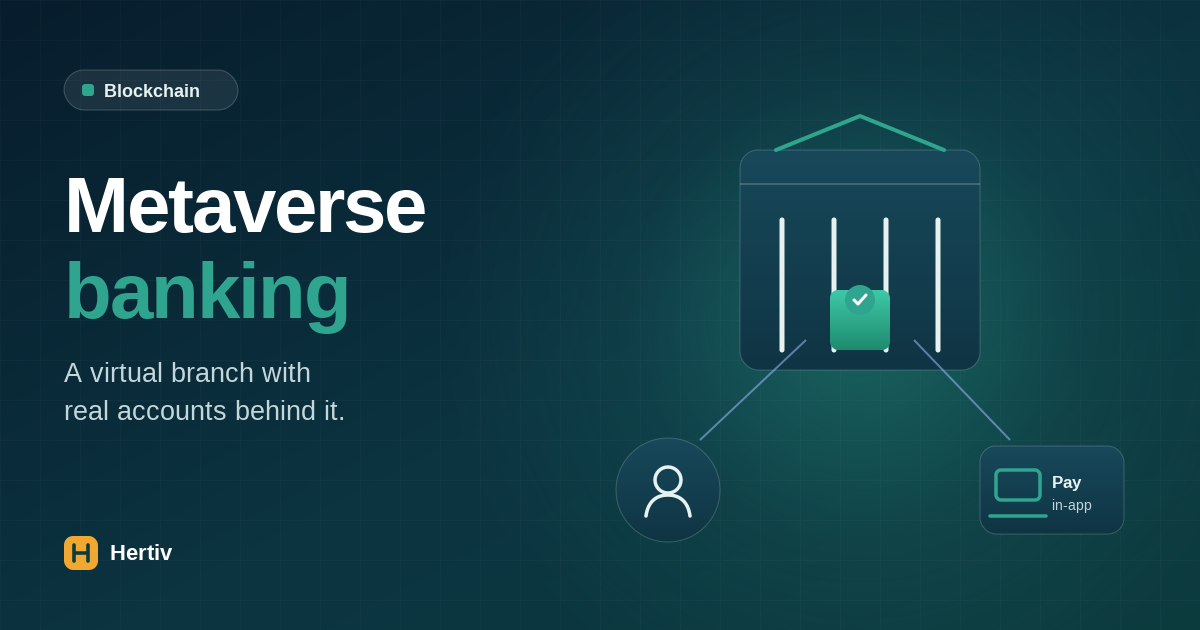
Banking in the metaverse means a bank offers services inside a 3D virtual world, where customers meet advisers as avatars. Here is what a virtual branch covers.
On this page
Short answer
Banking in the metaverse means a bank offers services inside a shared 3D virtual world, where a customer walks into a virtual branch as an avatar, talks to an adviser, and opens an account or arranges a loan. The branch is a digital space rather than a building, and the money still moves through the bank's normal accounts and payment rails. It is a new front door, not new money.
What does banking in the metaverse mean?
Banking in the metaverse means a bank offers its services inside a shared 3D virtual world, where a customer enters as an avatar and walks into a virtual branch. The customer can talk to an adviser, ask about a loan or an account, and attend a financial workshop. The money still moves through the bank's normal accounts, so the metaverse is a new front door rather than a new kind of money.
A virtual branch is not a game. It is a space the bank designs for the same reasons it designs a high-street branch: to be found, to be trusted, and to make a conversation easy. The difference is that the customer reaches it from a headset or a screen, and the branch can change its layout for each visitor, showing mortgage help to one person and business banking to another.
| What the bank offers | What the customer does | What stays the same |
|---|---|---|
| Virtual branch | Enters as an avatar and meets an adviser | Accounts, checks and contracts |
| Adviser avatar | Asks questions by voice or chat | The adviser is a real person |
| Events and classes | Attends workshops on money topics | The content is the bank's own |
| Payments and wallets | Pays through the bank's app or card | Normal payment rails and rules |
For the background on virtual worlds themselves, see what the metaverse is and how it works.
What can you do in a virtual bank branch?
In a virtual branch you can do most of what a visit to a branch covers: open an account, ask about a mortgage or a business loan, review a savings plan, and get help with a card or a payment. The adviser appears as an avatar, and you can share documents on a virtual screen while you talk. The conversation is the point; the 3D setting is just the room it happens in.
- Open an account with identity checks. The checks are the same as in a branch, done through a secure screen.
- Ask about a mortgage or loan. The adviser can show rates, deposits and monthly costs on a shared screen.
- Review savings and investments. Your portfolio and goals are shown in the same place as the conversation.
- Get help with cards and payments. Lost cards, disputed payments and limits can be sorted in the room.
- Attend a class on budgeting or fraud. Short workshops run in the same space as the branch.
Identity checks still happen the normal way. A virtual branch does not remove the need to prove who you are; it usually adds a step, because the bank must link your avatar to your real account. Expect the same documents and the same checks as a branch visit, done through a secure screen rather than across a desk.
How do payments work in a virtual world?
Payments in a virtual world work in two ways. In most bank-run spaces, you pay with normal money through the bank's own app or card, and the virtual world is only where you agree the payment. In some worlds, people also pay with crypto tokens or in-world currencies, which the bank may accept, convert, or simply warn you about. The bank's job is to make the payment safe either way.
If the payment runs through crypto rails, the bank needs the same controls as any other crypto payment, which is where crypto payment gateway controls come in.
The risk is confusion. A customer who buys a virtual item with tokens may not realise the tokens have a real price that moves. A good virtual branch states the price in normal money as well as tokens, and asks for a clear confirmation before any payment leaves the account.
Example (hypothetical): a virtual mortgage appointment
Example (hypothetical): a customer meets a mortgage adviser in a virtual branch to talk about a $400,000 home. The adviser shows the deposit, the loan and the monthly cost on a shared screen, and the customer asks questions by voice while looking at the same numbers. The meeting takes 40 minutes, and the customer books a follow-up before leaving the virtual room.
The numbers on the screen are simple. A 20% deposit on $400,000 is $80,000, so the loan is $400,000 - $80,000 = $320,000. At 6% a year, the interest on $320,000 is $19,200 a year, or $1,600 a month. The customer sees the same figures they would see in a branch, and the adviser explains what changes if the rate moves.
Nothing about the mortgage itself changes. The application, the credit check and the contract are the same as in a branch; only the room is different. That is the honest test of a virtual branch: if it does not make the decision clearer, it is decoration.
What are the risks and limits?
The risks of banking in the metaverse are familiar ones in new clothes. Identity theft, fraud and misleading sales do not disappear in a virtual world, and a friendly avatar is no proof that the person behind it works for the bank. A virtual branch must prove it is the real bank, through a link from the bank's own site or app, before a customer shares anything.
- Fake branches that copy a bank's look. A space can copy logos and colours without being the bank.
- Avatars that hide who is really talking. The person behind the avatar may not be who they claim to be.
- Token prices that move fast. A price in tokens can change between agreeing and paying.
- Access for people without headsets. A branch that needs a headset leaves out most customers.
- Privacy of voice and movement data. A virtual room can record far more than a phone call.
Access is the quiet limit. A virtual branch that needs a headset leaves out customers who do not own one, so banks that take this seriously also offer the same service on a normal screen. If a service only works in a headset, it is a demo, not a branch.
What are the common mistakes?
The most common mistakes banks make in the metaverse are building a branch nobody visits, copying a physical branch into 3D without asking what customers need, and treating a virtual space as a marketing stunt rather than a service.
- Building before asking customers what they want. A branch nobody asked for stays empty.
- No clear link from the bank's site or app. Customers cannot tell the real branch from a copy.
- No human help when the avatar cannot answer. A scripted avatar that cannot hand over to a person is a dead end.
- Token prices shown without normal money. Customers cannot judge a price they cannot convert.
- No plan for fraud and complaints. A virtual branch needs the same complaint path as a real one.
A second mistake is measuring success by visits. A virtual branch that gets thousands of curious visitors and no completed applications has not worked. The measures that matter are the same as in a branch: questions answered, applications started, and problems solved.
How should you use a virtual bank branch safely?
You should use a virtual bank branch the way you would use any new banking channel: start from the bank's own app or site, check the address, and never share passwords or codes with an avatar. A real bank will never ask for your password in a virtual world, and it will never rush you into a payment.
If something feels off, leave the virtual room and call the bank on the number on your card.
- Start from the bank's own app or site. Follow its link to the virtual space, never a link from a message.
- Check the branch address and the adviser. Confirm the space and the person before you share anything.
- Never share passwords or codes. No adviser in any world needs your password.
- Confirm prices in normal money. Ask for the price in your own currency before you agree to pay.
- Keep a record of what was agreed. Save the summary, the reference number and the follow-up date.
The safest habit is to treat the virtual branch as a place to learn and ask, and to sign the important papers through the bank's normal channels. A mortgage or a loan agreement deserves the same care in a virtual world as it does in a branch.
To see how banks already use blockchain behind the scenes, read blockchain in banking.
Key takeaways
- Banking in the metaverse is a virtual branch, not a new kind of money
- Customers can open accounts, ask about loans and attend classes as avatars
- Payments still run through normal accounts, or through crypto rails with the same controls
- A virtual branch must prove it is the real bank before you share anything
- The honest test is whether the virtual room makes a decision clearer
Frequently asked questions
Is banking in the metaverse real banking?
Yes, when the branch belongs to a real bank. The accounts, the checks and the contracts are the same as in a physical branch; only the room is virtual. A space that is not linked from the bank's own site or app should be treated as unproven until the bank confirms it.
Do I need a headset to use a virtual bank branch?
Usually not. Most bank-run virtual spaces also work on a normal screen, because a branch that needs a headset leaves out most customers. If a service only works with a headset, treat it as a demo rather than a full branch.
Can I open an account in the metaverse?
Yes, in branches that offer it, but the identity checks are the same as in a physical branch. You will still need to prove who you are and link the avatar to your real identity, usually through documents and a secure check inside the bank's own systems.
How do I know a virtual branch is really my bank?
Start from the bank's own app or website and follow its link to the virtual space. A real bank will never ask for your password inside a virtual world, and it will never rush you into a payment. If in doubt, leave and call the bank on the number on your card.
Can I pay with crypto in a virtual bank branch?
It depends on the bank and the world. Some spaces accept tokens or in-world currencies, while others only take normal money through the bank's own app or card. A good branch shows the price in normal money as well as tokens, and asks for a clear confirmation before payment.
What is the point of a bank in the metaverse?
The point is a conversation without a visit: an adviser, a shared screen and a room you can enter from home. It suits customers who want help but cannot reach a branch. If the virtual room does not make a decision clearer, it is decoration rather than a service.


