How Asset Tokenization Works in Gaming
Asset tokenization turns in-game items into tokens players can own, trade and sell outside the game. Here is how it works and where it goes wrong.
On this page
Short answer
Asset tokenization in gaming means recording an in-game item, such as a weapon, skin or plot of land, as a token on a blockchain, so the player owns it outside the game's own database. The token proves who owns the item, lets the player trade or sell it on a marketplace, and lets the game take a fee on each resale.
What is asset tokenization in gaming?
Asset tokenization in gaming is the process of recording an in-game item as a token on a blockchain. A sword, a skin, a character or a plot of virtual land becomes a token with a unique record, and the player who holds the token owns that item. The item still only works inside the game that issued it, but the record of ownership lives on a public chain instead of only in the game's database.
The idea matters because most games keep items locked inside one account. A player who spends months earning a rare weapon cannot sell it, lend it or move it to another game. Tokenization changes the record, not the item itself: the game still decides what the weapon does, while the token decides who owns it and whether it can change hands.
This is different from simply selling items in a shop. A shop sale is a database entry the studio can change or delete. A token is a record on a chain that the studio cannot silently rewrite, which is why players trust it more. For the general idea behind the method, see how tokenization works.
What can be tokenized in a game?
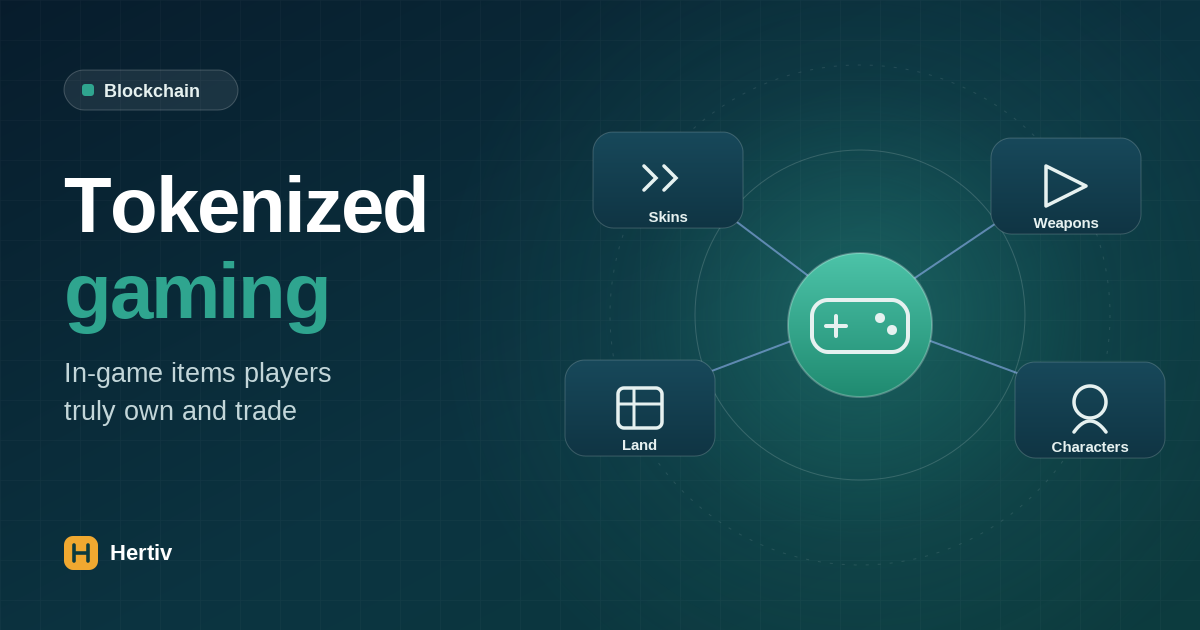
Almost any item with a clear identity can become a token. The table below shows the common types, what the token records, and what a player can do with each one.
| Asset type | What the token records | What the player can do |
|---|---|---|
| Cosmetic skins | Which skin, and who owns it | Wear it, trade it, sell it |
| Weapons and gear | The item and its stats | Use it, lend it, sell it |
| Virtual land | The plot and its location | Build on it, rent it, sell it |
| Characters and pets | The character and its history | Play it, lend it, sell it |
| In-game currency | The amount held | Spend it, send it, cash it out |
Cosmetics and gear are the easiest starting point, because they are already unique items with a price in the game's own shop. Land and characters are harder, because their value depends on the game's rules and on whether other players want them. Currency is usually a fungible token, which means every unit is the same, while items are usually non-fungible, which means each one is unique.
A studio should tokenize only items players already value. Tokenizing a common item nobody wants adds cost without adding demand, and a marketplace full of worthless tokens teaches players to ignore the feature. Start with the items players already trade, ask about or show off.
How does tokenization work in a game?
Tokenization works in five steps, and most of the work sits in the game's own servers rather than on the chain. The chain only stores the ownership record; the game stores the item's art, stats and rules.
- Define the asset. Decide which items become tokens, what makes each one unique, and how many of each type can exist.
- Pick a chain and a token standard. Use a chain players already use and a standard their wallets support, so nobody needs a new wallet to take part.
- Mint the token. When a player earns or buys the item, the game creates a token and sends it to the player's wallet.
- Link the token to the item. The token points to the item's data, so the game knows which token stands for which sword, skin or plot.
- Open a marketplace. Let players list, buy and sell tokens, with the game taking a small fee on each trade.
The link between token and item is the part teams get wrong most often. The token points to the item's data, usually through a record the game controls. If the game shuts down, the token may still exist on the chain, but the item it points to stops working. Players should know this before they pay: a token proves ownership of a record, not a promise that the game will run forever.
Most games use an existing chain and a standard token format instead of building their own. That keeps costs down and lets players use wallets they already own. A game that mints on a chain nobody uses forces every player to learn a new wallet, which kills adoption before the first sale.
What changes for players?
For players, the main change is that items become property they can move. A player can sell a weapon to another player, lend a character to a friend, or keep an item after leaving the game, instead of losing everything when the account closes. That is the promise that makes tokenization attractive to players who spend real money on games.
The second change is price discovery. When items trade on an open marketplace, players can see what an item is actually worth instead of guessing from the game's shop price. Rare items can gain value, and common items can fall to almost nothing, which teaches players quickly which items are worth chasing. For how this plays out in practice, see the factors that drive NFT gaming platforms.
The third change is risk. A tokenized item can be stolen if a player's wallet is compromised, and a scam marketplace can sell fake items. Players need a safe wallet, a way to check that an item is genuine, and a clear warning that items can lose value. A game that skips these steps will lose players faster than it gains them.
How do games earn from tokenized assets?
Games earn from tokenized assets in three ways: the first sale, a fee on each resale, and the extra spending that real ownership encourages. The first sale is the simplest: the game sells the item as a token instead of as a database entry, and keeps the money. The resale fee is the new part: every time the item changes hands on a marketplace, the game takes a small percentage.
A resale fee of 5% sounds small, but it adds up when items trade often. A weapon that sells ten times at $20 each earns the game $10 in fees on top of the first sale.
The fee also gives the game a reason to keep the marketplace honest, because a marketplace players trust generates more trades. The exact fee is a design choice, and setting it too high pushes trading to places that do not pay it.
The third source of income is harder to measure but often larger. Players who truly own their items tend to spend more on them, because the money is not lost when they stop playing. That only works if the game stays fun: tokenization cannot save a game nobody wants to play, and players can tell the difference between ownership and a sales pitch.
Example (hypothetical): a 10,000-player game
Example (hypothetical): a game with 10,000 active players tokenizes its weapon skins. In the first month, 2,000 players buy a skin for $10 each, which is $20,000 in first sales. The game also takes a 5% fee on resales, and 500 skins change hands at an average of $12 each, which is $6,000 in trades and $300 in fees.
Trading grows over the next five months to an average of 1,500 resales a month at $12 each. That is $18,000 a month in trades, and 5% of that is $900 a month in fees, or $4,500 over five months. Added to the $300 from the first month, fees total $4,800, and the game has earned $24,800 from the skins in six months.
The numbers are assumptions, not a promise. They show the pattern: first sales pay for the launch, and resale fees pay for the long term, but only if players keep trading. If trading stops, the fee income stops with it, which is why the game itself has to stay worth playing. For a wider view of tokenized assets, see real-world asset tokenization use cases.
What are the common mistakes?
The most common mistakes are tokenizing items nobody wants, promising ownership the game cannot deliver, and setting fees that push players away.
- Tokenizing everything. Not every item deserves a token. Tokenize the items players already value, and leave the rest as ordinary game data.
- Promising items work forever. A token survives the game, but the item does not. Be honest that the item only works while the game runs.
- Ignoring wallet safety. Players lose items when wallets are compromised. Teach safe wallets and check that marketplace listings are genuine.
- Setting fees too high. A large resale fee drives trading to marketplaces that do not pay the game at all.
- Treating token sales as the game. Players come for the game, not the tokens. If the game is not fun, no token will save it.
- No plan for scams. Fake items and copycat marketplaces appear fast. The game needs a way to mark genuine items and warn players.
Key takeaways
- Asset tokenization records an in-game item as a token on a blockchain, so the player owns it outside the game's database
- Skins, weapons, land, characters and currency can all be tokenized, but only items players already value are worth it
- The chain stores ownership; the game stores the item's art, stats and rules
- Games earn from the first sale, a fee on each resale, and the extra spending real ownership encourages
- A token proves ownership of a record, not a promise that the game will run forever
Frequently asked questions
What does it mean to tokenize a game item?
Tokenizing a game item means recording it as a token on a blockchain, so the token, not just the game's database, says who owns it. The item still only works inside the game that issued it, but the player can trade or sell the token on a marketplace.
Do players really own tokenized items?
Players own the token, which is a record of ownership on a public chain. They do not own the game, the art files or the servers, so the item only works while the game runs. Ownership of the token is real, but it is not ownership of the game itself.
Can tokenized items be used in other games?
Usually not. An item's stats, art and rules belong to one game, so another game would have to support it on purpose. A few games share items by agreement, but that is rare, and players should not buy an item expecting it to work elsewhere.
How do games make money from tokenized items?
Games earn from the first sale of the item, a small fee on each resale on the marketplace, and the extra spending that comes when players feel they own what they buy. The resale fee is the new part: without tokenization, the game earns nothing when players trade.
What happens to my items if the game shuts down?
The tokens stay on the chain, because the chain does not shut down with the game. But the items they point to stop working, since the game servers that run them are gone. A token is a record of ownership, not a guarantee that the game will keep running.
Are tokenized game items a good investment?
They are not a safe investment. Item prices rise and fall with the game's popularity, and a game that loses players can leave its items worth almost nothing. Buy items because you want to use them in the game, not because you expect them to gain value.


