AI Trading Agents: How They Decide, Trade and Stay Safe
AI trading agents watch markets, decide what to buy or sell, and place orders on their own. Learn how they work, where they help, and the guardrails they need.
On this page
Short answer
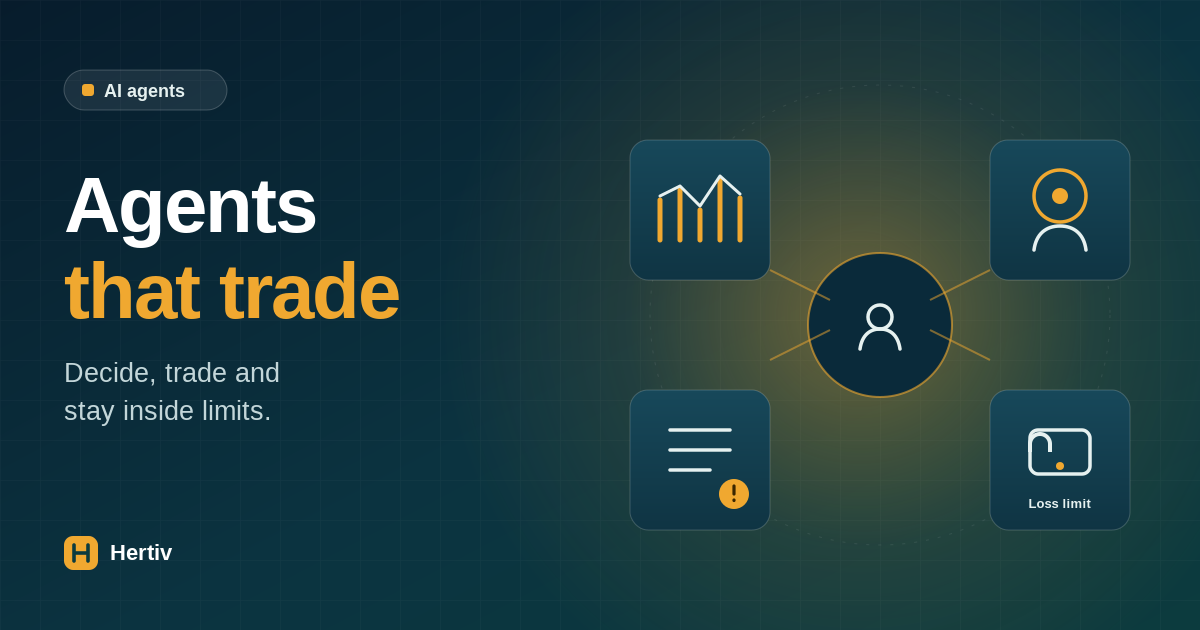
An AI trading agent is software that watches market data, decides what to trade, and places orders without a person approving each one. Unlike a fixed trading rule, it adapts its decisions as conditions change, within limits its owner sets in advance.
What is an AI trading agent?
An AI trading agent is software that watches market data, decides what to buy or sell, and places orders on its own, inside limits set by its owner. It combines a model that reads the market with a set of rules that say what it may and may not do.
An agent differs from a fixed trading rule in three ways:
| Feature | Fixed rule | AI trading agent |
|---|---|---|
| Decisions | Same trigger every time | Adapts to new patterns |
| Inputs | Price and volume only | Price, news and sentiment too |
| Actions | One order per trigger | Plans a sequence of orders |
| Learning | Only when a person changes it | Updates as new data arrives |
The agent is not a person and it does not understand markets. It finds patterns in data and acts on them, which works until the pattern breaks. That is why every serious agent runs inside hard limits: maximum position size, maximum daily loss, and a list of instruments it may touch.
How does an AI trading agent decide what to trade?
An AI trading agent decides in a loop: it reads data, scores the opportunity, checks its limits, and only then places an order. Each step is separate, so a failure in one step can be caught by the next.
First it gathers data: prices, volumes, order book depth, and sometimes news or public filings. Then the model scores what it sees, for example by estimating whether a price move is likely to continue or reverse. The score is not a prediction of the future; it is a pattern match against past data.
Before any order, the agent checks its limits. Is the position size within the cap? Would the trade breach the daily loss limit? Is the instrument on the approved list? If any check fails, the order is blocked and logged.
Finally it places the order, often in small pieces to avoid moving the price, and watches the fill. If the market moves against it beyond a set point, it closes the position rather than waiting and hoping.
What can an AI trading agent do on its own, and what stays with a person?
An AI trading agent can watch markets around the clock, react in seconds, and manage routine tasks such as rebalancing a portfolio or closing a position at a set loss. Those are jobs where speed and consistency matter more than judgement.
What stays with a person is everything that needs judgement: choosing the strategy, setting the limits, deciding which instruments are allowed, and judging whether the market regime has changed. A person also owns the kill switch and the decision to restart after a halt. For teams building these systems, AI agents for finance covers the control points that matter.
The split matters because the agent cannot tell when its own model has stopped working. A strategy that made money in a calm market can lose money fast in a volatile one, and only a person watching the results will notice the change.
A workable rule is that the agent acts inside a written plan, and anything outside the plan needs a person. If the agent wants to trade an instrument it has never traded, or size a position beyond the cap, it must stop and ask.
How do you test an AI trading agent before risking money?
You test an AI trading agent in three stages, and you do not skip any of them. Each stage catches a different kind of failure.
- Backtest on past data. Run the agent over historical prices and check returns, drawdowns and how often it trades. Watch for overfitting: a strategy tuned to past data often fails on new data.
- Paper trade live. Run the agent against live prices with fake money. This tests the data feed, the order logic and the speed of decisions without risk.
- Trade small and real. Start with a tiny amount of real money, because real fills, fees and slippage differ from paper trading. Only scale up after weeks of stable results.
Keep a fixed test set that the agent has never seen during tuning, and judge it on that set. If the results on unseen data are far worse than on the tuning data, the strategy is fitted to the past, not built for the future. For the broader picture of algorithmic trading, see how AI powers algorithmic trading.
What are the risks of AI trading agents?
The risks of AI trading agents are model failure, data failure, and loss of control. Each one needs its own guardrail, because they fail in different ways.
Model failure happens when the market changes and the patterns the agent learned stop working. A model trained on calm markets can misread a volatile one, and it will keep trading with confidence while it is wrong.
Data failure happens when a feed is late, wrong or missing. An agent trading on stale prices can place orders at prices that no longer exist, and a missing feed can leave it blind while positions are open.
Loss of control happens when the agent trades faster than a person can follow, or when several agents react to each other and amplify a move. Hard limits on position size, daily loss and trading speed are the main defence, along with a kill switch that a person can hit in seconds.
Fees and taxes are a quieter risk. An agent that trades often can rack up fees that eat the gains, and short-term trades are often taxed differently from long-term holdings. Check both before scaling up. Crypto agents face the same issue, and building a crypto trading bot shows how fees and fills behave in practice.
Example: a small fund tests an AI trading agent
Example (hypothetical): a small fund wants an agent to trade one liquid stock index future. It sets a starting capital of $100,000, a maximum position of $20,000, and a daily loss limit of $1,000. The agent may only trade during market hours.
In backtesting over two years, the agent returns about 8% a year with a worst drawdown of 4%. The fund then paper-trades it for six weeks, and the results are close to the backtest, so it starts live trading with $10,000, one tenth of the planned capital.
In the first live month, the agent makes $300 after fees, but one day it loses $600 in an hour when a news event moves the market. The loss is inside the $1,000 daily limit, so the agent stops for the day as designed. The fund keeps it at $10,000 for two more months before deciding whether to scale up.
The lesson is the process, not the return: limits, paper trading, small live size, and a decision rule for scaling. The fund never judges the agent on one good week.
What are the common mistakes with AI trading agents?
The most common AI trading agent mistakes are trusting a backtest, skipping the kill switch, and letting the agent trade without limits.
- Trusting a backtest. A strategy tuned on past data often fails on new data. Judge it on data it has never seen.
- No kill switch. Every agent needs a way for a person to stop it in seconds, and someone watching who can use it.
- No position or loss limits. An agent without hard caps can lose more in an hour than a person would risk in a month.
- Ignoring fees and slippage. Frequent trading looks profitable before fees; after fees it often is not.
- Letting it trade new instruments. An agent tuned for one market should not be pointed at another without fresh testing.
- No logging. If you cannot replay what the agent saw and did, you cannot find out why it lost money.
Key takeaways
- An AI trading agent decides, trades and manages positions inside limits its owner sets
- It adapts to new patterns, unlike a fixed rule, but it cannot tell when its model has stopped working
- Test in three stages: backtest, paper trade, then trade small and real
- Hard limits on position size and daily loss are the main defence against model failure
- Log every decision so you can replay what the agent saw and did
Frequently asked questions
What is the difference between an AI trading agent and a trading bot?
A trading bot usually follows fixed rules, such as buying when a price crosses a line. An AI trading agent uses a model to score opportunities and plans a sequence of actions, adapting as conditions change. Both need limits, logging and a kill switch, but the agent needs closer monitoring because its decisions are harder to predict.
Can an AI trading agent guarantee profits?
No. No agent can guarantee profits, and any claim that one can is a warning sign. Markets change, models fail, and fees eat returns. A serious agent is judged on risk-adjusted results over months, not on a single good week.
How much money do you need to start with an AI trading agent?
Start with an amount you can afford to lose, and only a fraction of what you plan to risk in total. Many teams start with a tenth of the planned capital, paper trade first, and scale up only after weeks of stable live results.
Do AI trading agents work in crypto markets?
They can, and crypto is where many agents are built, because markets run around the clock and data is easy to reach. The same rules apply: test in three stages, set hard limits, and watch fees. Crypto adds extra risks, such as exchange outages and thin order books.
What data does an AI trading agent need?
At minimum it needs reliable price and volume data, plus order book depth for the instruments it trades. Some agents also use news or public filings. The data feed must be fast and checked for gaps, because an agent trading on stale prices can place orders that no longer make sense.
Should I build or buy an AI trading agent?
Buying is faster, but you must be able to see what it does, set its limits and stop it. Building gives control but needs data, testing and monitoring that most teams underestimate. Either way, the guardrails matter more than the model.