How AI and Machine Learning Power Algorithmic Trading
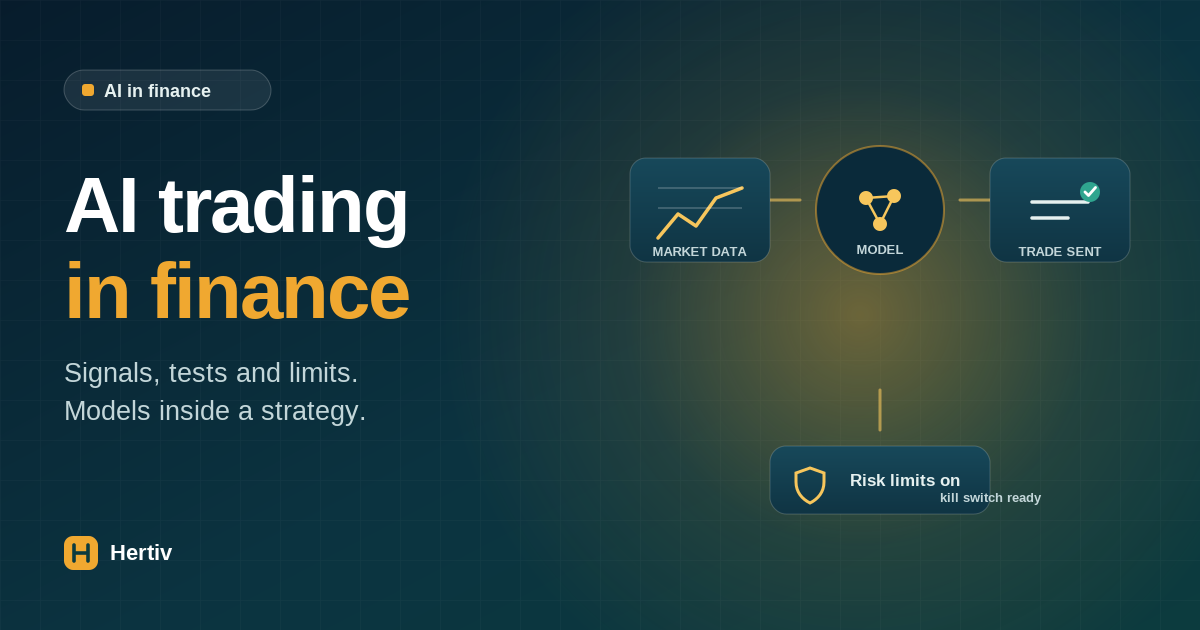
AI and machine learning help algorithmic trading scan data, rank trades and control risk, but only inside a tested strategy with hard limits.
On this page
Short answer
Algorithmic trading uses software to place orders from rules and learned patterns, and AI and machine learning add models that spot signals, time orders and flag risk faster than a human can. They work best inside a tested strategy with hard limits, clean data and a person who can stop the system.
What is algorithmic trading with AI and machine learning?
Algorithmic trading with AI and machine learning is the use of software that follows rules and learned patterns to place buy and sell orders without a human clicking each trade. The program watches market data, decides when a trade fits its rules, and sends the order to an exchange or broker.
Traditional algorithmic trading follows fixed rules written by a trader, such as buying when a price crosses its 50-day average. Machine learning adds models that learn patterns from past data, such as which combinations of price, volume and news have preceded a move. The model does not replace the strategy; it supplies signals inside a strategy a human still defines and controls.
These systems run in banks, funds, brokerages and retail trading platforms. A large fund might run hundreds of models across many markets, while a small team might run one model on one market. In both cases the same questions apply: what data feeds the model, how is it tested, and what stops it when it behaves badly?
Where do AI and machine learning help in a trading system?
AI and machine learning help most in the parts of trading where patterns repeat and humans are slow: scanning data, ranking opportunities, timing orders and watching risk. They help least where judgement, context and accountability matter, such as deciding how much capital a new idea deserves.
| Stage | What AI and machine learning do | What the human still does |
|---|---|---|
| Signal research | Tests many price, volume and news patterns at speed | Chooses which ideas are worth testing |
| Prediction | Estimates the chance of a move or a reversal | Decides whether the edge is real or an artefact |
| Execution | Splits large orders to reduce market impact | Sets size, timing and venue limits |
| Risk control | Flags unusual positions, volatility and exposure | Approves limits and can halt the system |
| Monitoring | Spots drift when a model stops behaving as expected | Investigates and retires models that decay |
Most production systems mix fixed rules with learned models. The rules enforce limits and logic that must never be broken, while the model ranks opportunities inside those limits. Predictive analytics covers the modelling patterns used at the signal stage in more depth.
What data and features feed the models?
The models are fed with market prices, traded volumes, order-book depth, company fundamentals, news text and macro indicators, turned into features the model can read. Common features include moving averages, volatility measures, volume ratios, price momentum and the gap between a price and its recent range.
Data quality decides more than model choice. Prices must be adjusted for splits and dividends, timestamps must line up across sources, and missing or bad ticks must be handled before training. A model trained on data with look-ahead errors, where future information leaks into the past, will look brilliant in testing and lose money live.
News and sentiment data add signal for some strategies, but they are noisy and need careful handling. A headline count is not the same as a price move, and sentiment scores from one provider rarely match another. Teams that use alternative data usually start with one source, measure whether it adds anything beyond price and volume, and only then add a second. Good data engineering is what makes this repeatable rather than a one-off experiment.
How to build a first algorithmic trading system
You build a first algorithmic trading system by starting with one simple, testable idea and adding controls around it, rather than by building a platform first and looking for a strategy later.
- Write the idea down in one paragraph. State what the model buys, when, why it should work, and what would prove it wrong.
- Gather clean, point-in-time data. Use data as it was known at each date, with no future information leaking in.
- Build the simplest model first. A moving-average rule or a small regression gives you a baseline that a fancier model must beat.
- Backtest on data the model has never seen. Keep a holdout period untouched until the idea is final.
- Paper trade it live. Run the system against real market data with fake money for several weeks to catch data and execution bugs.
- Go live small, with hard limits. Cap position size, daily loss and order rate, and give a named person the power to stop it.
Each step has a clear exit: if the idea fails the backtest, drop it and move on. Teams that skip the paper-trading step usually find their bugs with real money instead. Machine learning development covers the model-building and evaluation workflow in more depth.
How to test a strategy before risking money
You test a strategy with backtests on unseen data, walk-forward checks and paper trading, and you treat any result that skips these steps as unproven. A backtest replays the strategy over past prices to see how it would have performed, but past performance is only evidence when the test is honest.
| Test | What it catches |
|---|---|
| In-sample backtest | Whether the idea has any signal at all |
| Out-of-sample backtest | Overfitting to the data used for tuning |
| Walk-forward test | Whether the idea survives as markets change |
| Cost-adjusted test | Whether fees, spreads and slippage erase the edge |
| Paper trading | Live data, execution and infrastructure bugs |
Costs deserve their own test. A strategy that trades often can look profitable before fees and lose money after them, so include commissions, spreads and a slippage estimate in every backtest. A short AI proof of concept with a fixed evaluation set is a cheap way to test whether a trading idea is real before committing capital to it.
Example: a small fund tests a momentum idea
Example (hypothetical): a small fund tests a simple momentum idea on one market. The rule buys when a price closes above its 20-day average and sells when it closes below it, with a fixed position size and a daily loss limit.
Over a two-year backtest the system makes 100 trades. 55 trades win an average of $400 each, and 45 trades lose an average of $300 each. Gross profit is 55 times $400, which is $22,000, minus 45 times $300, which is $13,500, leaving $8,500. Fees are $12 per trade, so 100 trades cost $1,200, and net profit is $7,300 before tax and funding costs.
The fund then checks the same idea on the following year, which the model has never seen. The out-of-sample result is weaker but still positive, so the fund paper trades it for six weeks. Paper trading reveals that real fills are slightly worse than the backtest assumed, so the fund adds a slippage estimate and re-runs the test before going live with a small allocation.
What are the common mistakes?
The most common mistakes are overfitting to past data, ignoring trading costs, and running a model with no kill switch. Each of these is easy to make and expensive to learn from live.
- Overfitting. Tuning a model until it fits one historical period perfectly usually means it fits noise, not signal.
- Ignoring costs. Commissions, spreads and slippage can erase a small edge entirely, especially for strategies that trade often.
- No kill switch. A model that keeps trading during a data outage or a market shock can do more damage in an hour than a year of gains.
- Stale data. Models trained on old market behaviour decay as conditions change, so they need regular retraining and monitoring.
- No human oversight. Fully automated trading without a named owner who understands the strategy is a governance failure, not an efficiency gain.
- Scaling too fast. Doubling size after a good month doubles the losses when the edge fades.
Trading systems also need clear ownership of risk and compliance, which is where AI governance and your compliance team should be involved from the start.
Key takeaways
- Algorithmic trading places orders from rules; AI and machine learning add learned signals inside those rules
- Data quality and honest backtesting matter more than model choice
- Costs, slippage and spreads can erase a small edge, so test with them included
- Paper trading catches live data and execution bugs before real money is at risk
- Every live system needs position limits, a daily loss cap and a kill switch
- Models decay as markets change, so retrain and monitor them on a schedule
Frequently asked questions
What is the difference between algorithmic trading and AI trading?
Algorithmic trading is the broader term: any software that places orders from rules. AI trading is a subset that uses machine learning models to find signals or make predictions. Most production systems combine fixed rules for limits with learned models for ranking opportunities.
Do I need machine learning to trade algorithmically?
No. Many working strategies use fixed rules only, such as moving-average crosses or rebalancing. Machine learning is worth adding when you have a clear signal idea, clean data and a way to test whether the model beats a simple baseline.
How much data do you need to train a trading model?
It depends on the market and the time frame. Intraday models need large volumes of tick or minute data, while daily models can work with years of daily prices. More important than volume is cleanliness: point-in-time data with no future information leaking in.
Can AI trading models lose money suddenly?
Yes. Models can fail when market conditions change, when data feeds break, or when many systems trade the same signal at once. That is why live systems need position limits, daily loss caps, monitoring for drift and a kill switch a human can trigger.
What is backtesting, and why is out-of-sample testing important?
Backtesting replays a strategy over past prices to estimate how it would have performed. Out-of-sample testing checks it on data the model never saw during tuning, which catches overfitting. A strategy that only works in-sample is not evidence of an edge.
Is algorithmic trading legal for a small fund or individual?
In most markets it is legal, but exchanges, brokers and regulators set rules on order types, market manipulation and reporting. Check the rules for your market and broker before going live, and keep records of orders, fills and model changes.


