AI Transformation: What It Is and How to Run It
AI transformation rebuilds how a company works around AI, not just adding a chatbot. Learn what it covers, how it differs from digital change, and how to run it.
On this page
Short answer
AI transformation is the process of changing how a company operates, decides and serves customers by building AI into its core workflows, data and products. It is a multi-year programme that touches people, processes and technology, not a single tool or project.
What is AI transformation?
AI transformation is the process of changing how a company works by putting AI at the centre of its core workflows, decisions and products. It means redesigning processes around what AI can do, rather than adding a tool to a process that stays the same.
Five areas usually change together:
| Area | What changes | Example |
|---|---|---|
| Operations | Manual steps become AI-assisted | Invoice checks run without retyping |
| Customer service | Agents draft replies from your data | Tickets answered with cited sources |
| Products | AI features become part of the offer | Search that answers in plain words |
| Decisions | Reports give way to live analysis | Forecasts updated as orders arrive |
| People | Roles shift toward review and judgement | Staff check AI output, not retype it |
The change is real only when the work itself changes. Buying a model licence while keeping the same forms, queues and sign-offs is not transformation, it is a new subscription. Transformation shows up in how a task is done, who checks it, and what happens when the AI is wrong.
How is AI transformation different from digital transformation?
AI transformation differs from digital transformation in what changes: digital transformation moved work from paper and manual systems onto software, while AI transformation changes how the software itself makes decisions and does the work.
Digital transformation gave a company a CRM, a cloud system and online forms. AI transformation gives the same company a system that drafts the follow-up, flags the risky account and summarises the case before a person opens it. The first digitised the record; the second changes who does the thinking. Teams that rushed into AI without this groundwork often hit the same problems described in why generative AI adoption fails.
The two overlap in practice. A company that never cleaned up its data will struggle with AI, because models need reliable inputs. But a company that finished its digital change and stopped there has not transformed with AI. It has modern tools and old habits.
One practical test: if you switched off the AI tomorrow, would the work still run the same way? If yes, you have added a feature, not transformed. If the process would need redesigning, AI has become part of how the work is done.
What does an AI transformation programme look like?
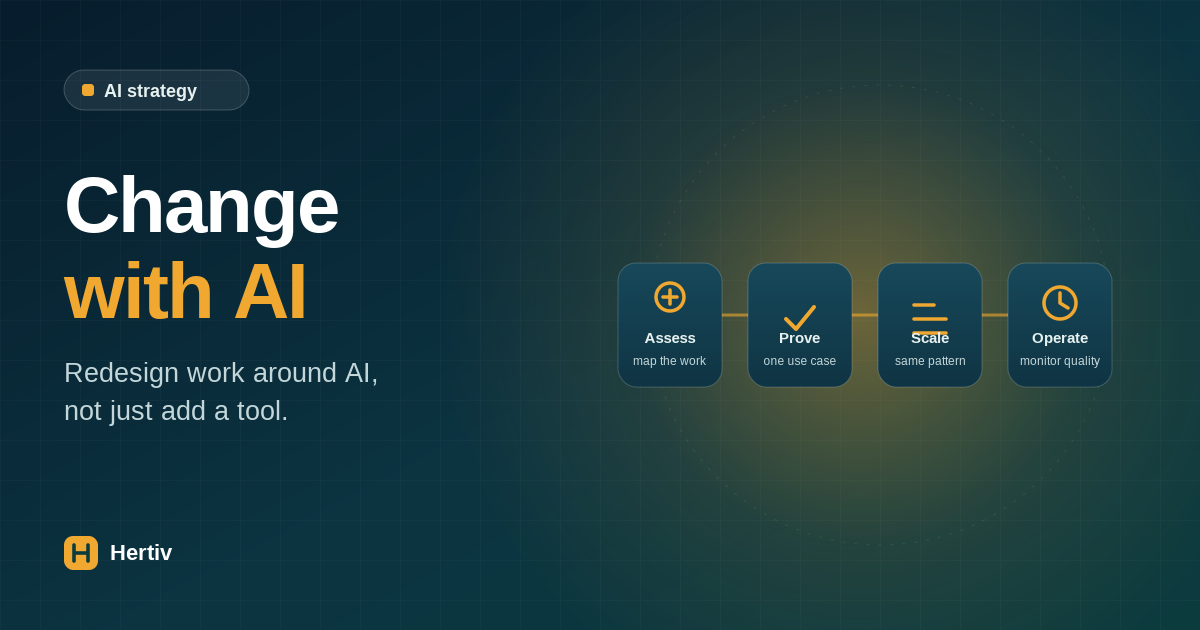
An AI transformation programme usually runs in four phases, each with a clear exit test before the next begins.
- Assess. Map where work is slow, where errors cost money, and where data already exists. Pick a shortlist of workflows, not a company-wide wish list.
- Prove. Ship one narrow use case with an evaluation set and a human review step. Measure time saved and error rate on real cases.
- Scale. Roll the proven pattern to similar workflows, with shared data, permissions and logging in place.
- Operate. Treat AI as part of the system: monitor quality, retrain or re-prompt as data changes, and review access regularly.
The phases matter more than the tools. Teams that skip the proof phase usually build something nobody trusts, and teams that skip the operate phase watch quality drift as data changes. A good programme spends as much time on evaluation, ownership and training as on the model itself.
Ownership should sit with the people who run the workflow, not only with the technology team. If the support team does not own its agent, it will not fix the answers, and the system will rot quietly. For teams that need help designing the programme, generative AI consulting covers the assessment and the first use case.
Where should a company start with AI transformation?
A company should start where a human already reviews the output, the data is already digital, and a wrong answer is caught before it costs money. That filter keeps the first project small and measurable.
Good first areas include support ticket drafting, document extraction, internal search over company documents, and meeting summaries. Each has a clear owner, a clear success measure, and a fallback when the AI is unsure.
Bad first areas include anything that touches payments, legal commitments or safety decisions without a human in the loop. Those need guardrails, traces and approval gates that a first project rarely has.
Before starting, it helps to run an AI readiness assessment to find which data and process gaps need closing first. The assessment is usually cheaper than fixing a project that was built on data nobody trusted.
It also helps to read what enterprises should know before adopting AI, which covers data, cost and risk in more detail.
How do you measure whether AI transformation is working?
You measure AI transformation by outcomes on real workflows, not by how many tools were bought or how often staff open a chat window. Each use case needs one outcome metric agreed before it ships.
Useful measures include time from ticket arrival to first useful reply, share of documents processed without rework, time to draft a report, and the error rate on a fixed evaluation set. Track the same measures over time so changes are comparable.
Two measures matter across the whole programme. The first is adoption by the people who do the work: if staff route around the tool, the design is wrong. The second is quality drift: re-run the evaluation set regularly, because data changes and answers degrade without warning.
What to avoid is measuring usage alone. High usage with no time saved and no quality gain is a cost, not a transformation. If you cannot name the outcome a use case improves, it should not be in the programme.
Example: a 500-person distributor transforms its service desk
Example (hypothetical): a 500-person distributor receives about 400 support tickets a week. Agents spend most of their day reading order histories, checking stock and drafting replies, and the average first reply takes about 6 hours.
The company starts with one use case: an agent that drafts replies from the help centre, order records and stock data, with citations. Agents review each draft before it is sent. In the first month, drafts are accepted with edits in about 70% of cases, and the rest are rewritten.
After three months of fixing the source articles the agent cites, the accept rate rises and the average first reply falls from 6 hours to about 2 hours. That is a saving of 4 hours per ticket on 400 tickets, or roughly 1,600 hours a week across the team, most of it spent on cases that need a person.
The company then applies the same pattern to invoice queries and returns, using the same data, permissions and review step. The transformation is the pattern, not the first tool: draft, cite, review, measure, then repeat.
What are the common mistakes in AI transformation?
The most common AI transformation mistakes are starting too broad, skipping evaluation, and treating the programme as a technology purchase instead of a change in how work is done.
- Starting with a broad assistant. A company-wide chatbot with no owner and no measure drifts, while one workflow with an owner ships and improves.
- No evaluation set. Without real cases and known good answers, quality debates are anecdotes and nobody can tell if the system got better.
- Ignoring data quality. Retrieval follows document quality: five conflicting versions of a policy produce five conflicting answers.
- No fallback path. When the AI is unsure, the work must reach a person. Failures that reach customers undo trust fast.
- Forgetting the people. Roles change, and staff need training in checking AI output, not just in opening the tool.
- Buying before proving. A large licence signed before one use case is measured locks the company into a tool that may not fit.
Key takeaways
- AI transformation changes how work is done, not just which tools are bought
- Digital transformation digitised the record; AI transformation changes who does the thinking
- Start where a human already reviews the output and a wrong answer is caught early
- Measure outcomes on real workflows, and re-run the evaluation set as data changes
- The pattern that scales is draft, cite, review, measure, then repeat
Frequently asked questions
What is the difference between AI transformation and AI adoption?
AI adoption usually means a team starts using an AI tool. AI transformation means the company redesigns workflows, roles and data around AI, with ownership, evaluation and guardrails. Adoption can be a first step, but transformation is the programme that follows when the first use case proves its worth.
How long does AI transformation take?
A first use case can ship in weeks when the data is ready. A real programme takes much longer, because each workflow needs its own evaluation, ownership and change management. Most companies treat it as an ongoing programme rather than a project with a fixed end date.
Do small companies need AI transformation?
Small companies can benefit from the same pattern at a smaller scale: one workflow, one owner, one measure. The difference is scope, not method. A ten-person team that automates its support drafting with review and measurement is transforming, just on a smaller stage.
What data do you need before starting?
You need the source documents or systems the use case depends on, plus a sample of real cases with known good answers for evaluation. If the source content is outdated or duplicated, clean it first, because retrieval quality follows document quality.
What is the biggest risk in AI transformation?
The biggest risk is shipping AI into a workflow without a human review step or a fallback. A wrong answer that reaches a customer costs more than the time saved, and a system with no evaluation set cannot be fixed because nobody can see what went wrong.
Should we hire AI specialists or train existing staff?
Most programmes need both: specialists to design the system and existing staff to own the workflow, check the output and fix the source data. The staff who do the work today are the ones who will spot bad answers first, so their training matters as much as the hire.