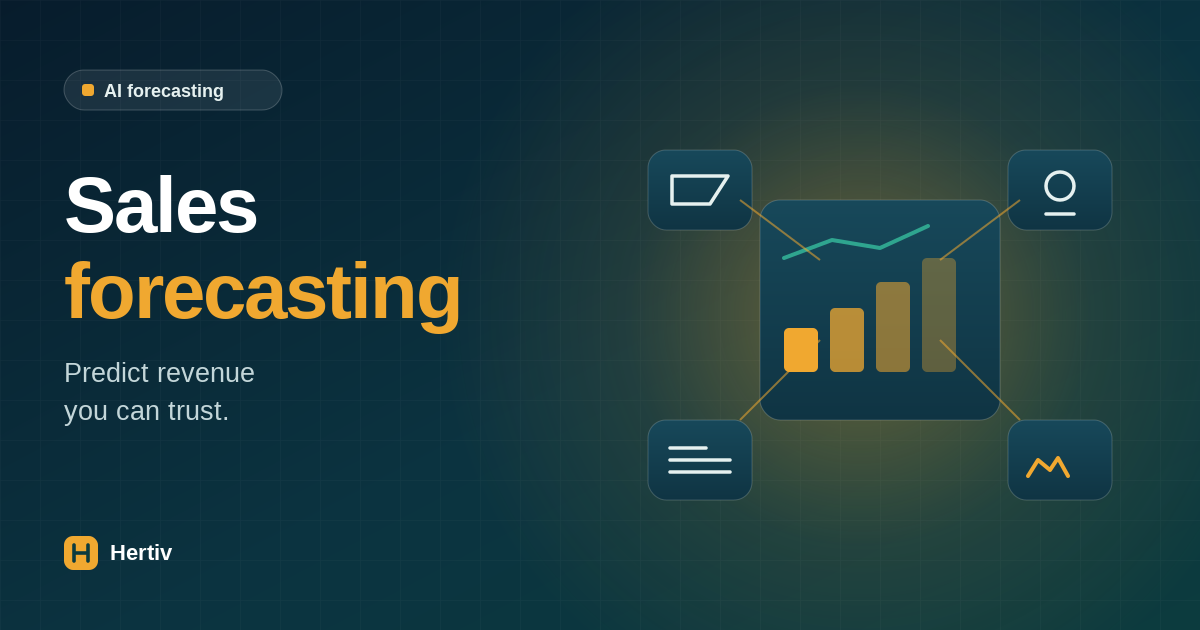
AI Sales Forecasting: How to Predict Revenue You Can Trust
AI sales forecasting reads your pipeline, deal history and rep activity to predict revenue by quarter. Here is how it works, how to measure it, and where it fails.
On this page
Short answer
AI sales forecasting uses past deals, current pipeline and rep activity to predict how much revenue will close in a period. It works best when the CRM data is clean and the forecast is checked against what actually closed. The forecast is a guide for planning and hiring, not a promise, and it needs a human review before it drives a quota or a budget.
What is AI sales forecasting?
AI sales forecasting is software that predicts how much revenue a team will close in a period, usually a month or a quarter, by learning from past deals and reading the current pipeline. It looks at deal size, stage, age, rep activity and past win rates, then turns that into a number the team can plan around.
It differs from a rep's gut feel in one way: it applies the same rules to every deal, so two similar deals get similar forecasts. That consistency is what makes the forecast useful for planning, even when the exact number is wrong.
| Forecast type | What it answers | Who uses it |
|---|---|---|
| Pipeline forecast | What the open pipeline is worth | Sales managers |
| Commit forecast | What will almost certainly close | Finance and leadership |
| Best case | What closes if everything lands | Sales managers |
| Upside | What could close with extra work | Reps and managers |
| Quota forecast | Whether the team hits target | Leadership |
Most teams need the commit number for planning and the pipeline number for coaching. The rest are useful only if someone acts on them. For the wider picture of prediction in sales, see predictive analytics in sales.
How does AI build a sales forecast?
An AI forecast starts with the CRM record of every deal: stage, value, close date, rep, and how long the deal has sat in each stage. The model learns which patterns led to wins in the past, such as deals that moved fast after a demo, or deals that stalled after a pricing call.
It then reads the live pipeline through the same lens. A deal that matches the winning pattern gets a higher chance of closing; a deal that looks like past losses gets a lower one. The forecast is the sum of those chances, weighted by deal value.
Rep activity adds a second signal. Calls, emails and meetings show whether a deal is actually moving, which the stage alone can hide. A deal marked as late stage with no activity for three weeks is a warning, not a promise. The model can only read what the CRM holds, so deals with no notes and no activity are guesses, not forecasts.
Which forecast method fits your team?
The right method depends on how much history you have and how your deals behave. A team with two years of clean CRM data can trust an AI model; a team with messy data should start with a simpler method and fix the data first.
Stage-based forecasting assigns a fixed chance to each pipeline stage, such as 10% for first call and 80% for contract sent. It is simple and easy to explain, but it treats every deal in a stage the same, which hides the weak ones.
Historical forecasting looks at what the team actually closed in past periods and adjusts for the current pipeline. It works well for steady teams with repeatable deals, and badly for teams whose deals change shape every quarter.
AI forecasting adds deal-level signals: activity, age, size, and how the deal compares with past wins and losses. It is the most accurate of the three when the data is good, and the most misleading when the data is thin, because it hides its guesses behind a precise-looking number.
How do you measure forecast accuracy?
Forecast accuracy is measured by comparing the forecast with what actually closed, period after period. The simplest check is the gap between the commit forecast and the real result, expressed as a percentage of the real result. A forecast that is usually within 10% is useful; one that swings by 40% is not.
Bias matters as much as accuracy. A team that always forecasts high has a different problem from a team that is sometimes high and sometimes low. The first needs a correction to its assumptions; the second needs better deal data.
Measure at the team level first, not per rep. Individual forecasts are noisy, and judging a rep on one quarter's error punishes honest reporting. Track the team forecast over four quarters before you decide whether the method works, and keep the same method for all four so the comparison is fair.
Example (hypothetical): a team fixes its quarterly forecast
Example (hypothetical): a sales team of eight reps forecasts $1.2 million for the quarter. The pipeline holds 40 open deals worth $2.4 million in total. The AI model gives the pipeline a 50% weighted chance, which is $1.2 million, so the forecast matches the team's number.
But the model also shows that 10 of the 40 deals have had no activity for three weeks, and those 10 are worth $600,000. Removing them leaves 30 active deals worth $1.8 million, and at the same 50% chance the forecast falls to $900,000.
The manager reviews the 10 quiet deals with the reps. Four are real but stalled, and six are dead. The team re-forecasts at $950,000, hires to that number instead of $1.2 million, and closes $980,000. The forecast was still off by $30,000, but the plan was built on a number the team could defend.
How to start with AI sales forecasting
Start small: one team, one quarter, and a forecast you check in public. The steps below keep the rollout honest, because a forecast nobody checks will drift without anyone noticing.
- Clean the CRM first: close dead deals, fix close dates, and make stage definitions match how deals really move.
- Pick one forecast type to publish, usually the commit number, and keep the rest private until the method proves itself.
- Run the AI forecast next to the reps' own forecast for one quarter, and compare both with what closed.
- Review the biggest misses in a weekly meeting, and ask what signal the model missed.
- Use the forecast for planning only until it has been within 10% for two quarters in a row.
The weekly review is the step most teams skip, and it is the one that improves accuracy fastest. A model that never learns from its misses will repeat them. For the planning side of the same problem, see AI in sales and operational planning.
What are the common mistakes?
The most common mistakes with AI sales forecasting are trusting the number without checking the data, and using the forecast to set quotas before it has proved itself. Both turn a planning tool into a source of bad decisions.
- Forecasting from a CRM full of dead deals and stale close dates
- Treating the AI number as a promise instead of a probability
- Setting quotas from the forecast before it has been accurate twice
- Judging reps on one quarter of forecast error
- Ignoring the deals with no activity, which the model cannot see clearly
- Changing the method every quarter, so accuracy can never be compared
Keep the method fixed for at least two quarters and review the misses in public. A forecast that improves slowly is worth more than a new tool every quarter. AI agents for sales covers the wider automation around the pipeline.
Key takeaways
- AI forecasting applies the same rules to every deal, which makes it useful for planning
- Clean CRM data matters more than the model: dead deals and stale dates corrupt the forecast
- Measure accuracy against what closed, and watch for bias as well as error
- Use the forecast for planning until it has been within 10% for two quarters
- Review the biggest misses weekly, and keep the method fixed while you learn
Frequently asked questions
How accurate is AI sales forecasting?
A well-run forecast is usually within 10% of what closes at the team level, once the CRM data is clean and the method has run for two quarters. Accuracy varies by deal size and sales cycle length, so measure your own team rather than trusting a vendor figure.
Does AI sales forecasting replace the sales manager's judgement?
No. The model reads patterns in past deals, but it cannot know that a customer just changed budget or that a champion left. The manager's job is to review the forecast, question the deals that look wrong, and adjust for what the data cannot see.
What CRM data does AI forecasting need?
It needs deal stage, value, close date, rep, and how long each deal has sat in each stage, plus activity such as calls and meetings. Without activity data, the model cannot tell a live deal from a stalled one, and the forecast becomes a stage average.
How is AI forecasting different from predictive analytics in sales?
Predictive analytics scores individual leads and deals, such as which leads are most likely to close. AI forecasting rolls those scores up into a revenue number for a period, which is what finance and leadership plan around.
Should quotas be set from the AI forecast?
Not until the forecast has proved accurate for two quarters in a row. Before that, use it for planning and hiring ranges, and keep quotas on the reps' own commit numbers. A quota built on an untested forecast punishes the team for the model's errors.
What if our CRM data is messy?
Fix the data first. Close dead deals, correct close dates, and agree what each stage means. A simple stage-based forecast on clean data beats an AI forecast on messy data, because the AI model hides its guesses behind a precise-looking number.