AI SaaS Product Classification: The Criteria That Matter
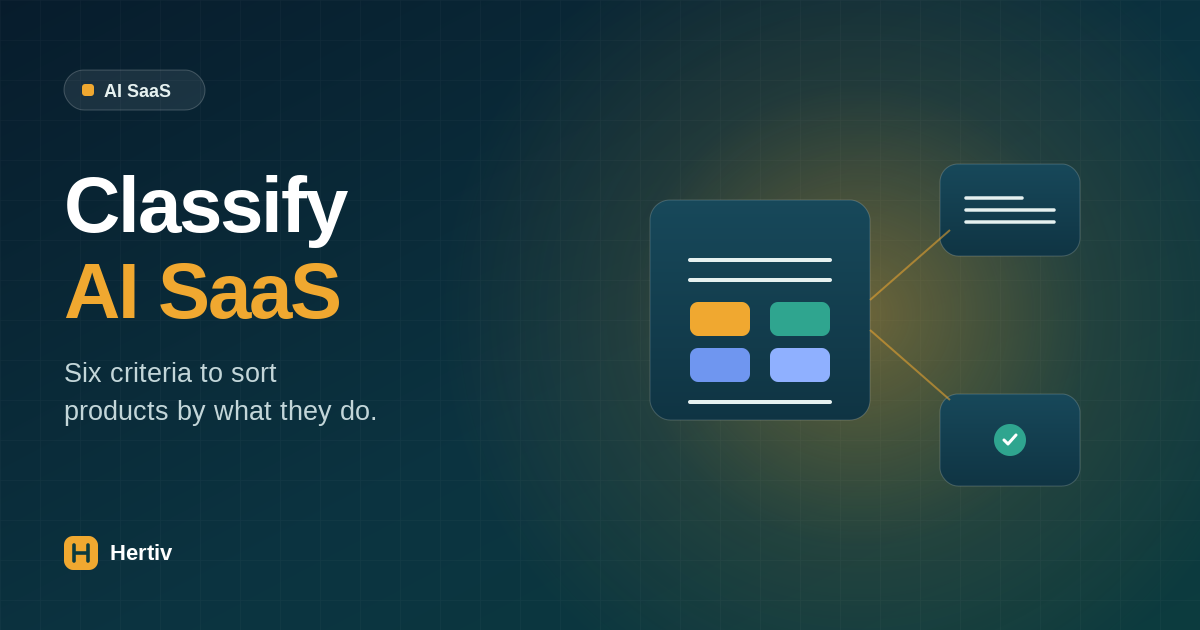
Classifying an AI SaaS product means sorting it by what it does, how much it decides, and what data it touches. Six criteria make the shortlist honest.
On this page
Short answer
AI SaaS products are classified by capability, autonomy, data use, deployment, pricing and compliance. Capability asks what the product does, autonomy asks how much it decides alone, and data use asks what it reads and writes. A product that looks the same on a pricing page can sit in a different class on each criterion, so classify on all six before you compare vendors.
What does classifying an AI SaaS product mean?
Classifying an AI SaaS product means sorting it into a category using fixed criteria, so that products in the same class can be compared fairly and products in different classes are not confused with each other. Without criteria, a chat box and an autonomous agent look like the same product on a pricing page.
The classification matters because it decides what you test. A drafting assistant needs a quality check; an agent that takes actions needs permissions, logs and a rollback plan. Buying the wrong class means testing the wrong thing.
| Criterion | What it asks | Why it matters |
|---|---|---|
| Capability | What does it do? | Sets the use case |
| Autonomy | How much does it decide alone? | Sets the risk and controls |
| Data use | What does it read and write? | Sets the privacy review |
| Deployment | Where does it run? | Sets the integration work |
| Pricing | What do you pay for? | Sets the real cost |
| Compliance | Which rules apply? | Sets the legal checks |
Use all six criteria together. A product can be low risk on one and high risk on another, and the highest-risk criterion is the one that decides how you buy it.
Capability: what does the product actually do?
Capability is the first criterion because it decides the use case. Most AI SaaS products fall into four capability classes: drafting, answering, analysing, and acting. A drafting tool writes first versions; an answering tool replies to questions from your content; an analysing tool finds patterns in data; an acting tool carries out steps on its own.
The classes overlap, which is why vendors blur them. A tool that drafts and also sends the draft is two classes at once, and the sending half needs the controls of an acting tool. Ask the vendor to name the class for each feature, not for the product as a whole.
Capability also decides the evaluation. A drafting tool is judged on edit rate; an answering tool on whether the answer cites its source; an analysing tool on whether its findings hold up on new data. Testing a product on the wrong measure makes a weak tool look strong.
Autonomy: how much does it decide on its own?
Autonomy is the criterion that sets the risk. A product that only suggests is low autonomy: a person reads every output before anything happens. A product that drafts and sends, books, or updates records is high autonomy, because its mistakes reach customers or systems without a human in between.
Most products sit in the middle: they act on routine cases and hand the rest to a person. The question to ask is where the line sits, and who can move it. If the vendor cannot show you the line, the product is more autonomous than it looks.
Autonomy decides the controls you need. Low autonomy needs a quality check; high autonomy needs permissions scoped per user, an approval step for irreversible actions, full logs, and a way to undo what it did. Budget for those controls before you sign, not after the first incident.
Data and deployment: what does it touch, and where does it run?
Data use asks what the product reads and writes. A tool that only reads public web pages is a different class from one that reads your CRM, your inbox and your contracts. The more it reads, the longer the privacy review, and the more it writes, the more you need to know about its error rate.
Ask three questions: which systems does it connect to, what data leaves your boundary, and how long is it kept? A product that sends your data to a third-party model is a different class from one that runs inside your cloud account, even if the features look the same.
Deployment asks where the product runs and who operates it. A multi-tenant cloud product is the simplest to buy and the hardest to audit; a product deployed in your own cloud account is the reverse. Neither is better in general, but the class decides who is responsible when something breaks, and that should be written down before you buy.
Example (hypothetical): classifying twelve tools
Example (hypothetical): a team is comparing twelve AI SaaS tools for its support and sales work. It scores each one on the six criteria and finds that the twelve split into three classes: five drafting and answering tools, four analysing tools, and three acting tools.
The five drafting and answering tools are low autonomy: a person reads every output. The four analysing tools read the CRM and the data warehouse but write nothing, so they need a data review but no approval step. The three acting tools book meetings, send messages and update records, so they need scoped permissions and logs.
The split changes the shortlist. The team buys two of the five drafting tools after an edit-rate test, one analysing tool after a data review, and none of the acting tools yet, because the permission work would take a month. The classification saved them from testing twelve tools on the same checklist, which would have hidden the real differences.
How to use the criteria when you buy or build
Use the six criteria as a shortlist filter, not as a scoring exercise. The steps below take an afternoon and stop most bad buys before they reach a trial.
- Write down the use case in one sentence, then name the capability class it needs.
- Ask the vendor where the autonomy line sits, and who can move it.
- List every system the product reads and writes, and note what leaves your boundary.
- Check deployment and pricing together: what you pay for, and who operates what.
- Confirm which rules apply, and get the data handling answers in writing before the trial.
If a vendor cannot answer one of these steps clearly, that is information, not a delay: the product is probably in a different class from the one on its pricing page. For the build side of the same question, see how to build a SaaS product.
What are the common mistakes?
The most common mistakes in classifying AI SaaS products are trusting the vendor's label, classifying on one criterion, and skipping the autonomy question. Each one leads to testing the wrong thing or buying the wrong controls.
- Trusting the vendor's category instead of checking the six criteria
- Classifying on capability alone and ignoring autonomy
- Forgetting to ask what data leaves your boundary
- Comparing prices without checking what the price covers
- Skipping the compliance check until after the trial
- Testing an acting tool with a drafting checklist
Classify first, then test. A product tested against the wrong class will pass a trial it should have failed, and the failure will show up in production. AI product development covers how to build a product that fits its class from the start.
For the cost side of the same decision, see AI SaaS product development cost.
Key takeaways
- Classify AI SaaS products on six criteria: capability, autonomy, data use, deployment, pricing and compliance
- Capability decides what you test; autonomy decides what controls you need
- A product can be low risk on one criterion and high risk on another
- Ask where the autonomy line sits, and who can move it
- Classify first, then test: the wrong checklist makes a weak tool look strong
Frequently asked questions
What are the main classes of AI SaaS products?
The four capability classes are drafting, answering, analysing and acting. A drafting tool writes first versions, an answering tool replies from your content, an analysing tool finds patterns in data, and an acting tool carries out steps on its own. Many products span two classes at once.
Why does autonomy matter more than features?
Autonomy decides the risk. A tool that only suggests needs a quality check; a tool that books, sends or updates records needs permissions, logs and a rollback plan. Two products with the same features can need very different controls if one acts and the other only suggests.
How do you classify a product that does several things?
Classify each feature separately, not the product as a whole. A tool that drafts and also sends is a drafting tool for the draft and an acting tool for the send, and the sending half needs the controls of an acting tool.
What should you ask about data use before buying?
Ask which systems the product reads and writes, what data leaves your boundary, how long it is kept, and whether it is used to train models. A product that sends your data to a third-party model is a different class from one that runs inside your own cloud account.
Does pricing belong in a product classification?
Yes, because pricing shows what you are really buying. A per-seat price, a per-action price and a per-outcome price create different incentives, and a product that looks cheap per seat can be expensive per action once the team uses it.
When should you reclassify a product?
Reclassify whenever a vendor adds a feature that changes autonomy or data use, such as an agent mode or a new integration. A product that was low risk when you bought it can move into a higher class without a new contract, so check the release notes each quarter.