AI-Powered KYC for Tokenization: How It Works
AI-powered KYC checks identity, sanctions and source of funds for token buyers, then enforces the result on-chain. Here is how the checks fit together.
On this page
Short answer
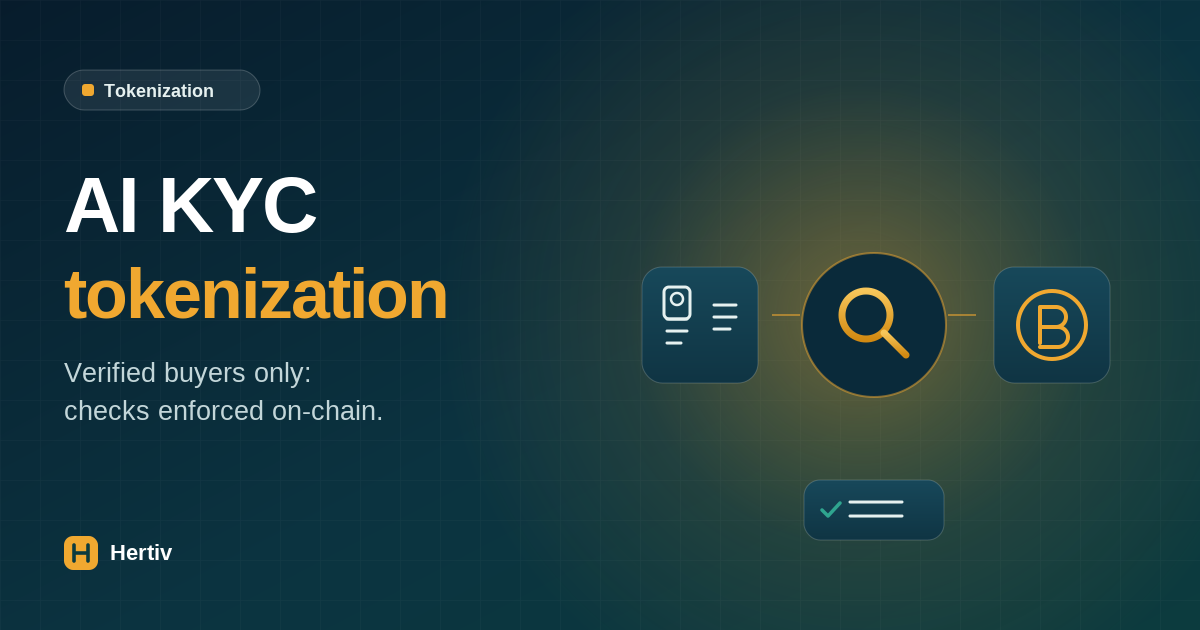
AI-powered KYC for tokenization is the use of machine learning to verify investors before they can buy a token, and to keep checking them afterwards. It reads identity documents, matches faces, screens sanctions lists and watches wallet activity, then records the result so the token contract only allows verified buyers. It speeds up onboarding while keeping the issuer inside the rules that apply to securities.
What is AI-powered KYC for tokenization?
AI-powered KYC for tokenization is identity checking built for token sales, where the buyer is verified by software before the token can move to their wallet. In a normal sale, a person shows a passport and waits for a manual check. In a token sale, the AI reads the document, checks it against sanctions and watch lists, and records the result, often in minutes rather than days.
The checks fall into four groups:
| Check | What the AI does | Why it matters |
|---|---|---|
| Identity | Reads the document and matches the face | Proves the buyer is who they claim to be |
| Sanctions | Screens names against watch lists | Blocks banned persons and regions |
| Source of funds | Traces where the money came from | Spots laundering and fraud risk |
| Wallet screening | Checks the receiving wallet history | Stops tainted funds entering the sale |
The token side is what makes this different from ordinary KYC. The result of the check is linked to the buyer's wallet, usually through an allowlist, so the token contract refuses transfers to wallets that have not passed. Compliance is enforced by the token itself, not only by a policy document. For the rules behind the checks, RWA tokenization compliance and KYC explains what issuers must do.
How does the AI check an investor?
The AI checks an investor in stages, and each stage has a human fallback. First it reads the identity document: the photo, the name, the number and the expiry date, and checks the document for signs of tampering, such as altered text or a photo that does not match the document type. A forged or expired document is rejected at this stage.
Next comes the face match and liveness check. The investor takes a selfie or a short video, and the model compares the face with the document photo and checks that the person is real and present, rather than a photo of a photo or a recorded video. This step is where most fraud attempts fail, because a stolen document alone is not enough.
Then the name is screened against sanctions lists, politically exposed persons lists and adverse media. The model handles spelling variants and transliterations, so a name written two ways still matches. A match does not mean an automatic rejection; it means the case goes to a human reviewer who decides whether it is the same person.
Finally, the AI looks at the source of funds and the receiving wallet. For a token sale paid in crypto, it traces the wallet history for links to mixers, dark markets or sanctioned addresses. A clean wallet passes; a risky one is flagged for review. The whole sequence usually takes minutes, but any uncertain case waits for a person.
How does KYC connect to the token itself?
KYC connects to the token through an allowlist: a list of wallet addresses that have passed the checks, which the token contract consults before every transfer. If the receiving wallet is not on the list, the transfer fails. This means a verified buyer cannot pass the token to an unverified friend, and a token cannot end up in a wallet the issuer has never checked.
The allowlist needs to stay current. A buyer who passes today may be sanctioned next month, or may lose their eligibility, so the list must support removal as well as addition. When a wallet is removed, the token contract should block its future transfers, and the issuer needs a process for what happens to tokens already held in that wallet.
Some issuers use a separate identity token or credential instead of a simple list. The investor holds a credential that proves they passed KYC, and the token contract checks for it. This keeps the identity data off the chain while the enforcement stays on it, which is a cleaner design for privacy.
The design choice matters for the legal side too. A token that promises returns is usually treated as a security, whatever the technology, so the KYC setup must match the rules for securities in each place the token is sold. Get the legal view before the technical design, not after. The platform side is covered by RWA tokenization platform development, which shows how the checks fit into the build.
What happens after onboarding?
After onboarding, the checks keep running. Ongoing monitoring watches for changes: a buyer who appears on a new sanctions list, a wallet that starts receiving funds from a risky source, or a pattern of transfers that looks like an attempt to move tokens to unverified buyers. The AI flags the change and a reviewer decides what to do.
Re-checks happen on a schedule and on triggers. Most issuers re-verify identity documents when they expire, re-screen names when the watch lists update, and re-check wallets when a large transfer is planned. A check done once and filed away is not enough, because the risks change while the token is still trading.
Records matter as much as the checks. Regulators expect the issuer to show who was checked, when, by which method and what the result was. The AI system should log every decision with the evidence behind it, so an auditor can follow the trail. A system that verifies people but keeps no records will fail the first audit.
The ongoing work is usually smaller than the onboarding work, but it never stops. A token that trades for years needs monitoring for years, so the issuer should budget for it as a running cost, not a one-off project. Plan the team and the tooling for the long term before the sale opens.
How do you run AI KYC for a token sale?
You run AI KYC for a token sale by choosing the checks, wiring them to the token contract, and testing the whole flow with real documents before the sale opens. A sale that opens with untested KYC will lose buyers to errors and rejections.
- Map the rules. List which investors are allowed, which regions are excluded, and which documents count as proof in each place you will sell.
- Pick a KYC provider. Choose a vendor that covers your regions, supports your document types, and keeps an audit trail you can show a regulator.
- Connect the allowlist. Wire the KYC result to the token contract so only verified wallets can receive tokens, and test a blocked transfer.
- Set the review rules. Decide which cases pass automatically, which go to a human, and how fast the human queue must clear.
- Test with real documents. Run staff and friendly testers through the flow with real passports and wallets, and fix the failure points.
- Plan the monitoring. Set up re-screening, expiry checks and record keeping before the first sale, not after it.
Test the failure paths as well as the happy path. A buyer with a faded passport, a name that matches a sanctions entry, or a wallet with a risky history should reach a human quickly and get a clear answer. If the review queue has no owner, those buyers will simply leave. For the identity side, why businesses use a blockchain KYC solution explains how shared verification changes the cost.
Example (hypothetical): a property fund tokenizes
Example (hypothetical): a property fund plans to tokenize a building and sell tokens to 400 investors. With manual KYC, each check takes about 45 minutes of staff time, so 400 checks take 400 x 45 = 18,000 minutes, or 300 hours, which is about eight working weeks for one person. The fund adds AI KYC, and the automated part takes about 4 minutes per investor.
Of the 400 investors, 340 pass automatically and 60 go to human review at 20 minutes each. The total is 400 x 4 = 1,600 minutes of automated checks plus 60 x 20 = 1,200 minutes of review, or 2,800 minutes in all, about 47 hours. The saving is 300 minus 47 = 253 hours, and the sale can open in days instead of weeks.
The fund also finds that 12 of the 60 review cases are genuine problems, including two wallets linked to sanctioned addresses, which the token contract then blocks. The point is not only speed: the automated checks caught cases a tired reviewer might have missed, and the audit trail shows every decision with its evidence.
What are the common mistakes?
The most common mistakes in AI-powered KYC for tokenization are trusting the automation without a review path, treating KYC as a one-off check, and designing the token before the legal view.
- No human review path. False matches on sanctions lists are common, and a buyer wrongly rejected with no appeal will not come back.
- One-off checks. Sanctions lists change and documents expire, so checks must be repeated and recorded.
- Token first, law second. A token that promises returns is usually a security, so the KYC design must follow the securities rules.
- Weak wallet screening. Checking the person but not the paying wallet leaves the easiest route for tainted funds open.
- No audit trail. Verifying people without logging the decisions leaves the issuer unable to prove compliance.
- Ignoring the user experience. A flow that rejects good documents or takes hours to finish will lose honest buyers.
AI makes KYC faster, but the responsibility stays with the issuer. The technology changes the speed of the check, not the duty to do it properly.
Key takeaways
- AI KYC verifies identity, sanctions, source of funds and wallet history before a token sale
- The result is enforced by the token contract through an allowlist, so unverified wallets cannot receive tokens
- Face matching and liveness checks stop a stolen document being used on its own
- Checks must be repeated and logged, because sanctions lists change and documents expire
- Test the flow with real documents and a human review queue before the sale opens
- A near-100 percent approval rate means the check is not being tested, not that it works
Frequently asked questions
What is AI-powered KYC for tokenization?
It is identity verification for token buyers that uses machine learning to read documents, match faces, screen sanctions lists and check wallets, then records the result so the token contract only allows verified buyers to hold the token.
How is tokenization KYC different from normal KYC?
The checks are similar, but the result is enforced on-chain: the token contract refuses transfers to wallets that have not passed. Normal KYC ends with an account being opened; tokenization KYC ends with a wallet being allowed to hold the token.
Can AI KYC catch a forged passport?
It can flag most forgeries by checking the document layout, fonts, security features and whether the photo matches the document type. Any uncertain document goes to a human reviewer, because the model can miss a good fake and wrongly reject a worn real one.
What happens if a buyer is sanctioned after passing KYC?
Ongoing monitoring should catch the change on the next screening and flag the wallet for review. The issuer then removes the wallet from the allowlist, which blocks future transfers, and follows its legal advice on the tokens already held.
Does AI KYC replace the compliance officer?
No. The AI does the document reading and the first screening, but a person decides the uncertain cases, sets the rules and owns the audit trail. The officer's job changes from checking documents to checking the system's decisions.
How long does AI KYC take for a token buyer?
A clean case usually takes minutes, from document upload to approval. Cases that need human review take longer, so the issuer should staff the review queue before the sale opens and tell buyers what to expect.