AI-Powered Free Slot Games: How the AI Features Work
Free slot games use AI to pick games for you, time bonus rounds and flag risky play. Here is what the AI does, how they earn money, and how to spot a fair one.
On this page
Short answer
An AI-powered free slot game is a free-to-play slot game that uses machine learning to personalise the experience for each player: it suggests games, times bonuses and adjusts challenges based on how that person plays. The spins still use a random number generator, so the AI changes the experience around the game, not the odds of each spin.
What is an AI-powered free slot game?
An AI-powered free slot game is a free-to-play slot game that uses machine learning to shape the experience around each player. The AI watches how you play — which themes you pick, how long sessions last, when you stop — and uses that to suggest games, time bonuses and set challenges that fit your habits.
The spins themselves are not decided by the AI. Every spin is produced by a random number generator, a tested algorithm that makes each result independent of the last. The AI works on the layer around the reels: what you see, what you are offered and when the game nudges you to take a break.
Free means no money is needed to play. You spin with virtual coins the game gives you, and you can usually earn more by playing daily or watching ads. Some games sell extra coins, but buying them is optional and never changes the odds.
How does AI change the way a slot game plays?
AI changes a slot game in three places: what it shows you, when it rewards you and how it paces the session. A new player sees popular games and simple tutorials, while a returning player sees games like the ones they already play. The aim is to keep the game interesting without making it harder to stop.
Bonuses are the second place. Instead of the same offer for everyone, the game can offer a bonus round when a player has been active for a while, or a small coin gift after a losing run. These are set by rules the studio writes, and the AI picks which rule fits the moment.
The third place is pacing. The game can suggest a break after a long session or lower the pace of prompts when a player keeps declining them. Used well, this makes the game feel less pushy. Used badly, it keeps people playing longer than they planned, which is why testing matters — see the casino game development steps.
What AI features do free slot games actually use?
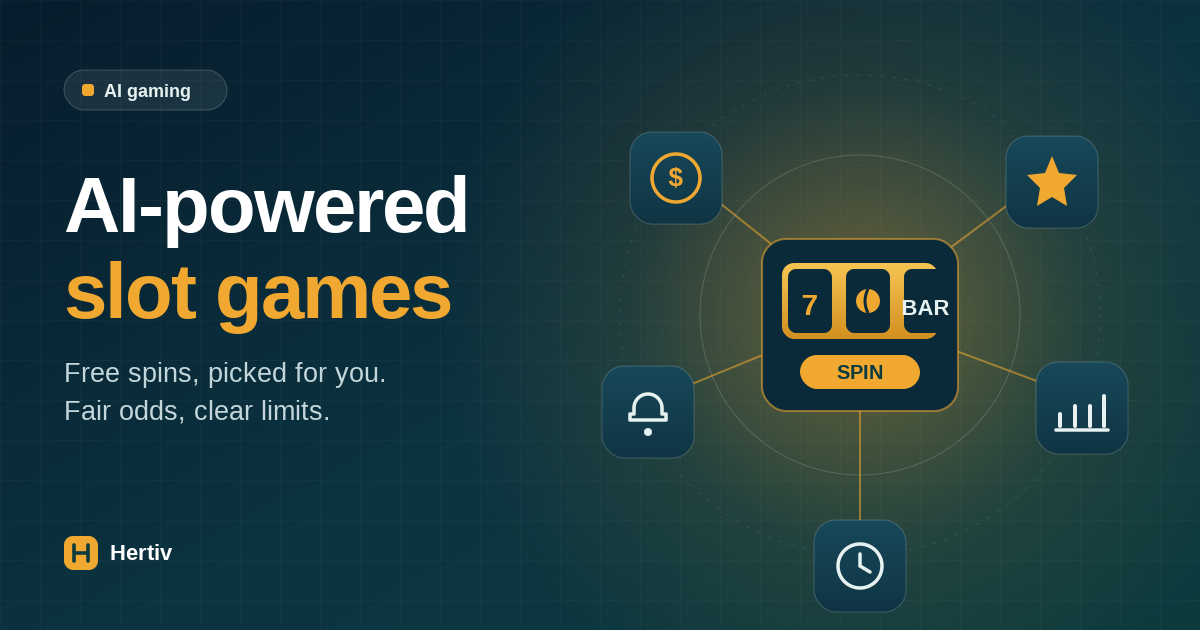
Most AI features in free slot games fall into six groups. The table below lists each one, what it does behind the scenes, and what changes for the player.
| Feature | What it does | What changes for you |
|---|---|---|
| Game recommendations | Matches your past picks to similar games | Less searching, more games you like |
| Adaptive bonuses | Times bonus rounds and coin gifts | Rewards arrive when you are active |
| Difficulty and pacing | Adjusts challenge level and prompt frequency | Sessions feel smoother, not harder |
| Support replies | Answers common questions in chat | Faster help for account and coin issues |
| Fraud and bot checks | Spots bots and stolen accounts | Fairer leaderboards and coin economy |
| Responsible-play flags | Watches for long sessions and fast betting | Reminders and cooling-off prompts |
Two of these deserve a closer look. Responsible-play flags watch for long sessions, fast betting and repeated top-ups, then trigger a reminder or a cooling-off prompt. Fraud checks look for bots and stolen accounts, which keeps the leaderboards and coin economy fair for real players.
How do free slot games make money if they are free?
Free slot games earn money in three main ways: advertising, optional coin purchases and, in some games, a paid version without ads. Ads usually appear between sessions or as an optional video you watch to earn extra coins. Coin purchases buy virtual currency that has no cash value and cannot be withdrawn.
The business model is the same one behind many free mobile games: most players never pay, and a small share buy coins or remove ads. That is why studios care about keeping players for months rather than days, and why the AI focuses on retention — suggesting games, sending return bonuses and timing events.
For the player, the key question is whether paying changes anything about fairness. In a well-run game it does not: bought coins buy more spins, not better odds. If a game sells a feature that changes your chance of winning, treat that as a warning sign and check the game's published rules. How studios think about this is covered in why slot game development can pay off.
Studios that build these games plan and test them the same way as other app teams; mobile app development covers the process.
How do you tell a fair game from a misleading one?
A fair free slot game states its odds in plain language. Look for a published return-to-player figure, a clear statement that spins use a random number generator, and terms that explain what coins can and cannot do. If a game hides its odds or promises that a paid feature improves your chances, walk away.
Check who made the game and where it is sold. Games from known studios on the main app stores pass review checks and publish support contacts. Cloned or side-loaded games often copy the look of a popular title without the same testing, and they are the ones most likely to push coin purchases hard.
Watch how the game treats limits. A fair game lets you set a daily coin or time limit and respects it. It also shows your session length and offers a break. A game that hides its settings, resets your limits or keeps offering coins after you decline is telling you how it makes its money.
Example (hypothetical): a week of free spins
Example (hypothetical): a player starts Monday with 10,000 free coins and bets 100 coins per spin. She plays 50 spins a day for seven days, which is 350 spins and 35,000 coins staked. The game tops her up with 5,000 coins a day from daily bonuses, so she receives 35,000 coins over the week.
Her wins total 28,000 coins across the week, so the maths is: 10,000 starting coins plus 35,000 bonus coins minus 35,000 staked plus 28,000 won equals 38,000 coins at the end of the week. She never paid anything, and the AI's job was limited to suggesting games and timing the daily bonus — it did not change the result of any spin.
The lesson is simple: in a free game, the coins are a budget, not money. The AI can make the week feel varied, but it cannot make the spins pay out more than the game's published return allows.
What are the common mistakes?
Most problems with free slot games come from treating virtual coins like real money, or from trusting a game that hides how it works. The mistakes below are the ones to avoid. Each one is easy to make, because the game is designed to keep you playing, and each one is easy to avoid once you know what to look for.
- Treating free coins as practice for real-money play, where the stakes are real
- Chasing losses by buying coins after a bad run
- Ignoring the session limit you set for yourself
- Believing a game is “due” to pay out after a long dry run
- Trusting a game that hides its odds or its maker
- Playing side-loaded copies of popular games instead of the store version
Key takeaways
- The AI personalises the experience around the reels, not the odds of each spin.
- Free games earn money from ads and optional coin purchases, not from changing your chances.
- A fair game publishes its return-to-player figure and states that spins use a random number generator.
- Responsible-play flags and session limits are the features that protect you, not the bonuses.
- Treat virtual coins as a budget, not money, and walk away from games that hide their odds.
Frequently asked questions
Are free slot games really free?
Yes, if the game is honest about it. You play with virtual coins the game gives you, and you can earn more by playing daily or watching ads. Coin purchases are optional, and bought coins buy more spins, not better odds.
Does the AI change my chance of winning?
No. Each spin is produced by a random number generator, which makes every result independent of the last. The AI changes what you see, which bonuses you are offered and how the session is paced, but it cannot change the result of a spin.
What is return-to-player, and why does it matter?
Return-to-player is the share of staked coins a game pays back over a long run, published by the studio. It tells you how much of your coin budget the game keeps over time. A game that will not publish the figure is hiding something.
Can AI spot problem play in a free game?
Some games use it that way. The AI watches for long sessions, fast betting and repeated top-ups, then shows a reminder or suggests a break. The feature only helps if the game respects the limit you set, so test it before you trust it.
Should I pay for coins in a free slot game?
Only if you enjoy the game and the coins are cheap entertainment for you. Paying never improves your odds, and it never turns virtual coins into real money. Set a monthly limit before you buy anything, and stop when it is reached.
How do I pick a safe free slot game?
Choose games from known studios on the main app stores, check that the odds and the maker are published, and confirm you can set a time or coin limit. Avoid side-loaded copies and any game that promises a paid feature will improve your chances.