AI Personalization in Consumer Experiences: What Changes
AI personalization changes what each consumer sees, from product picks to support replies. Here is where it shows up, what good looks like, and where it goes wrong.
On this page
Short answer
AI personalization in consumer experiences means using data about a person to shape what they see, what they are offered and how they are helped. A shopper sees products matched to past purchases, a reader gets stories on topics they follow, and a support chat starts with context instead of blank questions.
What is AI personalization in consumer experiences?
AI personalization in consumer experiences is the use of data and models to tailor products, content, offers and service to each person rather than showing everyone the same thing. It draws on past purchases, browsing, location, stated preferences and how the person responded to earlier suggestions.
The difference from simple segmentation is granularity. A segment puts thousands of people in one group, such as 'frequent buyers'. Personalization treats each person as a profile of their own, so two people in the same segment can still see different home pages, different prices for a subscription tier, or different support options.
It is not one feature. It is a set of decisions spread across a website, an app, email, advertising and support, all reading from the same profile. When the pieces share data, the experience feels coherent; when they do not, the same customer gets contradictory suggestions in different channels.
Where do consumers meet AI personalization?
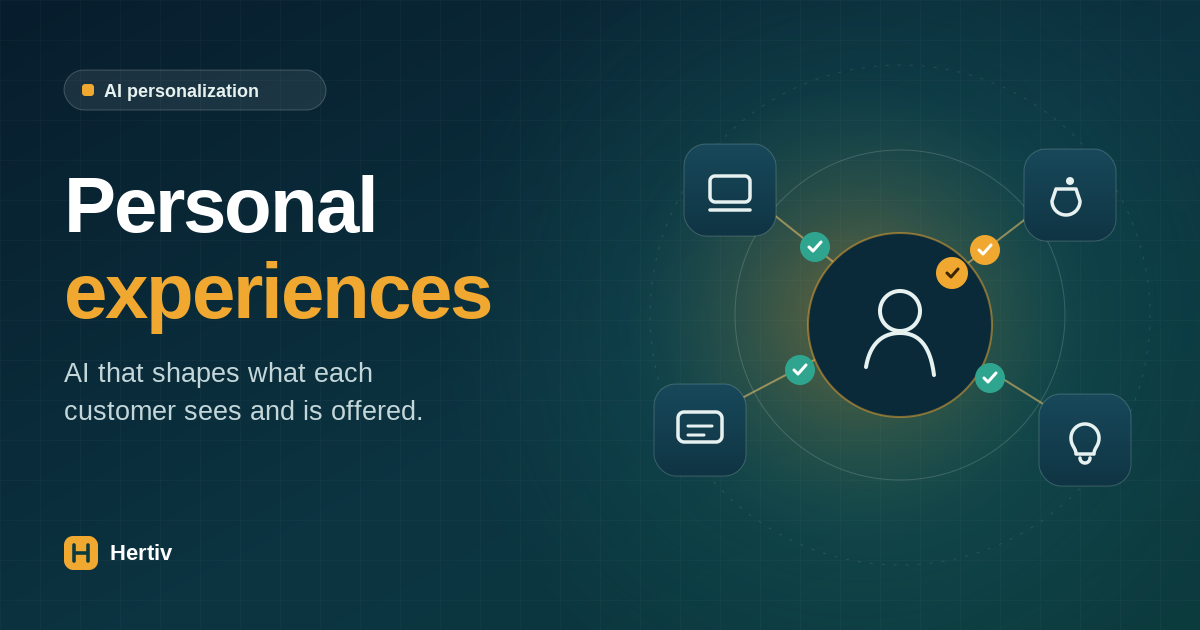
Consumers meet AI personalization in four places: what they are shown, what they are offered, how they are helped, and how they are reminded. Each one uses the same profile but in a different moment.
| Touchpoint | What the AI does | What the consumer notices |
|---|---|---|
| Home page and search | Orders products and content by likely interest | Relevant items appear first |
| Recommendations | Suggests items based on similar buyers | 'You may also like' lists that fit |
| Offers and pricing | Targets discounts to likely buyers | Coupons that match what they buy |
| Support chat | Starts with order history and context | Fewer repeated questions |
| Reminders | Times messages to past behaviour | Reminders that arrive when useful |
| Notifications | Filters alerts to what they act on | Less noise, more signal |
The home page is usually the first place people notice it. A returning shopper who bought running shoes sees new arrivals in that category, while a first-time visitor sees bestsellers. The mechanism behind that ordering is explained in how AI-driven personalization works.
What does good personalization feel like?
Good personalization feels like a shop that remembers you. Suggestions are close enough to be useful, the customer can correct them, and nothing about the experience feels intrusive. The test is simple: if you removed the personalization, would the customer notice and miss it?
Three signs mark the good kind. First, the suggestions are explainable: the customer can see why something was recommended, such as 'because you bought this'. Second, the customer has control, with a way to clear history, change interests or turn suggestions off. Third, the experience is consistent: the app, the website and the store staff work from the same understanding of the customer.
Bad personalization has the opposite signs. It repeats the same product the customer just bought, shows items they already own, or guesses at sensitive facts such as health or income. It also fails quietly: a wrong guess is shown with the same confidence as a right one, so the customer learns to ignore the whole feature.
How does a business set personalization up?
A business sets personalization up by joining its customer data, choosing a few places to apply it, and measuring whether those places improve. The work is mostly data plumbing and testing, not model building.
- Join the data. Connect purchase history, browsing, support tickets and loyalty data into one profile per customer.
- Pick two or three touchpoints. Start with the home page and recommendations, where results are easy to measure.
- Define the rules. Decide what the system may use, what it must never use, and what happens when it has no data on a new customer.
- Test against a control group. Show half of visitors the personalized version and compare clicks, orders and complaints.
- Give customers control. Add visible settings to view, edit or clear the data used for personalization.
- Review the failures. Read the cases where suggestions were ignored or reported, and fix the data behind them.
Retail teams often start with recommendations because the feedback is immediate. See AI for retail and e-commerce for the wider set of use cases that share the same customer profile.
Example: a grocery chain personalizes its weekly shop
Example (hypothetical): a grocery chain with 40,000 loyalty members wants its app to suggest a weekly shop. It starts with two touchpoints: a 'your usuals' list and a small set of new-item suggestions.
The usuals list is simple: items the household bought in at least three of the last eight weeks, shown in the order they are usually bought. The new-item suggestions use a short rule: items bought by at least 200 similar households that this household has never tried, limited to five per week.
In the first month, 6,000 members use the usuals list and 2,400 try a suggested new item. Of those, 1,800 add it to a second order. The chain counts a suggestion as working only when the item is bought again, not when it is merely clicked. That second-purchase check stops the team from counting curiosity as success.
What are the risks and limits of personalization?
The risks of personalization are privacy, wrong guesses and narrowing what people see. Each one is manageable, but only if the team plans for it before launch.
- Privacy. Customers expect to know what is collected and why. Collecting data without a clear purpose, or keeping it longer than needed, breaks trust faster than any bad recommendation.
- Wrong guesses. A model can infer sensitive facts from ordinary behaviour. The safe rule is to never act on an inference the customer has not shared, such as a health condition.
- Narrowing. Showing only what a person already likes can hide new products and new ideas. Mixing in a few diverse suggestions keeps the experience open.
- Cold start. A new customer has no history, so the system must fall back to popular items and ask a few preference questions instead of guessing.
- Stale data. Tastes change. A profile built on last year's purchases will keep recommending what the customer no longer wants.
Governance matters here more than in most AI projects, because the data is personal. AI governance and responsible AI consulting covers the controls that keep personalization inside the law and inside customer expectations.
What are the common mistakes?
The most common personalization mistakes are collecting data with no plan, personalizing everything at once, and measuring clicks instead of repeat behaviour.
- Collecting everything. More data is not better if nobody knows what each field is for. Collect what a named touchpoint needs.
- Personalizing every surface at once. When the home page, email and support all change together, nobody can tell which change helped.
- Measuring clicks. A click on a suggestion is cheap. A repeat purchase or a resolved support chat is the real signal.
- No off switch. Customers who cannot correct or disable personalization will assume the worst about what is collected.
- Ignoring the new customer. A system that only works for people with history makes the first visit the worst one.
- Copying a competitor's setup. Another company's profile fields and rules fit their customers, not yours.
Key takeaways
- AI personalization tailors products, content, offers and service to each person, not to a broad segment
- Consumers meet it on the home page, in recommendations, in offers, in support chat and in reminders
- Good personalization is explainable, controllable and consistent across channels
- Start with two or three touchpoints and test against a control group
- Measure repeat behaviour, not clicks, and never act on sensitive inferences
- Privacy, wrong guesses and narrowing are the main risks to plan for
Frequently asked questions
What is the difference between personalization and segmentation?
Segmentation puts people into groups, such as frequent buyers, and treats everyone in the group the same. Personalization builds a profile per person, so two people in the same segment can still see different products, offers and support options. Most systems use both: segments for broad rules and personalization for the details.
Does AI personalization need a lot of customer data?
It needs joined data more than large data. A profile that combines purchases, browsing and support history for one customer is more useful than a huge dataset where those sources cannot be matched. New customers need a fallback of popular items and a few preference questions until their history grows.
Why do personalized recommendations sometimes feel wrong?
Usually because the data is stale, the profile mixes several people on one account, or the model is guessing from too little history. Shared household accounts are a common cause: the system blends one person's tastes with another's and recommends for neither.
Can customers turn personalization off?
They should be able to. A clear setting to view, edit or clear the data used for personalization is now expected, and it builds trust. Some customers will turn it off, but most keep it on when the suggestions are useful and the controls are visible.
Is AI personalization legal under privacy rules?
It can be, when the data has a lawful basis, the purpose is stated, and customers can see and correct what is held. Rules differ by region, so the legal basis, retention period and consent flow need checking before launch, especially for health or financial data.
How do you know if personalization is working?
Compare a group that sees personalization with a control group that does not, and measure repeat purchases, support resolution and complaints, not clicks. A suggestion counts as working when the customer buys or uses the item again, which shows it was genuinely useful.