AI Orchestration in Banking Fraud Detection: How It Works
AI orchestration routes each payment through rules, models and human review in the right order, so fraud is caught fast and honest payments are not blocked.
On this page
Short answer
AI orchestration in banking fraud detection is the practice of running fraud checks as a connected flow: signals from a payment are gathered, rules and models score the risk, and only the unclear cases reach a human reviewer. The orchestrator decides which check runs next and when the payment can go through, instead of leaving each tool to work on its own.
What is AI orchestration in banking fraud detection?
AI orchestration in banking fraud detection is the way a bank ties its fraud checks together into one flow that decides what happens to each payment. A payment does not go to a single model and stop there; it passes through checks in order, and the orchestrator decides which check runs next based on what the earlier checks found.
The point is speed with care. A bank cannot ask a human to look at every payment, and it cannot block every payment that looks odd, because most payments are honest. Orchestration keeps the fast, cheap checks first and saves the slow, costly checks for the payments that need them. If you want the background, read what AI orchestration is first.
| Part | What it does | What it needs |
|---|---|---|
| Signals | Collect facts about the payment | Device, location, amount, history |
| Rules | Block or pass the obvious cases | Clear limits set by the bank |
| Models | Score the unclear cases | Past fraud and honest payments |
| Case queue | Send the riskiest cases to a person | Review tools and clear steps |
| Feedback | Feed review results back into the system | Labelled outcomes from reviewers |
Orchestration is not one model. It is the flow that connects the models, the rules and the people, and it is where most of the practical value sits. A good model with a bad flow still lets fraud through or blocks honest customers.
How does an orchestrated fraud check work?
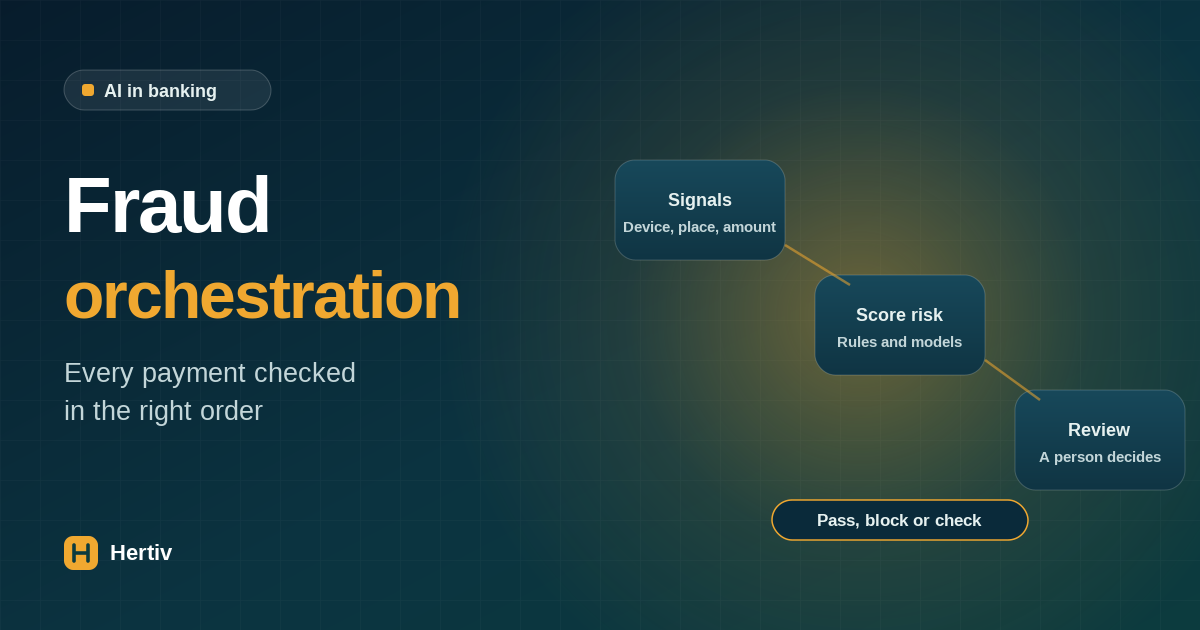
An orchestrated fraud check works by moving a payment through stages, with each stage deciding whether the payment can pass, must stop, or needs a deeper look. The first stages are fast and simple, and the later stages are slower and more careful.
A typical flow looks like this:
- Collect signals. The system gathers facts about the payment: the amount, the device, the location, the account history and how fast the payment followed the last one.
- Apply rules. Simple rules pass the obvious cases and block the clearly bad ones, such as a payment from a device that was reported stolen.
- Score with models. The payments that are left get a risk score from one or more models trained on past fraud and honest payments.
- Route the case. Low-risk payments go through, high-risk payments are blocked or challenged, and the middle group goes to a human reviewer.
- Learn from the outcome. The reviewer's decision is recorded and used to improve the rules and the models.
Each stage only runs when it is needed. That keeps honest payments fast and keeps the review team's time for the cases that truly need a person. The same staged thinking is used in AI agent workflows that route work between tools and people.
What signals feed the system?
The signals that feed a fraud system are facts about the payment, the device and the account, gathered in the moment the payment is made. No single signal proves fraud, so the system looks at them together.
Common signals include the amount and the currency, the time of day, the device and whether it is known, and the location and whether it matches the customer's usual places. The account's recent history matters too, such as how many payments were made in the last hour.
A payment that is large, from a new device, in a new place, at an unusual hour, and just after several failed attempts looks very different from a normal weekly payment.
Signals also come from outside the payment itself. A bank may check whether the card was recently reported lost, whether the account details changed that day, or whether the same device was used with several accounts. The orchestrator decides which of these signals to collect for each payment, so the cheap signals run first and the costly ones run only when the risk is high enough.
How do rules and models work together?
Rules and models work together by splitting the job. Rules handle the cases where the bank already knows the right answer, and models handle the cases where the answer needs judgement. Rules are fast, explainable and easy to change, while models can spot patterns that no rule describes.
A rule might say that a payment over a set amount needs a second check, or that a payment from a blocked country stops at once. A model might score a payment based on dozens of signals and give a number that says how much it looks like past fraud. The orchestrator uses the rule result first, then the model score, and then decides whether to pass, block or send the case to a person.
The balance matters. Too many rules and the system blocks honest customers for no reason. Too much trust in one model and a new kind of fraud can slip through because the model never saw it before. That is why banks keep both, and why reviewers check a sample of the cases the system passed as well as the ones it blocked. The same care is needed when testing AI models before they go live.
What happens after a payment is flagged?
After a payment is flagged, it goes to a case queue where a human reviewer looks at the signals, the score and the account history, then decides whether to let it through, block it, or ask the customer for more proof. The reviewer does not start from zero: the orchestrator hands over the reason for the flag and the facts that mattered most.
The reviewer has a few options. They can release the payment, block it and freeze the card, or contact the customer to confirm the payment is real. In many banks, a customer can confirm a payment in their app, which clears the flag in seconds and lets the payment go through without a phone call.
Every decision is recorded. When a reviewer clears a payment, that outcome teaches the system that similar payments are honest. When a reviewer confirms fraud, that case becomes training data for the next round of model updates. Without this feedback loop, the system slowly drifts away from what fraud actually looks like.
Example (hypothetical): one day of card payments at a small bank
Example (hypothetical): a small bank processes 10,000 card payments in one day. Rules and models flag 3 percent of them, which is 300 payments, and the rest go through without a review. Of the 300 flagged payments, reviewers clear 240 in the first pass because the signals turn out to be normal, such as a customer travelling abroad.
The remaining 60 payments need a deeper look. Reviewers call or message the customers, and 12 of those 60 turn out to be real fraud. That means 12 fraud cases were caught out of 10,000 payments, and 288 honest customers had a short delay instead of a blocked card.
The bank also checks a sample of the payments it passed. In one week it reviews 200 passed payments and finds 1 fraud case that slipped through, which is a reminder that no system catches everything. The team uses that case to add a new rule, and the next week's sample shows the gap is closed.
What are the common mistakes?
The most common mistakes in fraud orchestration are trusting one model, skipping the feedback loop, and blocking honest customers without a fast way back.
- Trusting one score. A single model can miss a new kind of fraud, so keep rules, models and human review working together.
- Skipping feedback. If reviewer decisions never reach the models, the system keeps making the same mistakes.
- Blocking without a way back. A blocked honest payment needs a quick fix, such as an in-app confirmation, or the customer will leave.
- Collecting signals you do not use. Every signal costs time and money, so collect only what changes a decision.
- Never checking what you passed. Review a sample of passed payments, or fraud that slips through stays hidden.
Key takeaways
- Fraud orchestration is a flow, not one model: rules, models and people in order
- Cheap, fast checks run first; slow, costly checks run only when the risk is high
- Rules handle the clear cases, models score the unclear ones, reviewers decide the rest
- Reviewer decisions must feed back into the rules and models
- A fast way to clear honest payments matters as much as catching fraud
Frequently asked questions
Is AI orchestration the same as a fraud detection model?
No. A fraud detection model gives one payment a risk score. Orchestration is the flow that decides which checks run, in what order, and what happens next, including when a human reviewer steps in. A bank needs both: the model to score and the flow to act.
How fast does an orchestrated fraud check run?
Most payments clear in well under a second, because the first checks are simple rules and the models run on facts that are already available. Only the flagged payments slow down, and most of those are cleared by a reviewer or a customer confirmation within minutes.
Why do honest payments get flagged?
Honest payments get flagged when they look like past fraud: a large amount, a new device, a new place or an unusual time. The system cannot tell a holiday purchase from a stolen card on its own, so it flags the payment and lets a reviewer or the customer confirm it.
Do small banks need AI orchestration?
Small banks face the same fraud as large ones, but with fewer reviewers. Orchestration helps most there, because it keeps the review team's time for the riskiest cases and lets the rest go through automatically. The flow can start simple, with rules and one model, and grow over time.
What data does the system need to start?
It needs past payments labelled as fraud or honest, plus the signals that were true at the time, such as device, location and amount. Without labelled history, the team should start with rules based on known fraud patterns and add models once enough labelled cases exist.
How do banks measure whether the flow works?
They track how many fraud cases are caught, how many honest payments are blocked, how long a flagged payment takes to clear, and how many cases each reviewer handles. A good flow catches more fraud while blocking fewer honest customers and clearing flags faster.


