AI Milestones: The Moments That Shaped Artificial Intelligence
From Turing's 1950 question to today's chatbots, the AI milestones that matter explain how the field got here. This guide covers the dates and what each one changed.
On this page
Short answer
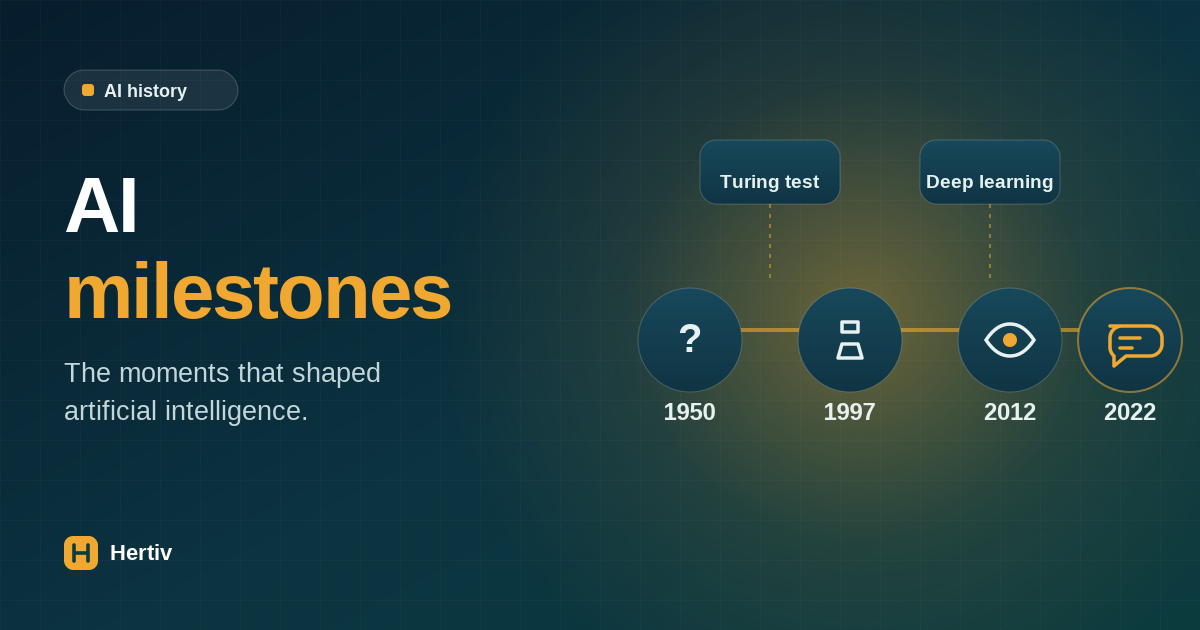
The AI milestones that matter most are the moments that changed how the field builds: Turing's test in 1950, the Dartmouth workshop in 1956, Deep Blue beating the chess champion in 1997, AlexNet in 2012, AlphaGo in 2016, the Transformer in 2017, and ChatGPT in 2022. Each one turned a research idea into something teams could use, and together they explain why AI moved from labs into everyday products.
Which AI milestones matter most?
The AI milestones that matter most are the moments that changed how the field builds, not just the ones that made headlines. A milestone counts here if it turned a research idea into something teams could use, or opened a direction that later work followed.
| Year | Milestone | Why it mattered |
|---|---|---|
| 1950 | Turing's test | Intelligence became something to measure |
| 1956 | Dartmouth workshop | The field got its name and agenda |
| 1966 | ELIZA | A simple program showed how easily people read meaning into software |
| 1997 | Deep Blue beats Kasparov | A machine beat the world chess champion |
| 2012 | AlexNet wins ImageNet | Deep learning became the standard for vision |
| 2016 | AlphaGo beats Lee Sedol | A learning system mastered Go |
| 2017 | The Transformer | Language models became easy to train at scale |
| 2022 | ChatGPT launches | AI reached the general public |
The rest of this guide walks through these moments in order, and explains what each one changed for the people building with AI.
The early years: a question and a name (1950-1956)
In 1950, Alan Turing published a paper that asked whether machines can think, and replaced the vague question with a test: if a machine's written answers cannot be told apart from a person's, it passes. The test gave the field something it had lacked, a way to judge progress from the outside.
Six years later, in the summer of 1956, a small workshop at Dartmouth College gave the field its name: artificial intelligence. The proposal, written in 1955 by John McCarthy, Marvin Minsky, Nathaniel Rochester and Claude Shannon, set out a plan to study how machines could use language, form abstractions and solve problems.
The early optimism ran ahead of what the machines of the time could do. Programs could play checkers and prove simple theorems, but they worked on tiny problems with hand-written rules, and scaling them up proved far harder than the Dartmouth group expected.
The first winters and the return of learning (1966-1986)
In 1966, Joseph Weizenbaum's ELIZA showed that a few pattern-matching rules could hold a conversation that felt human. People read understanding into its replies, which taught the field a lasting lesson: sounding intelligent and being intelligent are different things.
Progress then slowed. Funding fell in the 1970s after a critical report on AI research, and the field entered a period later called the AI winter. The 1980s brought expert systems, programs that applied hand-written rules to narrow jobs such as configuring computers, and for a while they paid their way in industry.
The turn back to learning came in 1986, when a paper on back-propagation gave neural networks a practical way to learn from data. The idea had been around for years, but the paper showed how to train networks with several layers, and that opened the path that deep learning would later follow. It is the same training idea described in what AI model training involves today.
Machines beat champions (1997-2011)
In May 1997, IBM's Deep Blue beat world chess champion Garry Kasparov in a six-game match. Deep Blue did not learn chess the way a person does; it searched millions of positions a second with the help of chess knowledge built in by its team. The win showed that a machine could beat the best human in a tightly defined game.
Fourteen years later, in 2011, IBM's Watson won the quiz show Jeopardy! against two of its greatest champions. Watson had to read clues in plain language, weigh uncertain answers and respond in time, which made it a far broader test than chess. It showed that machines could work with messy, human language at a level the public could see.
Both wins were narrow in the same way: each machine was built for one game, and neither could do anything else. The lesson was not that machines had become generally intelligent, but that a focused system with enough computing power could beat the best humans at a well-defined task.
Deep learning takes over (2012-2017)
In 2012, a deep neural network called AlexNet won the ImageNet image-recognition contest by a wide margin. It combined a large labelled dataset, graphics processors repurposed for neural-network maths, and a deeper network trained with back-propagation. After that win, deep learning became the default approach for image recognition.
In March 2016, DeepMind's AlphaGo beat Lee Sedol, one of the world's best Go players, 4-1. Go had long been considered too large to search by brute force, so AlphaGo learned from human games and then from playing against itself. Its surprising moves in the match showed that a learning system could find ideas human experts had not considered.
In 2017, a team of Google researchers introduced the Transformer, an architecture built around attention instead of the step-by-step processing used before. It made language models far easier to train at scale, and it became the foundation of the large language models that followed. The AI models guide explains the model families the Transformer made possible.
The generative era (2020-today)
In 2020, OpenAI published GPT-3, a language model at a scale no one had tried before, and it showed that plain-language prompts could work as instructions. Two years later, on 30 November 2022, OpenAI released ChatGPT as a free research preview, and a chat box put the technology in front of the general public for the first time.
The years since have been about putting models to work: agents that use tools, models that reason through steps before answering, and shared standards that let models connect to other software. The milestones of this era are less about single results and more about how quickly the technology moved into products.
Example (hypothetical): a product team planning its next year lists 12 milestones from this guide and groups them into four eras: 3 from the early years, 2 from the winters and learning, 3 from the champion years, and 4 from deep learning and the generative era.
The 3 + 2 + 3 + 4 adds to 12, and the exercise shows the team where its own product sits: it uses the Transformer era's tools to solve a problem from the expert-systems era. The history becomes a map, not just a list of dates.
What are the common mistakes when reading AI history?
The most common mistakes in reading AI history are treating a demo as a product, judging old work by today's standards, and assuming progress moves in a straight line.
- Treating a single result, such as a game win, as proof that general intelligence has arrived.
- Forgetting the winters, and assuming the field only ever moved forward.
- Crediting one milestone for a change that took a decade of smaller steps.
- Reading the past as a race between people, instead of a chain of ideas that built on each other.
History is most useful when it is read as a chain. Each milestone answered a question the last one raised, and the next one will do the same. The teams that use history well ask what each milestone changed for builders, not just who won. For leaders deciding what to build next, generative AI consulting turns that history into a plan.
Key takeaways
- Turing's 1950 test turned 'can machines think?' into something measurable.
- The Dartmouth workshop of 1956 gave the field its name and its agenda.
- Deep Blue, Watson, AlexNet and AlphaGo each proved a new kind of machine ability.
- The Transformer of 2017 made large language models practical to train.
- ChatGPT in 2022 moved AI from research labs into everyday products.
Frequently asked questions
What was the first AI milestone?
Most histories start in 1950, when Alan Turing published a paper asking whether machines can think and proposed a test for it. Earlier work on neurons and logic matters too, but Turing's paper is the moment the question became something you could measure.
What caused the AI winters?
Expectations ran ahead of what the technology could do, and funding fell when results did not match the promises. The best-known trigger was a critical 1970s report on AI research. Each winter slowed the field, but research continued, and the next wave built on what survived.
Why was AlexNet in 2012 so important?
AlexNet showed that a deep neural network, trained on a large labelled dataset with graphics processors, could beat older image-recognition methods by a wide margin. After that win, deep learning became the standard approach for vision, and soon for language too.
Did Deep Blue really understand chess?
No. Deep Blue searched millions of positions a second using chess knowledge built in by its team. It beat the world champion by being fast and thorough inside a tightly defined game, not by understanding chess the way a person does.
What came after ChatGPT?
ChatGPT's launch in late 2022 put language models in front of the general public. Since then the field has moved toward models that reason through steps, agents that use tools, and shared standards that let models connect to other software.
How should teams use AI history?
Use it as a map, not a scoreboard. Each milestone answered a question the previous one raised, so the useful question is what changed for builders. A team that knows which era its tools come from makes better guesses about what will change next.