AI Maturity Assessment: How to Measure Where You Stand
An AI maturity assessment scores how advanced your AI capability is across strategy, data, talent, governance and technology, so you can see what to fix next.
On this page
Short answer
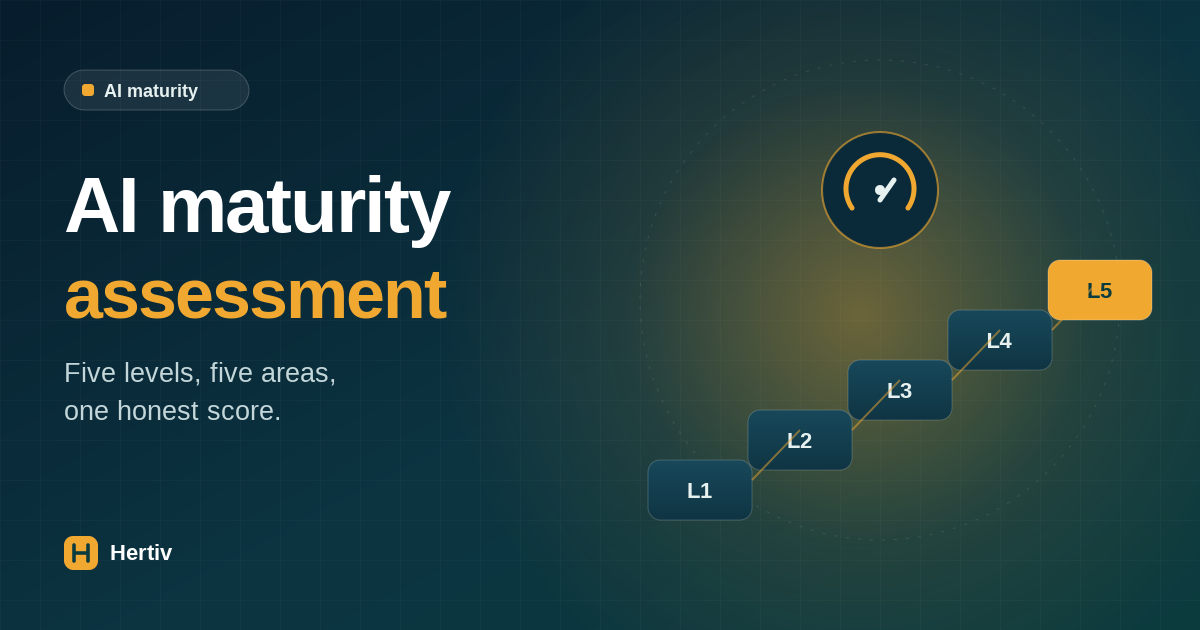
An AI maturity assessment is a structured review that scores how advanced an organisation's AI capability is, usually across five levels from ad hoc experiments to AI built into everyday decisions. It looks at strategy, data, people, governance and technology, then gives each area a level and a short list of what to improve before the next step.
What is an AI maturity assessment?
An AI maturity assessment is a structured review that measures how advanced an organisation's use of AI is, on a scale from early experiments to AI built into everyday decisions. It gives each part of the business a maturity level, so leaders can see which areas are ready to scale and which need basic work first.
The idea comes from maturity models used in software and data for years. Instead of asking whether you use AI, the assessment asks how well AI is governed, funded, staffed and measured. That shift matters, because two companies can both run pilots and still be at very different levels of readiness to scale.
| Level | Name | What it looks like |
|---|---|---|
| 1 | Ad hoc | Isolated experiments, no owner, no shared data |
| 2 | Piloting | A few pilots with a named owner and a small budget |
| 3 | Defined | Documented use cases, shared data rules, first policies |
| 4 | Managed | AI in live workflows, measured results, clear ownership |
| 5 | Embedded | AI in everyday decisions, governed and improved continuously |
Most organisations land at level 2 or 3 on their first assessment. That is a useful result, not a failure: it tells you exactly which gaps to close before spending more. A readiness assessment is a close cousin, but it answers a narrower question — whether you can start — while a maturity assessment shows how far you have come. See what an AI readiness assessment covers before you choose between the two.
What does an AI maturity assessment measure?
An AI maturity assessment measures five areas, and each one gets its own score. Strategy covers whether AI has clear goals, an owner and a budget. Data covers whether the data AI needs is findable, clean and governed. Talent covers whether staff can build, buy and use AI safely.
Governance covers who approves AI uses, how risks are reviewed and how decisions are recorded. Technology covers whether the tools, platforms and integrations can support AI in production rather than in a demo. A weak score in one area limits the others: strong models on messy data still fail, and good data without governance still creates risk.
Assessors look for concrete evidence in each area:
- Strategy. A written AI plan with named owners and funding.
- Data. Catalogued sources, access rules and quality checks.
- Talent. Named roles for building, reviewing and using AI.
- Governance. An approval list for AI uses and a risk log.
- Technology. Monitored models with rollback and logging.
Assessors gather evidence rather than asking for opinions. They read plans and policies, look at live systems, and talk to the people who run them. The data maturity models post explains the data side in more depth, since data is usually the lowest-scoring area.
How do you run an AI maturity assessment?
You run an AI maturity assessment in a few weeks, not months, by following a fixed sequence. The work is mostly interviews and document review, plus a short scoring workshop at the end.
- Agree the scope. Decide which teams, systems and AI uses are in scope.
- Pick the model. Use five levels and five areas, or a framework your team already uses.
- Gather evidence. Collect plans, policies, data catalogues, system logs and project lists.
- Interview owners. Ask each area owner what happens in practice, not what the policy says.
- Score each area. Agree a level per area in a workshop, with the evidence on the table.
- Write the roadmap. List the next three improvements per area, in priority order.
Keep the group small — an assessment lead, one owner per area, and a sponsor who can act on the result. Large committees slow the scoring down and soften the findings. If you want a step-by-step plan for the readiness version, how to run an AI readiness assessment follows the same pattern.
How do you score each dimension?
Each dimension is scored on the same five-level scale, and the score must match the evidence. Level 1 means the work happens informally, with no owner. Level 2 means someone owns it and a few examples exist. Level 3 means it is written down and followed. Level 4 means it is measured. Level 5 means it is reviewed and improved on a schedule.
Score conservatively. If a policy exists but nobody follows it, the score is the level of what actually happens, not the level of the document. Two assessors should score independently and then agree, which catches the optimistic reading. Record one or two pieces of evidence per score so the result can be checked later.
The overall maturity is usually the lowest area score, not the average. An organisation at level 4 in technology and level 1 in governance is not a level 4 organisation: the governance gap is what will block the next step. Report the lowest score first, then the average as context.
Example (hypothetical): a retailer checks its AI maturity
Example (hypothetical): a retailer with 40 stores runs an AI maturity assessment. It scores strategy 2, data 2, talent 3, governance 1 and technology 2. The average is 2.0, and the lowest score is 1, so the report calls the organisation level 1 overall, with a clear path to level 2.
The roadmap lists three fixes: appoint a governance owner and start a risk log, catalogue the five data sources the recommendation pilot needs, and write down the AI use-case list with named owners. The team estimates 6 weeks for the governance fix, 4 weeks for the data catalogue, and 2 weeks for the use-case list — 12 weeks in total, with some work running in parallel.
Three months later the team re-scores: governance moves from 1 to 2, data from 2 to 3, and the rest stay the same. The average is now 2.4 and the lowest score is 2, so the organisation is level 2 overall. The next roadmap then targets data quality and model monitoring.
What should you do after the assessment?
After the assessment, work on the lowest-scoring area first. A single weak area blocks progress more than a strong area helps it, so the roadmap should start where the score is lowest and the risk is highest.
Turn each gap into a named task with an owner and a date. 'Improve data quality' is not a task; 'catalogue the five sources the recommendation pilot needs by the end of next month' is. Review the scores every six months, or after a major change such as a new system or a new AI use case.
- Level 1 to 2. Name owners, list AI uses, start a risk log.
- Level 2 to 3. Write policies, catalogue data, fund the first live use case.
- Level 3 to 4. Measure results, monitor models, review risks on a schedule.
- Level 4 to 5. Automate checks, share what works, retire what does not.
Do not chase level 5 everywhere. Some areas only need level 3 for the business you run, and the extra effort buys little. The assessment is a guide to the next sensible step, not a race to the top of the scale.
What are the common mistakes?
The most common AI maturity assessment mistakes are scoring the policy instead of the practice, letting one strong area hide a weak one, and treating the report as the finish line.
- Scoring what the policy says instead of what actually happens
- Averaging the scores and hiding the lowest area
- Assessing only the technology and skipping governance and talent
- Running the assessment once and never repeating it
- Copying another company's target level without checking your own needs
- Letting the team that built the AI score its own work
Fix the scoring first. A second assessment run with the same evidence rules will show whether the roadmap worked, and it costs far less than the first one because the evidence is already gathered.
Key takeaways
- An AI maturity assessment scores strategy, data, talent, governance and technology on five levels
- The overall level is the lowest area score, not the average
- Score what actually happens, and keep one or two pieces of evidence per score
- Work on the lowest-scoring area first, with named tasks, owners and dates
- Re-score every six months; level 5 is not the right target for every area
Frequently asked questions
What is the difference between AI maturity and AI readiness?
Readiness asks whether you can start using AI: do you have data, skills and a use case. Maturity asks how advanced your AI capability already is, on a scale from ad hoc experiments to AI built into everyday decisions. A readiness check comes first; a maturity assessment shows how far you have come and what to improve next.
How long does an AI maturity assessment take?
Most assessments take two to four weeks. The work is interviews, document review and a scoring workshop. Larger organisations with many teams can take longer, but the assessment should stay small and focused: a named lead, one owner per area, and a sponsor who can act on the result.
Who should run the assessment?
Someone who does not own the AI work being assessed, so the scoring stays honest. The assessor needs access to plans, systems and the people who run them. Teams that score their own work tend to score it a level higher than the evidence supports.
What does a level 3 organisation look like?
At level 3, AI uses are written down with named owners, data sources are catalogued, and the first policies exist. At least one use case runs in production. The difference from level 2 is that the practice is documented and followed, not just happening in a few places.
Do we need to reach level 5?
No. Level 5 means AI is reviewed and improved continuously across every area, which is more than most organisations need. Some areas only need level 3 for the business you run. Use the assessment to find the next sensible step, not to chase the top of the scale.
How often should we repeat the assessment?
Every six months, or after a major change such as a new system, a new AI use case or a reorganisation. Repeating the same scoring with the same evidence rules shows whether the roadmap worked and where the next gap is.