Data Maturity Models: Where Your Team Stands
A data maturity model places your team on a scale from ad hoc spreadsheets to data that drives decisions. Use it to find your level and the next step up.
On this page
Short answer
A data maturity model is a scale describing how well an organisation collects, trusts and uses data, usually in five levels from ad hoc to optimising. It is useful as a diagnosis: it names the current level, the evidence for it, and the single change that moves the team up one level.
What is a data maturity model?
A data maturity model is a scale that describes how well an organisation collects, trusts, and uses data. It places a team at a level — from ad hoc spreadsheets to data that drives decisions — and names what changes at the next level.
The point is not the score. It is the shared picture: everyone agrees where the team stands and what the next step is, instead of arguing about tools while the underlying data stays messy.
| Level | What data looks like | What decisions look like |
|---|---|---|
| 1. Ad hoc | Spreadsheets, manual pulls | Gut feel, one-off reports |
| 2. Repeatable | Shared definitions, some pipelines | Regular reports, known numbers |
| 3. Defined | Governed data, tested pipelines | Dashboards people trust |
| 4. Managed | Measured quality, monitored | Forecasts and experiments |
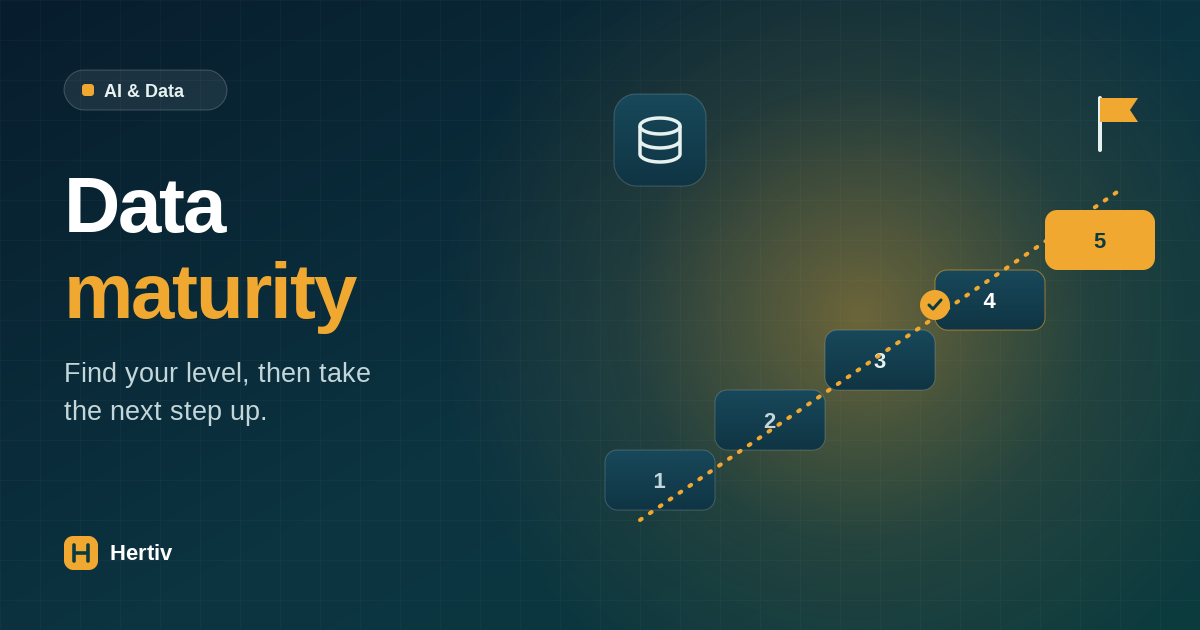
| 5. Optimising | Data products, feedback loops | Decisions tested and learned from |
Different models use different labels and counts, but the idea is the same: maturity is about trust and habits, not about how many tools you own.
What do the five levels look like in practice?
At level 1, data lives in personal spreadsheets and every report is built by hand. Two people asking the same question get different answers, and nobody can say which one is right.
Level 2 adds shared definitions and repeatable reports. The numbers still need manual work, but the same report gives the same answer each week.
Level 3 brings governance: named owners, tested pipelines, and access rules. Level 4 adds measurement — data quality is tracked like uptime, and problems are caught by monitors rather than by angry users. Level 5 treats data as a product, with feedback loops that improve it over time.
Most teams sit at level 2 or 3. That is normal, and it is also where the next step is clearest: the gap is usually definitions and ownership, not technology.
The jump from level 2 to 3 is usually the hardest, because it needs named owners and agreed definitions — people work, not tool work. The jump from 3 to 4 needs measurement, which is easier once ownership exists.
How do you assess your level honestly?
An honest assessment uses evidence, not opinion. Ask for the same number from three sources and see whether they agree; that single test tells you more than any survey.
- Pick five numbers the business uses every week.
- Ask three teams for each number and compare.
- Trace one number back to its source system.
- Count how many hours a week go to cleaning data by hand.
- Check whether anyone owns each key dataset.
If the numbers disagree or the trace ends in a spreadsheet, the team is at level 1 or 2. If they agree and the trace is short, the team is further along than it thinks.
Run the assessment with the people who use the numbers, not only with the data team. Their answers about trust are the evidence that matters most.
How do you move up one level?
Move one level at a time, and fix the constraint that blocks the next level. Buying a new platform before the definitions are agreed only moves the mess into a nicer tool. One level at a time also keeps the work fundable: each level has a clear outcome, so each step can be approved on its own merits.
From level 1 to 2, agree definitions for the ten most-used numbers and put them in one place. From 2 to 3, name an owner for each key dataset and add tests to the pipelines that build it.
From 3 to 4, measure quality — freshness, completeness, and accuracy — and alert on it. From 4 to 5, pick one decision and run it as an experiment, so the data habit becomes a learning habit. Starting a first project with this mindset is covered in starting a data science project.
Which maturity model should you pick?
Most maturity models agree on the shape — a few levels, each with clearer definitions, ownership, and measurement — and differ in the details. The right one is the one your team will actually use, not the one with the most impressive diagram.
Pick by fit: a model built for data teams will talk about pipelines and governance; a model built for business leaders will talk about decisions and value. If the language feels foreign to the people who must act on it, they will ignore it.
Run the same model twice a year so progress is comparable. Switching models every assessment makes the scores meaningless, because you cannot tell whether the team improved or the ruler changed.
Keep the assessment light. A half-day workshop with the people who use the numbers produces a more honest result than a month-long survey that nobody reads.
Example: a retail team finds its level
Example (hypothetical): a retail chain has six analysts who each spend 12 hours a week cleaning sales data by hand. That is 72 hours a week — nearly two full-time roles — spent on work that adds no insight.
After standardising definitions and building one shared pipeline, cleaning drops to 5 hours per analyst per week, or 30 hours in total. The team saves 42 hours a week, about 168 hours a month, and the weekly sales number finally agrees across departments.
The win is not the hours saved. It is that the sales number is now trusted, so managers stop re-checking it and start acting on it. That shift in trust is what moving up a level actually looks like. The business value of cleaner data is covered in data science for business.
What are the common mistakes?
The most common data maturity mistakes are treating the model as a score, buying tools before agreeing definitions, and measuring dashboards instead of trust.
- Chasing the score. Treating the model as a grade to show off rather than a diagnosis of what to fix next.
- Tools before definitions. Buying a platform before agreeing what the key numbers mean.
- Counting dashboards. Measuring maturity by the number of dashboards instead of trust in the numbers.
- No ownership. Skipping data ownership, so nobody fixes bad data when it appears.
- Jumping two levels. Trying to move from ad hoc to measured in one project, which stalls.
Key takeaways
- A data maturity model is a diagnosis, not a score: it names your level and the next step
- The five levels run from ad hoc spreadsheets to data treated as a product with feedback loops
- Assess with evidence: ask three teams for the same number and trace it to its source
- Move one level at a time, fixing definitions and ownership before buying new tools
- Trust in the numbers matters more than the number of dashboards
Frequently asked questions
What is the best data maturity model to use?
There is no single best model; most use four or five levels with similar ideas. Pick one whose level descriptions match your team's language, then use it consistently so progress is comparable over time. The model matters less than the honest assessment.
How long does it take to move up one maturity level?
One level usually takes a few months of focused work, not a single project. Agreeing definitions and naming owners can happen in weeks; building tested pipelines and quality measurement takes longer. Plan for steady work rather than a big launch.
Can a small team reach a high maturity level?
Yes. Maturity is about habits, not headcount. A small team with agreed definitions, one owner per dataset, and tested pipelines can sit at level 3 or 4, while a large team with no ownership stays at level 1.
What is the difference between data maturity and data quality?
Data quality is one part of maturity: whether the data is accurate, complete and fresh. Maturity is broader — it covers definitions, ownership, governance, measurement and how decisions use data. Good quality data in a team that does not trust it is still low maturity.
Do we need a data maturity assessment before buying tools?
Yes, and it is cheap insurance. An assessment shows whether the gap is definitions, ownership or technology. Buying a platform when the real gap is definitions only moves the same mess into a nicer tool.
Who should own a data maturity assessment?
A mix of data and business people, led by someone both sides trust. The data team can trace pipelines, but only the business users can say whether they trust the numbers. An assessment run by one side alone usually misses half the picture.


