What Is an AI Readiness Assessment, and How Does It Work?
An AI readiness assessment checks whether your data, systems, people and rules are ready for AI before you spend money on building it.
On this page
Short answer
An AI readiness assessment is a structured review of whether an organisation can build and run AI systems successfully. It looks at data quality, systems, skills, governance and the use cases themselves, then reports what is ready, what is missing and what to fix first. It is done before a build, not after a pilot has already failed.
What is an AI readiness assessment?
An AI readiness assessment is a short, structured review that answers one question: is this organisation ready to use AI, and where should it start? It is not a technology purchase and not a strategy document. It is a practical check of the foundations that AI depends on.
The review usually takes two to four weeks. An assessor interviews staff, looks at sample data, checks how systems connect and reviews the rules that govern data use. The output is a report that ranks use cases against the data and skills the team actually has, and lists the gaps in order of importance.
The point is to avoid the most common failure in AI projects: building a model on data that is incomplete, hard to reach or legally off limits, then discovering the problem after months of work. A readiness check finds that out in weeks, for a small fraction of the build cost. Hertiv offers an AI readiness assessment that follows this pattern.
What does the assessment check?
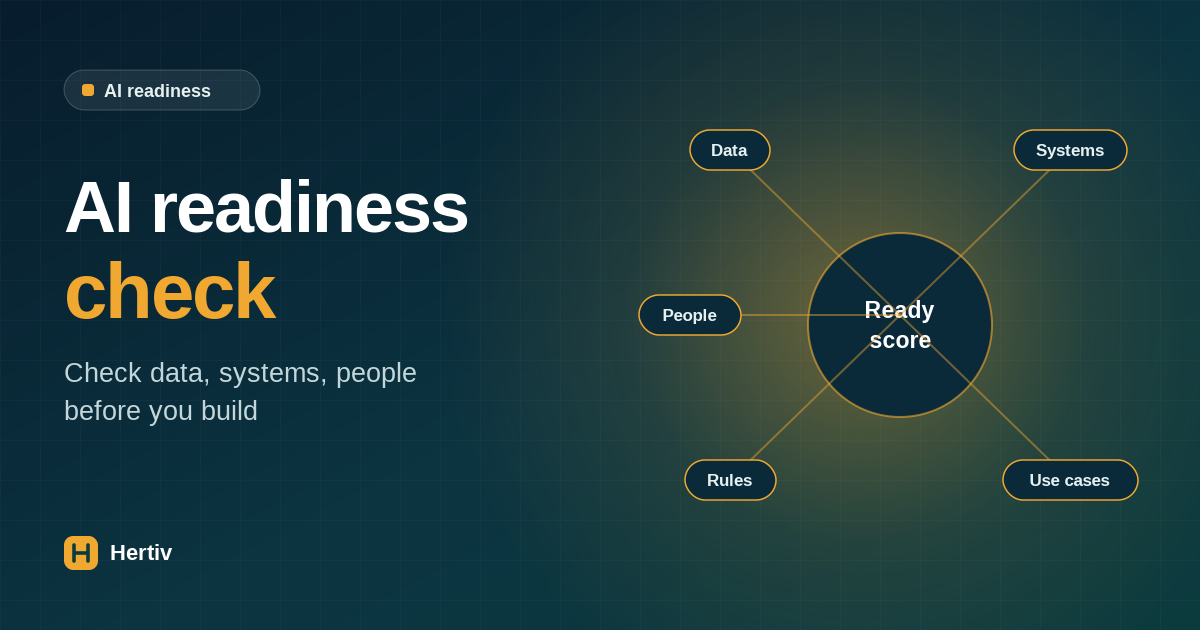
A good assessment covers five areas. Each one is scored, and the weakest area usually sets the pace for the whole programme, because AI is only as strong as its weakest input.
| Area | What is checked | Why it matters |
|---|---|---|
| Data | Quality, coverage, access and labelling | Bad data produces wrong answers |
| Systems | How data flows between tools | Blocked data stops a project |
| People | Skills, roles and time available | No owner means no follow-through |
| Governance | Privacy, security and sign-off rules | Rules decide what is allowed |
| Use cases | Value, measurability and effort | Weak cases waste the budget |
Data usually gets the most attention, because it is where most gaps hide. The assessor asks simple questions: can you get the records the model needs, are they labelled correctly, and who is allowed to use them? If any answer is no, that use case is not ready yet.
How does the assessment run?
The assessment runs in four steps, and each step narrows the work to what matters most.
- Scope the use cases. List the AI ideas on the table and pick the three to five that look most promising.
- Interview the owners. Talk to the people who own the data, the process and the budget for each case.
- Check the data and systems. Look at samples, check access, and map how data moves between tools.
- Score and report. Rate each area, rank the use cases, and list the gaps in the order they should be fixed.
The report should name a first use case, the data work it needs, the owner, and a rough timeline. A report that only says "improve data quality" without naming the data, the owner and the effort is not finished. Before building, a proof of concept is the usual next step once a case passes the check.
What does the report look like?
The report is short: a score per area, a ranked list of use cases, and a fix list. The score is usually a simple scale, such as one to five, with a sentence explaining each number. A score of two on data access means the team cannot reach the records it needs, and the report should say why.
The use case ranking matters most. A case with strong data and a clear owner ranks above a case with bigger promised value but no data at all. That ranking is how the assessment saves money: it stops the team from starting the case that looks best in a slide deck and starting the one that can actually ship.
Good reports also name what not to do. A use case that needs data the company is not allowed to use should be parked, not started. Writing that down early avoids a difficult conversation six months later.
Example: a retailer checks readiness before building
Example (hypothetical): a retailer with 40 stores wants an AI tool that answers customer questions from its product catalogue. The assessment team scores five areas from one to five and finds data at 2, systems at 3, people at 4, governance at 3 and use cases at 4.
The total is 16 out of 25. The weak point is data: product descriptions sit in three different systems, and a fifth of the items have no description at all. The report recommends fixing the catalogue first, which the team estimates at four weeks of work, then running a small pilot on the 200 best-described products.
The pilot runs on clean data, answers are checked by staff, and the team learns the real accuracy before spending on a full build. Without the assessment, the same team would have built on the messy catalogue and blamed the model for the mistakes.
What are the common mistakes?
The most common mistakes are treating the assessment as a formality, scoring what the team wishes were true, and shelving the report once it is written.
- Scoring wishes, not facts. A data score of four means the data is actually reachable and labelled, not that it could be.
- Skipping the interviews. The data owner knows where the gaps are; a document review does not.
- Ranking by excitement. The most exciting use case is often the least ready, and starting it first burns the budget.
- No owner for the fixes. A gap with no named owner and no date stays a gap.
- One assessment, forever. Readiness changes as systems and data change, so the check should repeat each year.
What should you do after the assessment?
After the assessment, fix the top gap for the top-ranked use case, then run a small pilot with human review. Do not try to fix every gap at once, and do not start a second use case until the first one is running.
A practical sequence is to clean the data the first case needs, connect the systems it reads from, name an owner, and agree how success will be measured. The pilot should have a clear stop point: if accuracy or time saved does not meet the target, the team stops and learns, rather than spending more.
If the gaps are large, the assessment may recommend a data or governance project first, before any AI work. That is a useful answer too. Knowing what the model needs is part of the work, and testing AI models properly starts with data you can trust.
Key takeaways
- An AI readiness assessment checks data, systems, people, governance and use cases before a build
- The weakest area sets the pace: AI is only as strong as its weakest input
- The report should rank use cases and name the first fix, its owner and its effort
- Data gaps are the most common finding, and they are cheaper to fix before building
- Repeat the check yearly, because readiness changes as systems and data change
Frequently asked questions
How long does an AI readiness assessment take?
Most take two to four weeks, depending on how many use cases are in scope and how easy it is to reach the data owners. A single use case with one data source can be assessed in a week, while a company-wide review with five cases takes longer.
What is the difference between an AI readiness assessment and a proof of concept?
The assessment checks whether you are ready to build, by reviewing data, systems, skills and rules. A proof of concept builds a small working version to test whether the idea works in practice. The assessment usually comes first, because it picks the case worth proving.
Who should take part in an AI readiness assessment?
The data owner, the process owner, someone from IT or engineering, and the person who owns the budget. Without the data owner in the room, the assessment guesses about the one thing that matters most.
Does a small business need an AI readiness assessment?
A lighter version is enough. List the use case, check you can reach the data it needs, confirm who owns it and agree how you will measure success. That is a readiness check, even without a formal report.
What happens if the assessment says we are not ready?
That is a useful result. It names the gaps, usually in data or access, and the work needed to close them. Fixing the top gap for the best use case is cheaper than building on data that is not ready.
How often should readiness be reassessed?
Once a year, or after a big change such as a new system, a merger or a new data rule. Readiness drifts as systems and data change, and a yearly check catches that before the next AI project starts.


