AI Innovations in Dubai: What Is Happening Now
AI innovations in Dubai run from a national strategy launched in 2017 to the Dubai AI Campus and Chief AI Officers in every department. Here is what is live.
On this page
Short answer
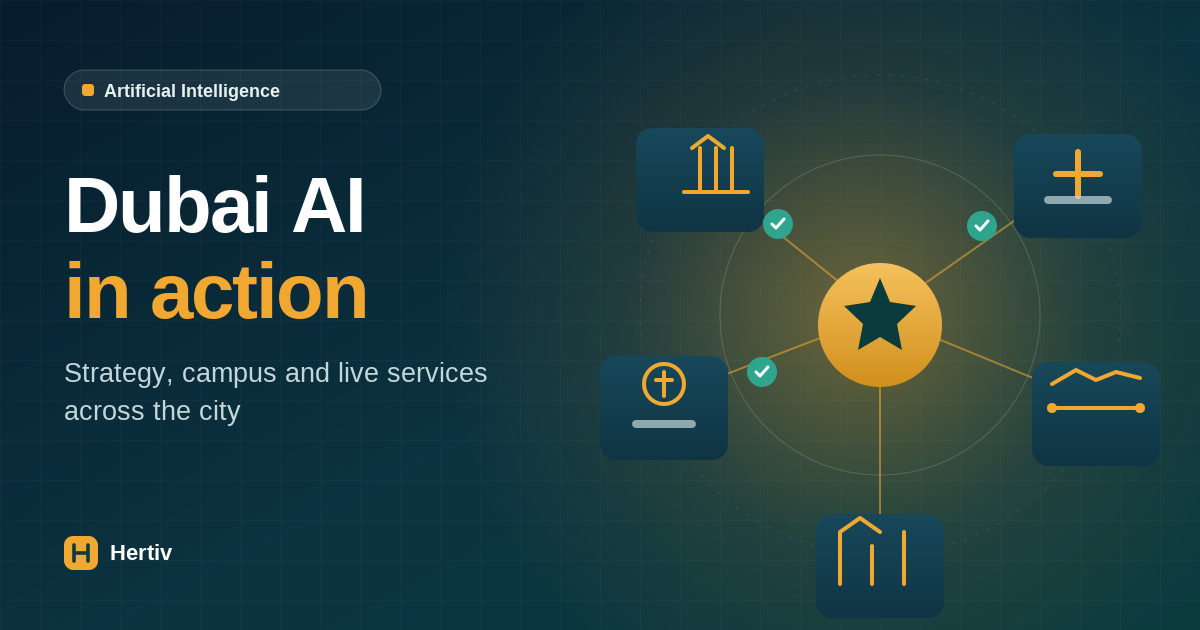
AI innovations in Dubai are the live deployments of artificial intelligence across the city's government services, hospitals, banks and transport networks, backed by the UAE's 2017 national AI strategy and Dubai's own 2024 Universal Blueprint for AI. The Dubai AI Campus in DIFC hosts the startups building the tools, and every government department has a Chief AI Officer responsible for putting them into service.
What are AI innovations in Dubai?
AI innovations in Dubai are the government programmes, startups and deployed systems that put artificial intelligence into daily services across the city, from government counters and hospitals to transport and finance. Dubai treats AI as city infrastructure, not as a research project, so the work shows up in services residents and businesses already use.
The pattern is consistent: a government plan sets the direction, a dedicated cluster hosts the companies, and large public services adopt the tools first. That is why Dubai's AI story reads as a list of live deployments rather than a list of announcements.
| Area | What is happening | Who uses it |
|---|---|---|
| Government services | AI answers and processes applications | Residents and businesses |
| Healthcare | AI triage and imaging support | Clinics and hospitals |
| Finance | AI checks and customer service | Banks and insurers |
| Transport | AI traffic and transit planning | Commuters and operators |
| Startups | AI firms clustered at DIFC | Founders and investors |
For the health side of that story, see AI in healthcare in Dubai, which covers what clinics use now and which rules shape it.
Why did Dubai move early on AI?
Dubai moved early because the UAE made AI a national policy in 2017, when it published its National Strategy for Artificial Intelligence and appointed the world's first Minister of State for Artificial Intelligence. The strategy set 2031 as the target year for the UAE to rank among the world's leading AI nations.
The early start matters for a simple reason: rules, talent and infrastructure take years to build. By the time other cities were writing their first AI plans, Dubai already had a strategy, a minister and a set of government AI projects under way, so later programmes could build on existing work instead of starting from zero.
The federal strategy covers eight sectors, including health, transport, energy, education and the environment. Dubai then added its own city-level plan on top, which is where the Dubai Universal Blueprint for Artificial Intelligence comes in.
What is the Dubai Universal Blueprint for AI?
The Dubai Universal Blueprint for Artificial Intelligence is Dubai's city-level AI plan, launched in April 2024. Its stated aim is to add AED 100 billion a year to Dubai's economy through the digital economy and to raise productivity by 50%.
The Blueprint works through concrete steps rather than slogans. One of the first was a mandate for every Dubai government entity to appoint a Chief AI Officer, so each department has a named person responsible for putting AI into its services.
It also created the Dubai AI Campus, a dedicated cluster for AI companies inside the DIFC Innovation Hub. The idea is to put startups, investors and large companies in one place, so that a small AI firm can find customers, funding and office space without leaving the district.
What is the Dubai AI Campus?
The Dubai AI Campus is a dedicated cluster for AI companies inside the Dubai International Financial Centre, inaugurated in May 2024 as the first phase of the Blueprint. Its first phase registered more than 75 businesses on a 10,000-square-foot site.
The campus offers a dedicated AI licence under DIFC's legal framework and brings together companies working on AI products, from small startups to teams from large technology firms. A second phase is planned to extend over 100,000 square feet, with a stated target of attracting more than 500 companies and creating more than 3,000 jobs by 2028.
For a company choosing where to base an AI team, the campus answers three questions at once: where to register, who to sell to, and who to hire. Banks, insurers and government bodies sit nearby in DIFC, and the campus runs events that connect them with the startups inside. The firms already based in the city are covered in top AI development companies in Dubai.
Where does Dubai use AI today?
Dubai uses AI today across government services, health, finance and transport. Government departments use AI to answer questions, process applications and route requests, with a Chief AI Officer in each entity responsible for the rollout.
In health, Dubai clinics use AI to sort patient messages, support imaging and speed up routine checks, under rules set by the Dubai Health Authority. In finance, banks and insurers in DIFC use AI for customer service, fraud checks and document work.
Transport is another live area: the Roads and Transport Authority uses AI in traffic management and public transport planning, and utilities use it to manage demand. The common thread is that these are working systems inside large organisations, not pilots. If your own company is planning a similar move, an AI strategy consulting engagement in Dubai usually starts by mapping which of these patterns fits your operations.
Example (hypothetical): a Dubai retailer joins the AI cluster
Example (hypothetical): a Dubai retailer with 12 shops wants AI help with stock and customer questions. It joins the AI Campus, where it meets three small AI firms in a month instead of searching for six months.
It picks one firm to build a stock-forecasting tool for its top 200 products and another to answer common customer questions on its website. The stock tool takes eight weeks to build and test; the customer-question tool takes five weeks. The arithmetic is simple: 13 weeks of work replaces an estimated 40 weeks of searching, shortlisting and procurement done the old way.
The retailer keeps its own staff in charge of decisions: the AI suggests stock levels, a manager approves them. After three months it reviews whether stock-outs fell and whether customers got faster answers, and only then decides whether to extend the tools to all 12 shops.
What are the common mistakes?
The most common mistakes with AI in Dubai are copying another city's plan, treating the campus as a shortcut, and starting with technology instead of a service problem.
- Copying another city's AI plan instead of using Dubai's own rules, licences and clusters.
- Joining the AI Campus expecting customers to arrive, instead of selling to the banks and departments nearby.
- Starting with a model instead of a service problem, such as long queues or slow approvals.
- Ignoring the Chief AI Officer route: government buyers work through named officers, not cold emails.
- Skipping data and privacy checks, which stall a project once a regulator asks questions.
A small, checked pilot inside one department beats a city-wide plan that never gets past the first meeting. Prove the value once, then extend it.
Key takeaways
- Dubai's AI push rests on a 2017 national strategy and a 2024 city Blueprint
- The Dubai AI Campus in DIFC hosts the startups building the tools
- Every Dubai government department has a Chief AI Officer
- AI is live in government services, health, finance and transport
- Start with one service and one buyer, then extend what works
Frequently asked questions
What is the Dubai Universal Blueprint for AI?
It is Dubai's city-level AI plan, launched in April 2024. Its stated aim is to add AED 100 billion a year to Dubai's economy through the digital economy and to raise productivity by 50%. Its first steps included Chief AI Officers in every government entity and the Dubai AI Campus at DIFC.
What is the Dubai AI Campus?
It is a dedicated cluster for AI companies inside the Dubai International Financial Centre, inaugurated in May 2024. Its first phase registered more than 75 businesses, and a second phase aims to attract more than 500 companies and create more than 3,000 jobs by 2028.
Which sectors use AI most in Dubai?
Government services, healthcare, finance and transport lead the way. Government departments use AI to answer questions and process applications, clinics use it for triage and imaging support, banks use it for service and fraud checks, and the transport authority uses it for traffic and transit planning.
Do I need a special licence to run an AI company in Dubai?
The Dubai AI Campus offers a dedicated AI licence under DIFC's legal framework. Outside the campus, a normal trade licence applies, and the rules differ by free zone and activity, so check the current requirements with DIFC or a licensing adviser before you register.
How do I start using AI in a Dubai business?
Pick one service problem, such as slow approvals or long queues, and one buyer or department to pilot with. Talk to the AI firms at the Dubai AI Campus, run a small pilot for a few weeks, and review the results before extending the tool to the rest of the business.
Is Dubai's AI push only for large companies?
No. The Dubai AI Campus is built for startups as well as large firms, and many of the tools in use were built by small teams. A small business can start with one pilot, such as answering customer questions, without a large budget or a dedicated AI team.