AI in Warfare: What It Does and What It Cannot Do
AI in warfare is already used for surveillance, logistics and training, and it is tested for targeting and autonomy. Here is where it is used and what it cannot do.
On this page
Short answer
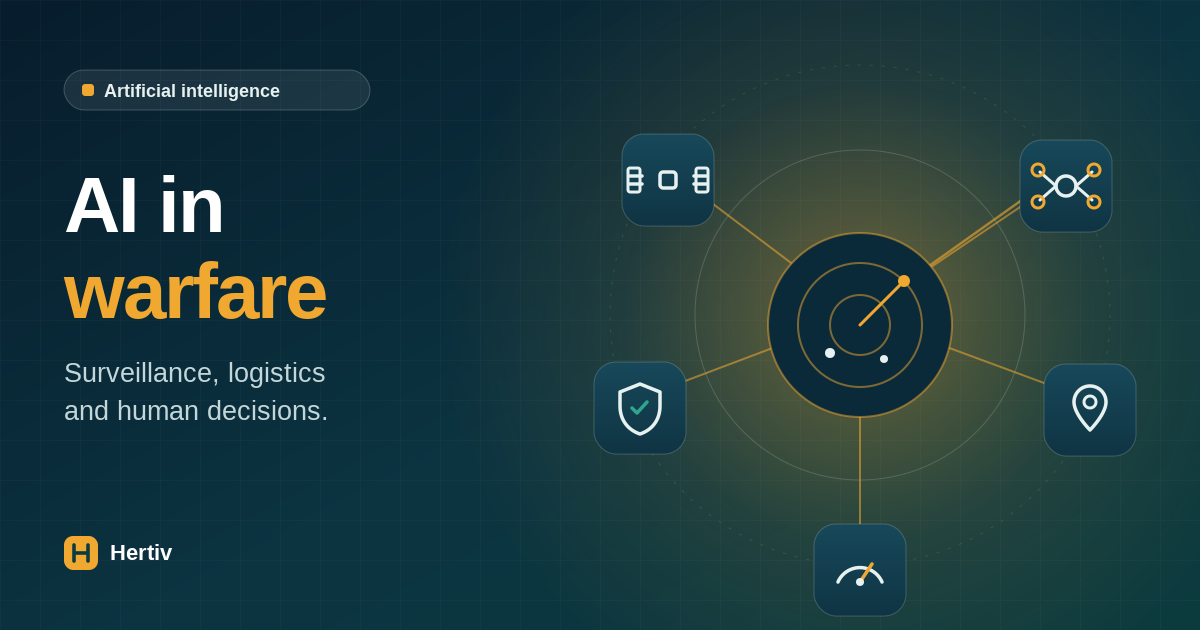
AI in warfare means using machine learning for military tasks: reading surveillance images, planning logistics, maintaining equipment, training soldiers and supporting decisions. It is used most where data is plentiful and the task is repetitive; it is not a replacement for human judgement in decisions about force.
What is AI in warfare?
AI in warfare is the use of machine learning by armed forces to analyse information, plan operations and operate equipment. The AI reads images, signals, maintenance records and supply data, then produces assessments, alerts and recommendations that commanders and operators review.
The table below shows the five areas where AI is used most in military work today.
| Area | What the AI does | Human role |
|---|---|---|
| Surveillance | Sorts images and video, flags objects | Confirms what matters |
| Logistics | Plans routes and predicts shortages | Approves the plan |
| Maintenance | Predicts part failures from sensor data | Schedules the repair |
| Cyber defence | Spots intrusions and anomalies | Decides the response |
| Training | Builds adaptive simulations | Sets the exercise |
Militaries were early users of AI because they hold large amounts of sensor data and because the cost of a slow decision can be high. The same technology is used in civilian work, from medical imaging to fleet maintenance, but the stakes and the rules are different in a military setting.
For the wider picture of AI in defence technology, why the military needs the metaverse covers how simulation and virtual training fit into the same picture.
How is AI used for surveillance and reconnaissance?
AI is used for surveillance by sorting the flood of images and video that drones, satellites and sensors collect. A human team cannot watch every feed, so models flag the objects, movements and changes that are worth a look, such as a vehicle where none was before.
One well-known example is the US Department of Defense programme that used machine learning to sort drone video, so analysts spent their time on clips the model flagged instead of watching hours of empty footage. The model did not decide what was a target; it reduced the amount of footage a person had to watch.
The limits are familiar from civilian computer vision: poor light, bad weather and unusual angles all reduce accuracy, and a model trained on one kind of terrain can fail in another. Analysts are trained to treat a model flag as a suggestion, not a fact, and to check it against other sources. The vision models behind this work are the same kind covered in what object detection is, and the same limits apply.
What does AI do for logistics and maintenance?
AI helps military logistics by forecasting what will be needed, where, and when. Models read consumption records, weather, routes and exercise plans, then suggest stock levels and delivery schedules. The aim is to avoid both shortages and the cost of shipping too much.
Predictive maintenance is a second use. Sensors on vehicles, aircraft and ships record vibration, temperature and wear, and models flag the parts likely to fail before they do. Maintenance teams can then fix a part during planned downtime instead of after a breakdown in the field.
These are the least controversial uses of military AI, because they are the same jobs AI does in civilian fleets and factories. The data is internal, the decisions are reversible, and the benefit is measured in readiness and cost rather than in combat outcomes.
How autonomous are military drones and vehicles?
Military drones and vehicles are autonomous in navigation and routine flight, but not in decisions about using force. A drone can fly a route, hold a position and return home on its own, and some can search an area for a defined object. A human still authorises any weapon release in the systems that are publicly known.
Swarming is the next step being tested: groups of small drones that share information and divide a search area between them. The research goal is coordination, so one operator can supervise many aircraft instead of flying one at a time.
Fully autonomous weapons that select and engage targets without human approval are the subject of an open international debate. No major military has publicly confirmed deploying such a system, and several states have called for rules that keep a human in the decision. The technology for autonomy exists; the policy does not yet agree on where the line sits.
What are the limits and risks of AI in warfare?
The main limits are data, deception and accountability. Models need training data that matches the real environment, and war is exactly the setting where conditions change fast and data is scarce, incomplete or deliberately misleading.
Deception is a real risk. An adversary can feed false signals, spoof sensors or poison the data a model learns from, and a model that trusts its inputs will produce confident wrong answers. Testing against deception is part of military AI development, but no test covers every trick.
Accountability is the hardest problem. If an AI-assisted decision causes harm, it is not always clear who is responsible: the commander, the operator, the developer or the model itself. Most legal and military thinking puts responsibility on the human who authorised the action, which is why human oversight is treated as a requirement rather than a preference.
How is AI in warfare governed?
AI in warfare is governed by a mix of existing law, military rules and emerging policy. The laws of armed conflict already require distinction between combatants and civilians, proportionality and precautions against harm, and those rules apply whether a human or a model helped make the decision.
Most militaries publish principles that require human judgement in decisions about force, testing before deployment, and audit trails for AI-assisted actions. Some states have proposed international rules for autonomous weapons, and talks on the subject continue in international forums.
Export controls are a third layer. Many governments restrict the sale of advanced chips, models and military software, so the supply chain for military AI is itself a policy question. Teams building defence technology need to check these rules early, because they shape what can be built and sold.
For teams building AI under strict oversight, AI governance and responsible AI consulting covers the controls that keep human review in the loop.
Example (hypothetical): a maintenance team plans repairs with AI
Example (hypothetical): a base maintains 40 trucks, and each truck carries sensors that record engine temperature, vibration and hours since the last service. A model reads the sensor data each week and lists the trucks most likely to need a repair in the next month.
In one month the model flags 6 trucks. The maintenance team inspects all 6 and finds real wear in 5 of them, so 5 repairs are done during planned downtime. One flagged truck is fine, so the team records it as a false alarm and checks why the model flagged it.
Before the model, the team found most faults only when a truck broke down, which took about 3 days of downtime per breakdown. With planned repairs, each fix takes about half a day. The gain is measured in trucks available, not in combat, and every repair decision stays with the maintenance chief.
What are the common mistakes?
The most common mistakes are trusting a model in conditions it was never tested in, treating a flag as a fact, and forgetting that an adversary will try to fool the system.
- Trusting lab accuracy. A model that scores well on clean test data can fail in rain, dust or a new setting.
- Treating a flag as a decision. A model flag is a suggestion; the decision needs a human and other sources.
- Ignoring deception. Spoofed sensors and poisoned data are real threats, not edge cases.
- No audit trail. If nobody can reconstruct what the model saw and recommended, accountability fails.
- Removing the human too early. Automating a step before the team understands its failure modes creates risk, not speed.
Key takeaways
- AI sorts, flags and recommends; humans decide, especially about force
- Surveillance, logistics and maintenance are the most established military AI uses
- Models fail in new conditions and can be deceived, so testing must match reality
- The laws of armed conflict apply to AI-assisted decisions, not just human ones
- Accountability stays with the human who authorises the action
Frequently asked questions
What is AI in warfare?
AI in warfare is machine learning used by armed forces to analyse images, plan logistics, maintain equipment, train soldiers and support decisions. It is used most where data is plentiful and the task is repetitive, and it does not replace human judgement.
Is AI used to choose targets?
AI can flag objects and suggest what deserves a closer look, but in the systems that are publicly known, a human authorises any use of force. Fully autonomous target selection without human approval is the subject of an open international debate.
What is the main military use of AI today?
Surveillance and logistics are the main uses: sorting drone and satellite imagery, planning supply routes and predicting equipment failures. These jobs use large amounts of sensor data and produce recommendations a human reviews.
Can AI be fooled in warfare?
Yes. Adversaries can spoof sensors, feed false signals or poison training data, and a model that trusts its inputs can produce confident wrong answers. Military AI development includes testing against deception, but no test covers every trick.
What laws govern AI in warfare?
The laws of armed conflict apply: distinction between combatants and civilians, proportionality and precautions against harm. These rules cover AI-assisted decisions as well as human ones, and most militaries add their own rules requiring human oversight.
Does AI make war safer or more dangerous?
Both arguments exist. Supporters say AI can reduce mistakes by checking more data and flagging errors; critics say it can speed up decisions beyond human control and lower the barrier to using force. The debate is unresolved.