AI in Treasury Management: Cash, Risk and Liquidity
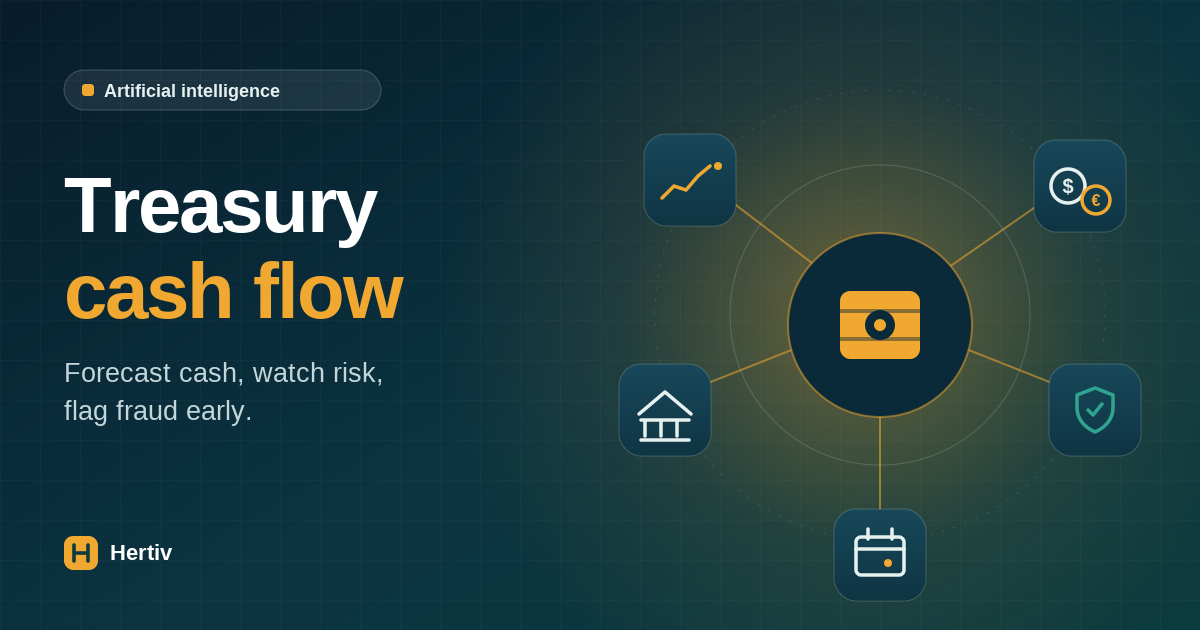
AI in treasury management forecasts cash, watches currency and rate risk, and flags fraud before money moves. Learn what it does, what it needs and how to start.
On this page
Short answer
AI in treasury management is the use of machine learning to forecast cash positions, monitor financial risk and speed up routine treasury work. It reads bank feeds, invoices, market rates and payment history, then warns the treasury team about shortfalls, exposures and unusual transactions. The team still makes the decisions; the AI makes sure no decision is made on stale numbers.
What is AI in treasury management?
AI in treasury management is the use of machine learning to help a company manage its cash, its financial risks and its payments. It takes over the repetitive work of gathering balances, matching transactions and watching rates, so the treasury team can spend its time on the decisions that matter.
A treasury team answers three questions every day: how much cash do we have, how much will we have next week, and what could go wrong. AI helps with all three. It forecasts cash from invoices and payment history, tracks exposures to currency and interest rates, and flags payments that look wrong before they leave the account.
It is not a replacement for the treasurer. Cash decisions still involve judgement about suppliers, customers and banks, and no model can make those calls alone. What AI does is keep the numbers fresh and the warnings early, so the judgement is applied to facts rather than to last month's spreadsheet.
How does AI forecast cash?
AI forecasts cash by learning the payment habits behind the numbers. It looks at when customers usually pay, when suppliers usually get paid, and how those patterns shift by season, customer and invoice size. The forecast is then a range, not a single number, with the most likely outcome in the middle.
The forecast starts with the data the company already has: bank balances, open invoices, payroll dates, loan schedules and tax deadlines. The model adds history, so a customer who pays in 45 days on average is not treated as if they pay in 30. That alone removes most of the optimism from a manual forecast.
Good forecasts are updated daily and show their working. When the forecast changes, the team should be able to see which invoice or payment moved it. A forecast that nobody can explain is a forecast nobody will trust, however accurate it claims to be. Teams that already use AI demand forecasting software will find the same pattern: the model is only as good as the history it is fed.
What treasury risks can AI watch?
AI watches treasury risk by scanning for exposures and oddities that a person checking one account at a time would miss. It does not remove risk, but it makes the risk visible while there is still time to act.
| Risk | What AI watches | Why it matters |
|---|---|---|
| Cash shortfall | Forecast balances against known payments | A shortfall found a week early is a phone call, not a crisis |
| Currency exposure | Open positions by currency and date | A 5% move can erase a quarter of margin |
| Interest-rate moves | Floating-rate debt and maturing loans | Refinancing costs change with the market |
| Counterparty risk | Late payments and concentration by customer | One large customer failing can drain cash fast |
| Payment fraud | Unusual amounts, new payees, odd timing | Fraud spotted before the payment clears is recoverable |
| Duplicate payments | Matching invoice numbers and amounts | Double payments are common and rarely noticed quickly |
The fraud check deserves special attention. AI fraud detection in treasury works by learning the normal pattern of each payee and flagging the payment that breaks it: a supplier paid twice in one week, a new bank account for an old supplier, or a payment far above the usual amount. Those flags are cheap to check and expensive to miss.
How does AI help with payments and liquidity?
AI helps with payments by preparing them, checking them and timing them. It can group payments by currency and date, so a company does not convert money twice or pay early for no reason. It can also suggest which account to pay from, based on balances and upcoming receipts.
For liquidity, AI keeps a live view of cash across banks, currencies and subsidiaries. Instead of a treasurer opening five banking portals each morning, one screen shows where the money is and where it will be next week. That view is the basis for moving money between accounts, drawing on a credit line, or placing surplus cash where it earns something.
Investment of surplus cash is the one area to keep human. AI can rank options by return and risk, but the decision to lock money away for a month or a quarter belongs to the treasurer, who knows what payments are coming that the model cannot see.
How to start with AI in treasury
You start with AI in treasury by fixing one cash question that the team already argues about, then building the data feed that answers it every day. The tool comes after the question.
- Pick one question. Choose a question the team already asks weekly, such as whether cash will cover the next payroll and supplier run.
- Connect the bank feeds. Pull balances and transactions from every bank into one place, daily, with no manual retyping.
- Clean the invoice data. Make sure customer and supplier records are consistent, so the model can learn real payment habits.
- Forecast one horizon. Start with a 13-week cash forecast, which matches a quarter and is short enough to check.
- Add one risk check. Add fraud flags on outgoing payments first, since they pay for the project if they catch even one bad payment.
- Review weekly for a quarter. Compare the forecast with reality each week and fix the data behind the misses.
Do not try to automate the whole treasury function at once. A daily cash forecast and a fraud flag, working well for one quarter, earn the trust needed to expand into currency, rates and liquidity. That trust is the real deliverable of the first project.
Example (hypothetical): an exporter steadies its cash flow
Example (hypothetical): a mid-size exporter holds 800,000 pounds in operating cash. In one week, a 350,000-pound supplier payment and 220,000 pounds of payroll fall due on the same days. That leaves 230,000 pounds, which is below the company's 300,000-pound minimum buffer.
The AI cash forecast flags the shortfall nine days early, while there is still time to act. The treasurer pulls a 150,000-pound customer payment forward by offering an early-payment discount, and delays a 120,000-pound equipment purchase by two weeks. The balance after the supplier payment and payroll is then 380,000 pounds, comfortably above the buffer.
Without the early flag, the team would have found the shortfall two days before payday, when the only options were an expensive emergency loan or a delayed supplier payment. The model did not make the decision. It gave the team nine days instead of two, and nine days is enough to fix almost anything in treasury.
What are the common mistakes?
The most common mistakes in AI treasury management are feeding the model dirty data, trusting a single-point forecast, and automating payments without a human check. Each one is easy to avoid once it is named.
- Dirty invoice data. Duplicate customers, wrong currencies and missing due dates make the forecast wrong in ways that look confident.
- Single-point forecasts. A forecast with no range hides the risk. Always ask for the best case, the likely case and the worst case.
- Automating payments fully. Let AI prepare and flag payments, but keep a human approving anything above a set limit.
- Ignoring small exposures. Currency and rate risks look small until several of them move at once. Track the total, not just the largest.
- No review habit. A forecast that is never compared with reality drifts silently. Review it every week.
Key takeaways
- AI in treasury management forecasts cash, watches risk and checks payments
- A forecast is a range, not a single number, and the team should see what moved it
- Fraud flags on outgoing payments are the fastest win for most teams
- Daily bank feeds and clean invoice data matter more than model choice
- Start with a 13-week cash forecast and one risk check, then expand
Frequently asked questions
What does a treasury management system do?
A treasury management system holds cash positions, forecasts, payments and risk in one place, so the treasury team works from a single view instead of five banking portals and a spreadsheet. AI adds forecasting, fraud flags and risk monitoring on top of that system. The system is the record; the AI is the early warning.
Can AI replace a treasurer?
No. AI can forecast cash, flag odd payments and track exposures, but it cannot negotiate with a bank, judge a customer's credit, or decide how much risk the company should carry. The treasurer's job shifts from gathering numbers to deciding what to do about them, which is the part that needs judgement.
How accurate are AI cash forecasts?
Accuracy depends on the data, not the model. Companies with clean invoice records and stable customers often see forecasts within a few percent for the next four weeks. Companies with messy records or lumpy, one-off payments see wider ranges. The honest answer is a range: the likely outcome, the best case and the worst case.
What is the first AI use case in treasury?
A daily cash forecast for the next 13 weeks is the usual first step, because it answers a question the team already asks and it is easy to check against reality. Fraud flags on outgoing payments are a close second, since catching even one bad payment can pay for the project.
Does AI treasury software need a new bank?
No. Most AI treasury tools connect to existing bank accounts through bank feeds or file uploads, and work with the banks a company already uses. The work is in connecting every account and cleaning the invoice data, not in changing banks.
How does AI detect payment fraud?
It learns the normal pattern for each payee: usual amounts, usual timing and usual bank details. A payment that breaks the pattern, such as a supplier paid twice in a week, is flagged for a human to check. The flag is a question, not an accusation, and most flags turn out to be harmless.