AI in Transportation: What It Does and Where It Helps
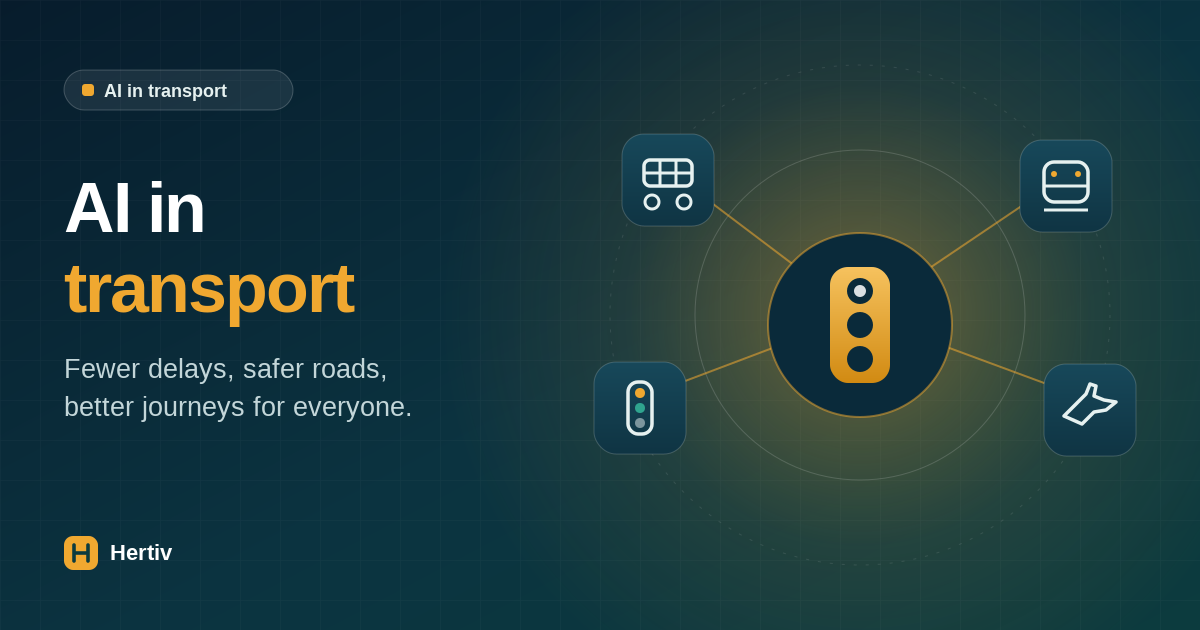
AI in transportation helps vehicles and networks move people and goods with fewer delays and crashes. Here is what it does, where it works and what it cannot do.
On this page
Short answer
AI in transportation is software that learns from vehicle, road and timetable data to predict delays, plan routes and schedules, and flag safety risks. It helps traffic signals adapt to live flow, buses and trains run on time, and maintenance teams fix wear before it causes a failure. People stay in charge of safety decisions; the AI handles prediction and planning.
What is AI in transportation?
AI in transportation is software that learns from vehicle, road and timetable data to help people and goods move with fewer delays, lower costs and fewer crashes. It covers the vehicles themselves, the networks they run on and the control rooms that manage them.
The software works on three kinds of data: where vehicles are, what the network looks like right now, and what happened on similar days in the past. It turns that data into predictions, such as how long a trip will take, and into actions, such as changing a signal timing or rerouting a bus. People stay in charge of the decisions that affect safety and service levels.
The main areas, and what AI does in each:
| Area | What the AI does | What it needs |
|---|---|---|
| Traffic signals | Adjusts green times to current flow | Sensor and camera counts |
| Public transit | Predicts arrivals and plans schedules | Timetable and GPS history |
| Freight routing | Picks routes and delivery order | Orders, traffic and weather |
| Aviation | Predicts delays and plans turnarounds | Flight and gate records |
| Rail | Spots track wear and plans maintenance | Sensor and inspection data |
| Road safety | Flags risky spots and near misses | Crash and camera records |
Transportation is broader than logistics. AI in logistics focuses on moving goods through warehouses and delivery networks, while AI in transportation also covers passengers, public transit, traffic systems and the vehicles themselves. The two overlap where freight moves on public roads, and teams often share the same traffic and weather data.
How does AI manage traffic in cities?
AI manages city traffic by reading live counts from sensors and cameras, predicting where queues will form, and adjusting signal timings and lane use before congestion builds. It replaces fixed timetables that assume every hour behaves the same.
A common setup feeds vehicle counts, bus positions and pedestrian crossings into a model that scores each junction every few minutes. The model then stretches green time on the busiest approach, holds back traffic that would block a junction, and gives buses priority when they run late. Operators set limits, so a quiet side road never waits longer than a stated maximum.
The gains are usually modest but real: shorter queues at the worst junctions and more reliable bus times. The limits matter too. A model trained on dry-weather weekdays can misread a rainy match day, and a sensor that fails silently can feed bad counts for weeks. Cities that do this well check sensor health daily and keep a human operator able to override the system.
What does AI do in public transport?
In public transport, AI predicts arrival times, plans timetables and helps control rooms respond when a vehicle breaks down or a road closes. Passengers see the result as more accurate arrival boards and fewer unexplained gaps in service.
Timetable planning uses years of boarding and GPS records to match vehicle numbers to demand by hour and by stop. When a bus runs late, the system can suggest holding the next bus, skipping a stop, or sending a spare vehicle, and it shows the effect of each choice on waiting times. Dispatchers still make the call, but they see the trade-off instead of guessing.
The same data helps with maintenance. Vibration and mileage records flag vehicles that are likely to fail soon, so they can be serviced overnight instead of breaking down in service. Computer vision is also used in depots and stations to count passengers and spot crowding, which feeds back into timetable planning.
How is AI used in aviation and rail?
In aviation and rail, AI predicts delays, plans turnarounds and spots equipment wear before it causes a cancellation. The goal is the same in both: keep a tight timetable running when one late vehicle can knock on through the whole network.
Airlines use arrival and gate records to predict which flights will miss their slot and to reassign gates and crews early. Rail operators use sensor data from tracks and trains to schedule maintenance on the sections most likely to fail, rather than inspecting everything on a fixed calendar. Both depend on clean records; a model fed with inconsistent delay codes will learn the wrong lessons.
Passengers meet this AI as earlier warnings and faster rebooking when plans change. Behind the scenes it is mostly scheduling and maintenance maths, not a new kind of vehicle. The safety-critical parts, such as train control and flight control, stay under strict human and regulatory control, and AI is kept to planning and prediction.
Where does AI help road safety?
AI helps road safety by finding the places and behaviours that cause crashes, then pointing engineers and police at the fixes with the best return. It works from crash records, camera footage and vehicle sensor data rather than from opinion about which junction feels dangerous.
One common use is near-miss analysis: cameras at a junction record how often vehicles brake hard or pass close to pedestrians, which reveals risk before anyone is hurt. Another is speed and behaviour analysis on freight routes, where harsh braking and cornering patterns flag drivers who need coaching. AI in supply chain management uses similar telematics data for delivery fleets, and road-safety teams use the same patterns for public roads.
The limits are honest ones. Cameras miss what happens out of frame, crash records under-report minor collisions, and a model can mistake a busy junction for a dangerous one. Good programmes pair the model with site visits and before-and-after counts, and they publish the results so the public can see whether a fix actually worked.
Example (hypothetical): a city bus network cuts late buses
Example (hypothetical): a city runs 100 buses making 5 trips each per day, a total of 500 trips a day. Before AI scheduling, 18 in 100 trips arrived more than 5 minutes late, which is 90 late trips a day, and the average late bus was 9 minutes behind, adding up to 810 minutes of lateness a day.
The team feeds two years of GPS and boarding records into a scheduling model and retimes the worst routes, holding back buses that would bunch together. Late trips fall to 9 in 100, or 45 a day, and the average delay falls to 5 minutes, so total lateness drops to 225 minutes a day. The city keeps the same number of buses and drivers; the gain comes from spacing, not from extra vehicles.
The team also learns where the model fails. Rainy evenings still run late, because the training data had few wet days, so dispatchers keep a manual override for bad weather. The lesson is that the model improves the average day, and people still handle the unusual ones.
What are the common mistakes?
The most common mistakes in AI transportation projects are buying a model before fixing the data, automating a decision nobody owns, and measuring success by model accuracy instead of by trips on time.
- Dirty location data. GPS records with gaps or wrong timestamps teach the model the wrong timetable.
- No override. A system dispatchers cannot override in an emergency will be switched off at the first crisis.
- Ignoring the edge cases. Rain, events and roadworks are where passengers notice failure most.
- Measuring the wrong thing. A model can be 95% accurate and still leave buses bunched, if accuracy is measured on the easy hours.
- Forgetting privacy. Cameras and location data need clear rules on what is stored, for how long, and who can see it.
Key takeaways
- AI in transportation predicts delays and plans routes, schedules and maintenance from vehicle, road and timetable data
- Traffic signals, transit timetables and freight routing all improve when the model reads live data instead of fixed timetables
- Aviation and rail use AI for delay prediction and wear-based maintenance, while safety-critical control stays human
- Road safety gains come from near-miss analysis and behaviour patterns, checked with site visits and before-and-after counts
- Start with clean location data and a named set of trips or junctions to improve, and keep a human override
Frequently asked questions
What is the difference between AI in transportation and AI in logistics?
AI in logistics focuses on moving goods through warehouses and delivery networks, while AI in transportation is broader: it covers passengers, public transit, traffic systems, aviation, rail and road safety as well. The two overlap where freight moves on public roads, and teams often share traffic and weather data.
Can AI replace traffic engineers?
No. AI can score junctions and suggest signal timings, but engineers set the limits, check the data and take responsibility for safety. The model handles the routine adjustments; people handle the unusual days, the roadworks and the complaints from residents.
Does AI in transportation need cameras everywhere?
No. Many systems run on GPS, timetable and sensor data alone. Cameras add value for counting passengers and spotting near misses, but they also add privacy rules and maintenance costs, so teams should add them only where the data earns its keep.
How long before a city sees results from AI traffic systems?
A single junction can improve within weeks of the sensors and model going live, but a network-wide change takes longer. Most cities start with the worst junctions, prove the gain with before-and-after counts, and then expand one corridor at a time.
Is AI used in self-driving vehicles part of this?
Self-driving vehicles are one part of AI in transportation, but most of the value today comes from planning and prediction: schedules, signals, routing and maintenance. The vehicles themselves are still a small share of traffic in most cities.
What data does an AI transportation project need first?
It needs clean location and timetable records: GPS traces, boarding counts, signal timings and crash records, with consistent timestamps. Two years of history is a good starting point, because it covers seasons, school terms and events.