AI Enterprise Governance: Oversight That Scales With Use
AI enterprise governance is the roles, rules and checks that let a large company run many AI systems safely. Boards, risk teams and product teams share the work.
On this page
Short answer
AI enterprise governance is the company-wide system of roles, rules and checks that controls how AI is built, bought and used across every department. It covers which models are approved, who is accountable for each one, how risks are graded, and how decisions are recorded, so that a company can run many AI systems at once without losing track of what each one does or who approved it.
What is AI enterprise governance?
AI enterprise governance is the company-wide system of roles, rules and checks that controls how AI is designed, bought, deployed and retired across every department. It treats AI as a shared corporate risk and a shared asset, not as a set of separate team projects.
A single team can ship a chatbot with a short review. A company with dozens of models in HR, finance, sales and support needs something broader: one place where every model is listed, one set of risk grades, and one chain of accountability that reaches the board.
The point is not to slow teams down. It is to make sure that when a model affects customers, staff or money, someone named is responsible for it, the decision is written down, and the model can be stopped if it misbehaves. That is what separates a governed programme from a collection of pilots.
How is enterprise governance different from project-level governance?
Project-level governance answers questions about one model: what data it uses, how it was tested, and who signs off before launch. Enterprise governance answers questions about the whole portfolio: how many models exist, which ones carry the most risk, and whether the same rules apply in every unit.
The difference shows up in the artefacts. A project produces a model card and a test report. An enterprise produces a model inventory, a risk register, a policy that applies to all vendors, and a regular report to a risk committee. The project view is deep; the enterprise view is wide.
Most companies need both. Project checks catch problems in a single system, while enterprise checks catch the problems that only appear at scale: the same vendor used in ten places, a model retired in one unit but still live in another, or a policy that nobody in the regions has read.
What does an enterprise AI governance framework include?
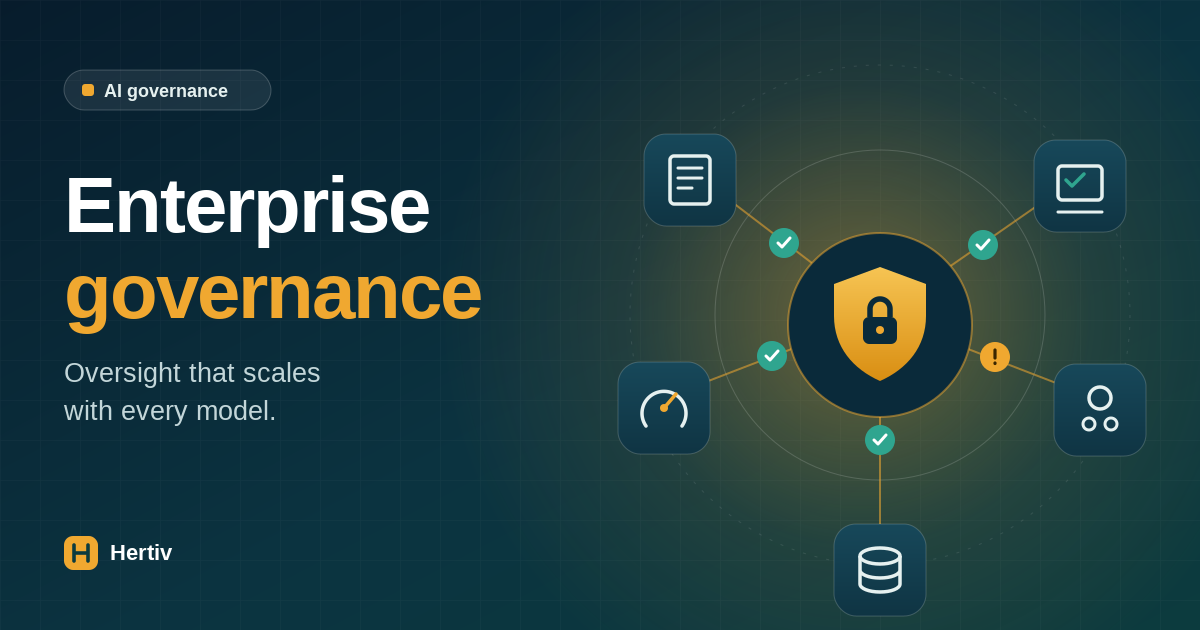
An enterprise AI governance framework has five parts, and each one needs an owner and a review date. If a part has no owner, it does not happen.
| Component | What it covers | Who owns it |
|---|---|---|
| Model inventory | Every AI system in use, its owner and its risk grade | Chief data or AI officer |
| Risk grading | Which models need full review and which need a light check | Risk committee |
| Policies and standards | Rules for data, vendors, testing and sign-off | Governance lead |
| Monitoring and audit | Live checks, incident logs and regular audits | Internal audit and engineering |
| Accountability and reporting | Who answers to the board and how often | Board risk committee |
The inventory is the foundation. Without a list of models, risk grading has nothing to grade and audits have nothing to audit. Companies usually start by listing what they already run, then add rules for anything new.
Who owns AI governance in a large company?
Ownership is shared, but it must be named. The board or a board risk committee sets the risk appetite and receives regular reports. An executive sponsor, often the chief data officer or chief AI officer, owns the framework and the model inventory.
Each business unit names a model owner for every system it runs. That person is responsible for keeping the model's record current, reporting incidents, and retiring the model when it is no longer needed. Central teams for legal, security and data set the standards that unit owners follow.
A governance lead or small team coordinates the work: running the inventory, scheduling reviews, and chasing missing records. Without that role, ownership spreads so thin that nobody acts, which is the pattern described in what AI governance covers.
How do you set up governance across business units?
Setting up governance across units works best as a short sequence with a named owner for each step. The goal of the first pass is a complete inventory, not a perfect policy.
- List every AI system in use, including vendor tools and models inside spreadsheets.
- Grade each model by risk: who it affects, what it decides, and what happens if it is wrong.
- Assign an owner to every model and a review date.
- Write one short policy that covers data, testing, vendor checks and sign-off.
- Start a regular review cycle, monthly for high-risk models and quarterly for the rest.
- Report progress to the risk committee, including models found, risks graded and incidents logged.
Keep the first cycle short. A company that spends a year writing policy before listing its models will govern a list it has never seen.
How do you keep a model inventory and audit trail?
A model inventory is a register, not a document. Each entry records the model, its purpose, its owner, its data sources, its risk grade, its approval date and its next review. The register lives in a system that owners update, not in a slide deck that goes stale.
An audit trail records the decisions: who approved a model, which tests were run, what changed in each version, and what incidents occurred. When a regulator or an internal auditor asks how a decision was made, the trail is the answer. If the trail is missing, the answer is a guess.
Review dates matter more than review depth. A high-risk model checked every month with a short checklist is safer than a model reviewed once in depth and then forgotten. The inventory should show the next review date for every entry, and the governance lead should chase anything overdue.
Example (hypothetical): a company finds the models it already runs
Example (hypothetical): a 2,000-person services company asks each unit to list the AI it uses. The count comes back at 46 systems: 12 already approved, 18 needing a review, and 16 that should be retired or replaced. The total adds up: 12 plus 18 plus 16 is 46.
The team retires the 16 first, because each one is a risk with no owner. Then it reviews the 18, grading 6 as high risk and 12 as low risk. The 6 high-risk models get monthly checks and a named owner; the 12 low-risk models get a quarterly check.
Three months later the inventory lists 30 live models, each with an owner and a review date. The board receives a one-page report: models live, risks graded, incidents logged. Nothing in the report is new technology; it is the same inventory, kept current.
What are the common mistakes?
The most common enterprise governance mistakes are writing policy before listing models, giving ownership to a committee instead of a person, and treating the inventory as a one-off project.
- Policy without an inventory. Rules that apply to models nobody has listed cannot be enforced.
- Ownership by committee. If three teams own a model, nobody updates its record.
- One-off inventory. A list built once and never updated is out of date within a quarter.
- Same rules for every model. A scheduling assistant does not need the review a credit model needs.
- No retirement path. Models stay live because nobody is responsible for switching them off.
- Reports nobody reads. A governance report that never reaches the board changes nothing.
Start with the inventory, name one owner per model, and report to the board on a fixed schedule. The rest of the framework can grow around those three habits. For the steps that follow, how to implement AI governance covers the rollout in detail.
Key takeaways
- Enterprise governance covers the whole AI portfolio, not one model at a time
- A current model inventory is the foundation; risk grading and audits build on it
- Every model needs a named owner and a review date
- High-risk models get monthly checks; low-risk models get quarterly checks
- Report to the board on a fixed schedule, with models live, risks graded and incidents logged
Frequently asked questions
What is the difference between AI governance and AI enterprise governance?
AI governance is the general discipline of controlling how AI is built and used. Enterprise governance applies that discipline across a whole company: one inventory, one set of risk grades and one reporting line to the board, so that rules hold in every business unit, not just in the team that wrote them.
Who should own AI enterprise governance?
The board sets risk appetite and receives reports. An executive sponsor owns the framework, and each business unit names a model owner for every system it runs. A small governance team coordinates the inventory, schedules reviews and chases missing records.
How many models does an enterprise need to govern?
As many as it runs, including vendor tools and models inside spreadsheets. Most companies find more than they expect on the first count. The inventory should list every system, even a small one, so that nothing runs without an owner and a risk grade.
How often should high-risk AI models be reviewed?
Monthly checks are a common pattern for high-risk models, with a short checklist covering data, outputs, incidents and drift. Low-risk models usually get a quarterly check. The review date matters more than the depth of any single review.
Does enterprise governance slow down AI adoption?
It slows the risky parts and speeds the safe ones. Teams with a clear policy and an approved inventory can launch low-risk tools quickly, because the checks are already defined. The delay comes when governance is added after a model is already live.
What should a board report on AI include?
A one-page report usually covers models live, risks graded, incidents logged and models retired. It should name the highest-risk models and any overdue reviews. The board does not need technical detail; it needs to know what is running, who owns it and what went wrong.