What Is AI Risk Management, and How Does It Work?
AI risk management is the work of finding, grading and reducing the harm an AI system can cause, from wrong answers to leaked data, before and after it goes live.
On this page
Short answer
AI risk management is the process of finding, grading and reducing the harm an AI system can cause. A team lists what could go wrong, such as a wrong answer, a biased decision or a data leak, then decides how likely each harm is and how bad it would be. The team then adds controls, tests the system, and keeps watching it after launch.
What is AI risk management?
AI risk management is the work of finding, grading and reducing the harm an AI system can cause. It covers the model, the data it was trained on, the way people use it, and the way it connects to other systems.
The work starts before launch. A team writes down the ways the system could fail, such as giving a wrong medical answer, rejecting a good job applicant, or repeating private data from its training set. Each risk gets a grade based on how likely it is and how much harm it would do.
| Risk | Example | Who is harmed |
|---|---|---|
| Wrong output | A chatbot gives a wrong refund rule | The customer |
| Biased decision | A screening tool rejects good applicants | Applicants |
| Data leak | A model repeats private text | The person in the data |
| Over-reliance | Staff stop checking the output | The business |
| Misuse | Someone uses the tool to deceive | The public |
| System failure | The model goes down at peak time | Users |
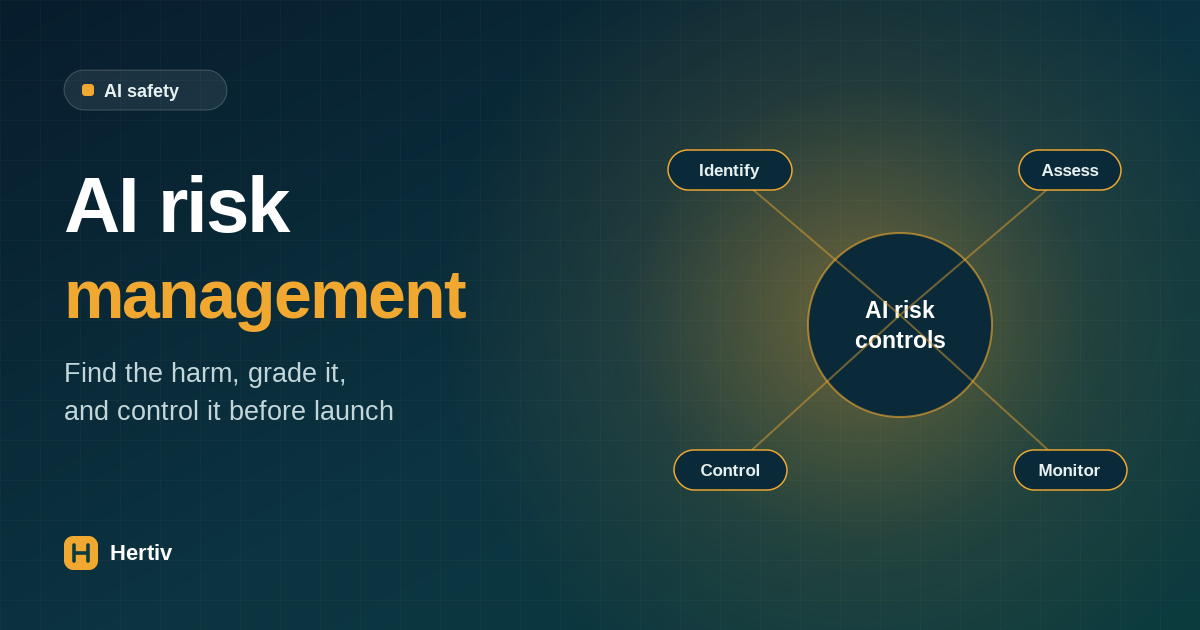
Risk management is not a one-time report. It is a loop: find risks, add controls, test, watch, and repeat. The loop matters because models change, data changes, and the way people use the system changes too.
What risks does AI create?
Wrong outputs are the most visible risk. A model can state a false fact with confidence, and a user who trusts it may act on it. The harm grows when the answer affects money, health or safety, so those uses need stronger checks.
Biased decisions are harder to see. A model trained on past hiring data can repeat past patterns, such as favouring one group of applicants. The output looks normal, which is why teams must test results across groups, not just overall.
Data leaks happen when a model repeats text from its training data, or when a user pastes private data into a prompt that is then stored. Teams should know what data goes in, where it is stored, and who can see it. Good testing of AI models catches many of these problems before users do.
How does the risk management process work?
The process starts by naming the use. A team writes down what the system does, who uses it, and what happens if it fails. A chatbot that answers shop questions is low risk; a tool that screens loan applications is high risk, and the two need different levels of care.
Next, the team lists risks and grades each one. A simple way is to score likelihood from 1 to 5 and impact from 1 to 5, then multiply them. A risk that scores 20 needs action before launch, while a risk that scores 4 can be watched.
Then the team adds controls for the highest scores. A control can be a human check, a limit on what the model can do, a filter on outputs, or a rule that the system must stop and ask a person. Each control gets an owner and a test date, so nothing is left as a vague promise.
What controls reduce AI risk?
Human review is the strongest control for high-stakes answers. The model drafts, a person checks, and only the checked answer goes out. This is slow, so teams use it where a mistake costs the most, not for every answer.
Limits are the next control. A support bot can be allowed to answer questions but not to issue refunds. A coding tool can suggest code but not push it to production. Limits keep the blast radius small when the model is wrong.
Filters and logs support both. An output filter can block personal data or banned content, and logs record what the model said and who approved it. Logs matter because they let a team trace a bad answer back to the prompt, the data and the model version that made it.
How do you monitor AI risk after launch?
Monitoring starts with sampling. A team reads a sample of real outputs every week and checks them against the rules. If the sample shows more errors than the test set did, the team knows the real world differs from the test.
Complaints and flags are the second source. Users should have an easy way to report a wrong or harmful answer, and someone should read those reports. A rising number of flags on one topic usually points to a real problem, not just picky users.
Finally, the team re-tests after every change. A new model version, new data or a new prompt can bring back an old risk. A short test run before each release, using the same cases as the first launch test, catches regressions early. Teams that build a proof of concept should also read how to build an AI proof of concept, which covers testing before scale.
Example (hypothetical): a support chatbot review
Example (hypothetical): a small online shop plans a chatbot that answers 200 customer questions a day. The team lists three risks: wrong refund answers, leaking order details, and the bot promising a discount it cannot give.
They grade each risk. A wrong refund answer is likely (4) and costs money (4), so it scores 16. A leak is unlikely (2) but serious (5), so it scores 10. A false discount promise is likely (3) and moderate (3), so it scores 9.
The team adds controls for the top risk first. The bot may quote the refund policy but may not approve refunds; a person approves them. That control costs 2 hours of staff time a day, against 200 questions the bot handles. If the bot answers 150 of the 200 questions and a person handles 50, the team still saves time, and the riskiest job stays with a person.
Common mistakes
The most common mistake is treating risk management as a document. A risk register that nobody reads does not reduce risk. The work only helps when someone owns each risk, tests the control, and checks the result.
Another mistake is testing only on clean data. Real users misspell words, ask odd questions and paste long text. If the test set has none of that, the launch will surprise the team.
A third mistake is giving the model more power than it needs. A bot that can refund, delete and email has three ways to cause harm; a bot that can only answer questions has one. Start narrow and widen the powers only after the narrow version works.
Finally, do not skip monitoring. A model that was safe at launch can drift as data and users change. A weekly sample of real outputs is the cheapest control a team can buy, and it catches problems while they are still small. For the wider picture, see the AI governance service page.
Key takeaways
- AI risk management is a loop: find risks, grade them, add controls, test, and keep watching.
- Grade each risk by likelihood and impact, and fix the highest scores before launch.
- Human review is the strongest control for high-stakes answers; limits and filters cover the rest.
- Test on messy, real-world inputs, not only on clean test data.
- Monitor a weekly sample of real outputs after launch, because risks change as data and users change.
Frequently asked questions
What is the first step in AI risk management?
Name the use and the harm. Write down what the system does, who uses it, and what happens if it fails. That short description decides how much care the system needs, because a shop chatbot and a loan screening tool carry very different risks.
How do you grade an AI risk?
Score likelihood from 1 to 5 and impact from 1 to 5, then multiply them. A risk scoring 20 needs action before launch, while a risk scoring 4 can be watched. The numbers are rough, but they force a team to agree on which risks matter most.
Who should own AI risk in a small team?
One named person, not a committee. That person keeps the risk list, checks that each control was tested, and reads the weekly sample of outputs. In a small team that owner is often the product lead, with help from an engineer on the technical risks.
Is AI risk management only for large companies?
No. Small teams face the same risks, and a wrong answer can hurt them more, because they have fewer people to catch it. The process scales down: a short risk list, two or three controls, and a weekly sample of outputs is enough to start.
How often should AI risks be reviewed?
After every change to the model, the data or the prompts, and at least once a month in normal use. A new model version can bring back an old risk, so a short test run with the same cases as the launch test should run before each release.
Does risk management slow down AI projects?
It slows the risky parts and speeds up the safe ones. A team that knows its top risks can ship the safe features fast and put human checks only where a mistake costs the most. That is faster than stopping a launch to fix a problem users already found.


