What Is AI Governance, and How Does It Work?
AI governance is the set of rules, roles and checks that keeps a company's AI safe, lawful and honest. It decides who may build and use AI, and how.
On this page
Short answer
AI governance is the set of rules, roles and checks a company uses to make sure its AI systems are safe, lawful and fair. It covers which AI may be built, what data it may use, who is responsible for it, and how its decisions are checked before and after it goes live.
What is AI governance?
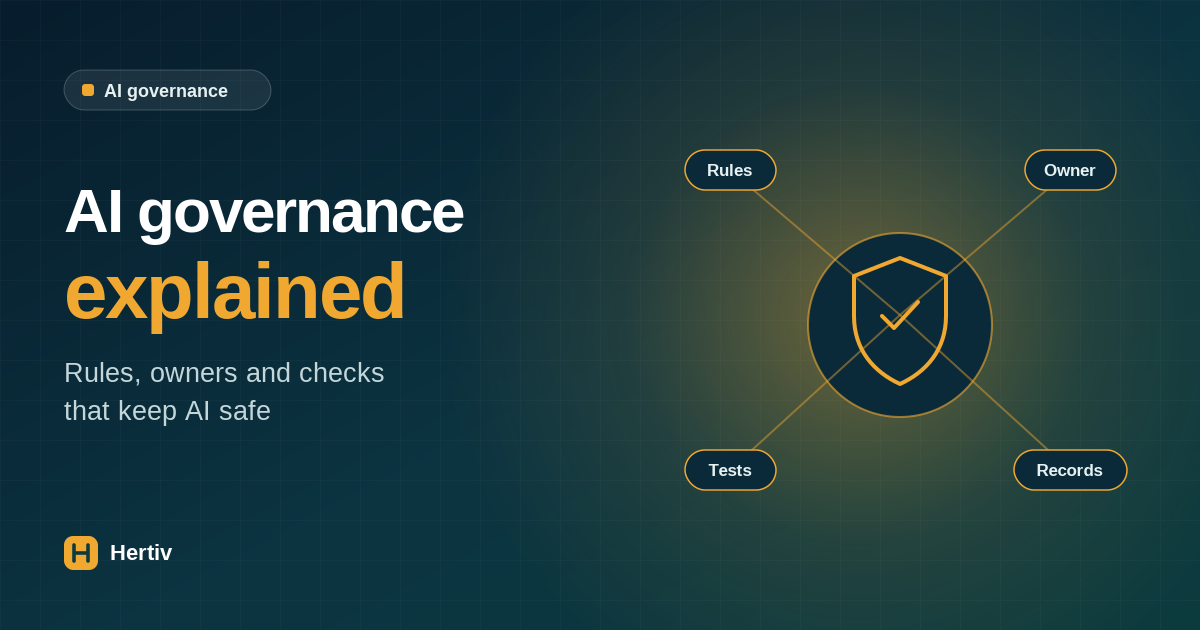
AI governance is the set of rules, roles and checks that keeps a company's AI safe, lawful and fair. It is not a single document or a single team. It is the way a company decides which AI to build, what data it may use, who is responsible for each system, and how its answers are checked.
Think of it as the difference between a model that works and a model a company can stand behind. A model can give good answers in a test and still be unsafe in real use, because it uses data it should not, gives different answers to different groups, or makes decisions no one can explain. Governance is the work that catches those problems before users do.
| Part | What it does | Example |
|---|---|---|
| Rules | Sets what is allowed | No customer data in training |
| Roles | Names who is responsible | One owner per AI system |
| Checks | Tests before launch | Accuracy and bias tests |
| Records | Writes down decisions | Why a model was approved |
| Monitoring | Watches after launch | Weekly error counts |
Governance applies to every AI a company runs, from a chatbot to a hiring tool. The rules get stricter as the risk rises, so a system that decides who gets a loan needs far more checks than one that sorts support tickets. For the consulting view, see AI governance consulting.
Why does AI governance matter now?
AI governance matters now because AI makes decisions that affect real people, and those decisions can go wrong in ways that are hard to see. A hiring tool can quietly favour one group, a chatbot can invent a policy, and a credit model can turn down people for reasons no one can explain. Without governance, those errors reach users before anyone notices.
Regulators are also paying attention. Laws in several regions now ask companies to explain how their AI works, what data it uses, and how they check it. A company that cannot answer those questions may face fines, a forced shutdown of a system, or a loss of trust that is harder to repair than any fine.
Governance also protects the business itself. A system that is checked, logged and owned is easier to fix when it fails, and easier to defend when a customer complains. A system with no owner and no records is a risk that grows quietly until something goes wrong.
What does AI governance cover?
AI governance covers five areas: data, models, decisions, people and records. Data rules say which data may be used, how it is stored, and when it must be deleted. A company should not train a model on customer messages it promised to keep private, and it should know where every dataset came from.
Model rules say how a model is tested before launch and who must approve it. A model that affects hiring, lending or health needs stronger tests than one that writes marketing copy, and the tests should include the questions real users ask, not only easy ones.
Decision rules say what the AI may and may not decide on its own. A chatbot can answer a delivery question, but it should not promise a refund. A credit model can suggest a score, but a person should make the final call on a borderline case. Those limits are written down, not left to chance.
Who is responsible for AI governance?
Responsibility for AI governance is shared, but each system has one named owner. The owner is the person who answers when the system goes wrong, and who signs off on changes. Without a named owner, no one fixes a problem, because everyone assumes someone else will.
A small team usually runs the rules day to day. It may include a product manager, a data engineer, a lawyer and a security specialist, depending on the size of the company. Their job is to review new systems, run the checks, and keep the records.
Senior leaders set the risk appetite. They decide which uses are off limits, such as deciding who gets hired without a human review, and they approve the budget for testing and monitoring. That decision belongs at the top, because it shapes what the whole company may build. For the security side, read how to test AI models.
Good governance also needs people who understand the systems in use. The range of AI systems a team may run is shown in AI agent use cases, and each one needs an owner.
How does AI governance work day to day?
AI governance works day to day through a short review before launch and regular checks after it. Before a system goes live, its owner fills in a form: what the system does, what data it uses, who it affects, and what could go wrong. A reviewer reads it, asks for tests, and either approves the launch or asks for changes.
After launch, the team watches the system. It counts errors, reads a sample of answers, and checks whether the system treats different groups of users the same way. When an error is found, the team finds the cause, fixes the data or the rules, and writes down what changed.
The records matter as much as the checks. A company that can show why a model was approved, what tests it passed, and what changed since launch can answer a regulator or a customer with facts, not guesses. A company with no records cannot.
Example (hypothetical): a hiring tool gets a governance review
Example (hypothetical): a company with 400 staff wants a tool that ranks job applications. The owner fills in the review form: the tool reads CVs, ranks them by skills, and a person interviews the top 20. The risk is that it favours one group, so the review asks for a test.
The team tests the tool on 200 past applications, 100 from women and 100 from men, with the same skills. The tool ranks 60 men and 40 women in the top 100, a gap of 20. The review asks why. The team finds the tool favours CVs with a certain job title that men held more often, so it removes that signal and tests again.
After the change, the tool ranks 52 men and 48 women in the top 100, a gap of 4. The review approves the tool with two conditions: a person reviews every interview shortlist, and the team repeats the test each quarter. The arithmetic shows the point: a test with 200 applications found a gap of 20, and a fix cut it to 4.
What are the common mistakes?
The most common mistakes in AI governance are writing rules no one follows, naming no owner, and testing once and never again.
- Rules on paper only. A policy that no one reads or enforces is worse than no policy, because it creates false confidence.
- No named owner. A system with no owner has no one to fix it when it goes wrong.
- One-off testing. A model that passed a test last year may fail today, because data and users change.
- No records. If you cannot show why a model was approved, you cannot defend it.
- Same rules for all risk. A low-risk tool needs light checks, while a high-risk one needs strong ones; one size fits neither.
Key takeaways
- AI governance is the rules, roles and checks that keep AI safe and lawful
- Every AI system needs one named owner who answers when it goes wrong
- Rules get stricter as the risk rises: hiring and lending need the most checks
- Test before launch, monitor after launch, and keep the records
- Governance protects users, the business and its reputation
Frequently asked questions
Is AI governance only for large companies?
No. A small company running one chatbot still needs an owner, a list of what data it uses, and a way to check its answers. The paperwork can be short, but the roles and the checks should still exist, because a wrong answer from a small company harms its customers just as much.
What is the difference between AI governance and AI ethics?
Ethics is the set of values a company wants to follow, such as fairness and honesty, while governance is the machinery that makes those values real: the rules, the owners, the tests and the records. A company can hold good values and still fail without governance, because no one is checking.
Do I need a lawyer for AI governance?
A lawyer helps with the legal parts, such as data rules and new AI laws, but governance is not only a legal job. Product, data and security people all play a part, and the owner of each system is usually a product or engineering lead, not a lawyer.
How often should AI systems be reviewed?
High-risk systems should be reviewed at least each quarter, and low-risk systems at least once a year. Any big change, such as new data, a new model or a new use, should trigger a fresh review, even if the last one was recent.
What happens if a company has no AI governance?
Errors reach users first, and when they do, the company cannot explain what happened or who was responsible. That can mean fines, a forced shutdown, lost customers and a loss of trust that takes years to rebuild. Governance is cheaper than the cost of a public failure.
Can AI governance slow down product teams?
It can, if the rules are heavy and the review is slow. The fix is to match the checks to the risk: a low-risk tool gets a short review, while a high-risk one gets a full one. Good governance gives teams a clear path to launch, not a wall.


