What Does an AI App Cost to Develop?
An AI app costs what its data, model and team cost, plus the monthly bill for running it. This guide breaks down the drivers, the build routes and a worked example.
On this page
Short answer
An AI app is an application whose main feature uses a machine learning model, such as a chatbot, a document reader or a recommendation feed. Its cost has three parts: building the app, preparing the data and the model, and the monthly bill for running it. The model part is what makes AI apps cost more than ordinary apps, and it is also the part teams most often underprice.
What does an AI app cost to develop?
An AI app costs what its data, model and team cost, plus the monthly bill for running it. A small app that calls an existing model API is the cheapest route, while an app that trains its own model on private data costs far more, because data labelling and training take weeks of skilled work.
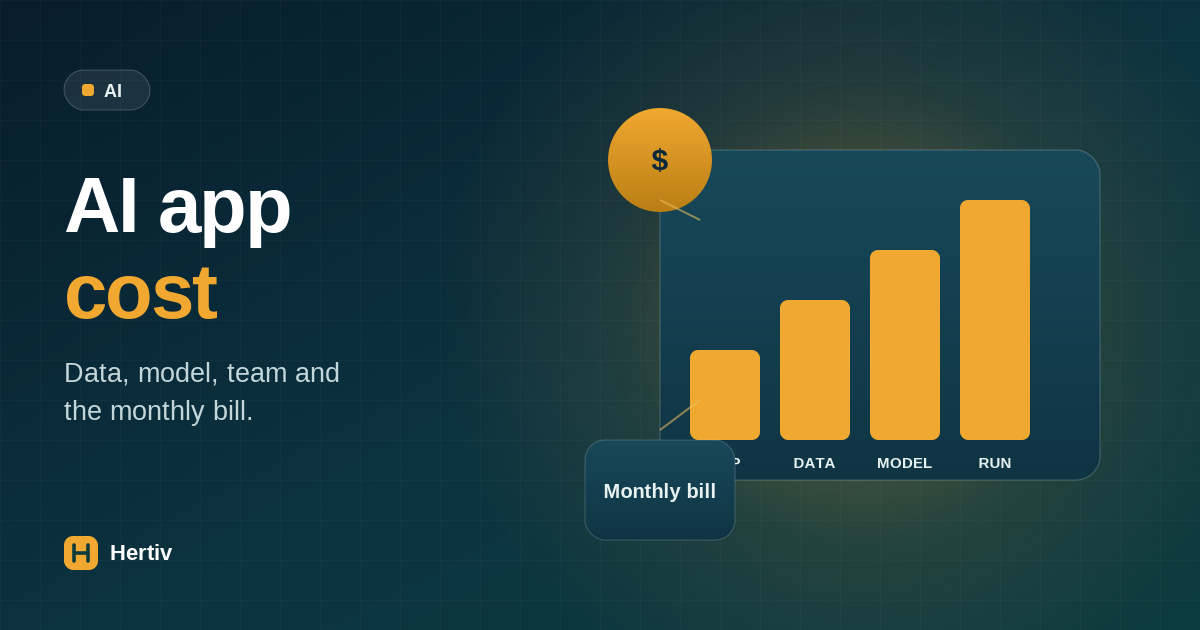
The cost splits into five parts: the app itself, the data, the model, the team, and the running bill. The app and the team are priced like any software project, while the data, the model and the running bill are specific to AI and need their own estimates.
| Cost part | What it covers | When it is biggest |
|---|---|---|
| App build | Screens, accounts, payments | Large feature lists |
| Data | Collecting and labelling examples | Private or rare data |
| Model | API fees, fine-tuning or training | Training from scratch |
| Team | Developers, data and design time | Long timelines |
| Running bill | Model calls, hosting, storage | High usage |
Teams should price all five parts before starting. A build quote that covers only the app, and leaves out the model bill, will look cheap and then surprise the team every month after launch.
What drives the cost up or down?
Four things drive AI app cost more than anything else: the data, the model route, the accuracy target, and the usage after launch. Each one can double the bill if it is set wrong at the start.
Data is the first driver. If the team already has clean, labelled examples, the model work is fast. If the data must be collected, cleaned and labelled by hand, that work can take longer than building the app. Rare cases cost the most, because the team must find enough examples of them to teach the model.
The accuracy target is the second driver. An app that drafts replies for a human to check can accept a lower accuracy than an app that acts alone, and lower accuracy means a smaller model and a smaller bill. Teams should set the target from the job, not from a wish for perfection.
Which build route should you choose?
There are three build routes for an AI app, and the cheapest one that meets the accuracy target is usually the right choice. Using an existing model API is fastest and cheapest to start, fine-tuning an existing model costs more but fits private data better, and training a model from scratch is the slowest and most costly route.
An API route means the app sends text or images to a provider's model and gets an answer back, paying per request. It suits most apps, because the provider handles the model, the servers and the updates. The running bill grows with usage, so the team must watch it.
Fine-tuning means taking an existing model and training it further on the team's own data, so it learns the team's terms and style. It suits apps where the generic model gets the words wrong or misses the domain. Training from scratch is rare and suits only teams with large datasets and specialist staff. For the wider cost picture, see the cost of implementing AI.
What does the team and timeline look like?
A small AI app team has a product lead, one or two developers, and a data or ML person part-time. The product lead defines the job and the accuracy target, the developers build the app, and the ML person handles the data, the model and the tests. Larger apps add a designer and a tester.
A small first version takes 10 to 16 weeks: two to four weeks for data and a model test, six to eight weeks for the app, and two to four weeks for testing and launch. The model test comes first, because it tells the team whether the idea works before the app is built.
Testing an AI app takes longer than testing an ordinary app, because the team must test the model's answers, not just the buttons. They check the model on real examples, count how often it is right, and set a rule for what happens when it is unsure. For how that testing works, see how to test AI models.
What does it cost to run an AI app?
Running an AI app costs money every month, and the model bill is usually the largest part. API models charge per request or per token, so the bill grows with the number of users and the length of each answer. A support app that drafts 10,000 replies a month pays for 10,000 model calls, plus hosting, storage and monitoring.
Teams cut the running bill by routing simple requests to a smaller, cheaper model, caching repeated answers, and shortening the text sent to the model. They also set limits, such as a daily cap per user, so one user cannot run up a large bill by accident.
The running bill should be in the business plan from the start. An app that costs $2,000 a month to run needs about 40 customers at $50 a month just to cover the model bill, before any other costs.
For a related cost view, see AI SaaS product development cost.
The monthly API side is covered in LLM API cost per month.
Example (hypothetical): a support-drafting app
Example (hypothetical): a team builds an app that drafts replies to customer support tickets. They plan 1,200 hours of work at $75 an hour, so the build costs 1,200 x $75 = $90,000. Data labelling adds $6,000 and model testing adds $4,000, giving a build total of $90,000 + $6,000 + $4,000 = $100,000.
A 10% reserve adds $10,000, so the full first-version budget is $100,000 + $10,000 = $110,000. The running bill is $1,800 a month for model calls and hosting, which is $1,800 x 12 = $21,600 a year.
The app charges $99 a month per support team. To cover the running bill alone, the team needs 19 paying teams, since 19 x $99 = $1,881 a month. To recover the build cost in two years as well, they need about 65 teams, since 65 x $99 x 24 = $154,440 against $110,000 build plus $43,200 running over two years.
What are the common mistakes?
The most common AI app cost mistakes are underpricing the data work, picking the most costly model route, and forgetting the running bill.
- Underpricing data. Collecting and labelling examples often takes longer than building the app itself.
- Training from scratch. Most apps work fine on an existing model API, and training from scratch is rarely needed.
- Forgetting the running bill. Model calls are charged every month, and the bill grows with users.
- No accuracy target. Without a target, the team keeps improving a model that is already good enough.
- Building the app first. Test the model on real examples before building screens around it.
Key takeaways
- An AI app has five cost parts: app, data, model, team and running bill
- Data work and the accuracy target drive the cost more than the app itself
- An existing model API is the cheapest route for most apps
- Price the monthly running bill before launch, not after
- Test the model on real examples before building the app
Frequently asked questions
How much does it cost to build an AI app?
There is no single number, because cost depends on the data, the model route and the team. A small app that calls an existing model API costs far less than an app that trains its own model, and the worked example above shows how to build the number from hours, rates and the monthly bill instead of guessing.
Is an AI app more costly than a normal app?
Yes, usually. The app part costs about the same as a normal app, but the data work, the model work and the monthly model bill are extra. An app that trains its own model costs far more than one that calls an API, so the model route is the main reason for the difference.
What is the cheapest way to add AI to an app?
The cheapest way is to call an existing model API for the AI feature, instead of training a model. The team pays per request, the provider runs the model, and there is no training bill. Costs stay low while usage is low, and the team can switch models later if a better one appears.
How do I estimate the monthly cost of an AI app?
Count the model calls per user, multiply by the number of users, and add hosting, storage and monitoring. The model provider's pricing page gives the per-call or per-token price, so the estimate is simple arithmetic once the team knows the usage. Add a margin for growth and for long answers.
Does an AI app need a data scientist?
A small app that calls an API can be built by developers with some ML guidance, while an app that fine-tunes a model needs an ML person. Training from scratch needs a data scientist and a larger team. Most first versions need ML help part-time, not full-time.
Can I reduce the cost of running an AI app?
Yes. Route simple requests to a smaller, cheaper model, cache repeated answers, and shorten the text sent to the model. Set a daily limit per user so one account cannot run up a large bill, and review the bill weekly in the first months after launch.


