What Does It Cost to Implement AI?
The cost of implementing AI depends on the use case, the data, the build route and the team. This guide breaks down the cost areas and the running costs.
On this page
Short answer
The cost of implementing AI depends on the use case, the data, the build route and the team behind it. A small assistant built on an existing model costs far less than a custom model trained on your own data, and the running costs after launch often matter more than the build cost itself.
What does it cost to implement AI?
Implementing AI is the work of taking a model from a demo to a system people rely on: connecting it to your data, building the workflow around it, testing it, and keeping it running. The cost is not the model alone; it is the data preparation, the integration, the evaluation and the support that surround it.
Costs vary widely because the use cases do. A support assistant that answers from a help centre is a different job from a system that reads contracts and writes into a finance tool. The first needs clean documents and a simple workflow; the second needs careful permissions, audit logs and a human review step.
Think in cost areas, not in one number. The sections below break the bill into parts you can estimate one by one. For a structured way to scope the work before spending, see an AI readiness assessment.
What drives the cost of an AI implementation?
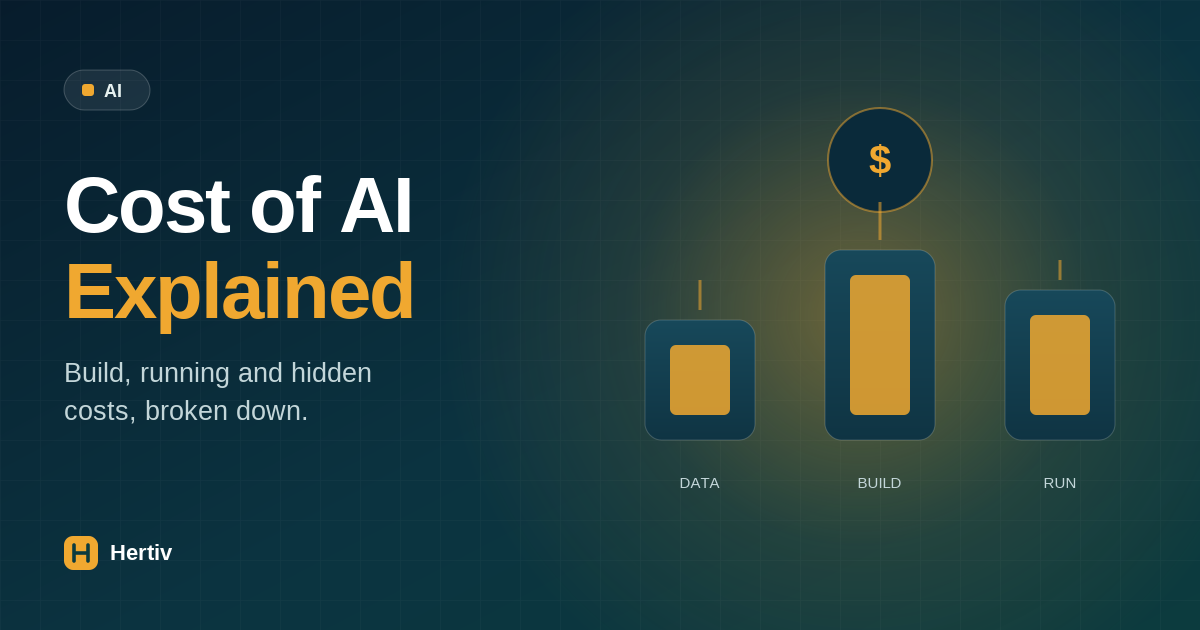
Five cost areas drive most of the bill, and each one changes with the use case.
| Cost area | What it covers | What changes it |
|---|---|---|
| Data preparation | Cleaning and labelling source data | How messy the source documents are |
| Build | Prompts, retrieval, integration, interface | How many systems it must connect to |
| Evaluation | Test sets, review and fixing failures | How costly a wrong answer is |
| Team | Engineers, designers and domain experts | How long the project runs |
| Running costs | Model calls, hosting and monitoring | How many requests it handles |
Data preparation is the area teams underestimate most. If the source documents are duplicated, outdated or scattered across systems, cleaning them takes longer than the build. Budget for it as its own line, not as a rounding error.
Which build route fits your budget?
There are three build routes, and the cheapest one that meets the need is usually the right pick.
Using an existing model through an API is the fastest and cheapest route for most teams. You send a prompt, get an answer, and pay per request. It fits support assistants, drafting and search, where the model's general knowledge plus your documents is enough.
Fine-tuning an existing model on your own data costs more, because you need labelled examples and a training step, but it can improve format, tone and accuracy on a narrow task. Training a model from scratch is the most expensive route by a wide margin, and it only makes sense for a few teams with a large dataset and a clear reason the other routes fail.
Start with the API route and an evaluation set. If the results are good enough, you have saved the fine-tuning budget. If they are not, the evaluation set tells you exactly what is failing, which makes the next step cheaper.
How long does implementation take?
Implementation time follows the same pattern as cost: a narrow use case with clean data moves fast, while a wide one with messy data takes longer.
A typical sequence runs in four phases. Scoping takes one to three weeks and ends with a written use case, a success metric and a data check. A proof of concept takes two to six weeks and tests the idea on real data with a small group. Production work takes four to twelve weeks and adds integration, permissions, logging and a fallback path. Rollout and support follow, with training and a plan for monitoring quality.
The proof of concept is the cheapest way to learn the real cost. If the data is not ready or the use case is wrong, you find out in weeks, not months. A short AI proof of concept with a fixed evaluation set is the usual way to do this.
What are the running costs after launch?
Running costs start on launch day and never stop, so they deserve a line in the budget from the beginning.
Model calls are the largest running cost for API-based systems, and they grow with usage: more requests, longer documents and more retries all add up. Hosting, storage and monitoring add a smaller but steady cost. Then there is the work of keeping the system good: reviewing failures, refreshing the source documents, and updating prompts when the model changes.
Set a monthly review of usage and cost, with an alert when spending passes a set level. The review should also look at quality, because a cheap system that gives wrong answers costs more in rework than a slightly dearer one that works.
Costs also change when the model provider changes prices or when a new model version needs new prompts and tests. Keep a small budget for these updates, and check the provider's pricing page when you plan the year. A system that depends on one provider should have a plan for switching, even if switching is never needed.
Example: a support assistant for a small team
Example (hypothetical): a 20-person company wants a support assistant that answers from its help centre. The team scopes the work, cleans 300 help articles, builds the assistant on an existing model, and tests it on 100 real past tickets.
Data preparation takes 120 hours at $90 an hour, which is $10,800. Building takes 200 hours at $110 an hour, which is $22,000. Evaluation takes 40 hours at $90 an hour, which is $3,600. The build total is $36,400, and running costs come to about $900 a month for model calls, hosting and monitoring.
The assistant handles the simple questions and hands the rest to a human. The company measures time saved per ticket and the share of answers the team accepts, and reviews both numbers monthly before deciding whether to expand the system.
What are the common mistakes?
Most AI implementations overspend on the model and underspend on the work around it. The same mistakes appear again and again.
- Starting with a broad assistant instead of one workflow with a clear owner
- Skipping data preparation, then blaming the model for bad answers
- No evaluation set, so nobody can tell whether the system is improving
- No fallback path, so failures reach customers instead of a human
- Budgeting only for the build and forgetting the running costs
- Choosing the most expensive build route before testing the cheapest one
If you want a clear estimate for your own use case, AI consulting is the place to start.
Key takeaways
- Cost is the data, the build, the evaluation, the team and the running bill
- The cheapest build route that meets the need is usually the right pick
- Data preparation is the cost teams underestimate most
- A proof of concept is the cheapest way to learn the real cost
- Running costs start on launch day and need their own budget line
Frequently asked questions
How much does it cost to implement AI for a small business?
It depends on the use case and the data. A small assistant built on an existing model, with clean documents and one workflow, is the cheapest path. A custom model or a system touching many tools costs far more. A proof of concept with a fixed evaluation set gives you a real number before you commit.
What is the most expensive part of implementing AI?
Data preparation and integration are usually the largest costs, not the model. Cleaning documents, connecting systems and setting up permissions take more time than most teams expect. Training a model from scratch is the exception: it is the most expensive route and is rarely needed.
Is it cheaper to build AI in-house or hire a team?
It depends on how often you will build AI systems. A one-off project is usually cheaper with an outside team, because hiring and keeping AI engineers takes time. A company planning many AI projects may find an in-house team cheaper over time, once the first systems are live.
How do you estimate the cost of an AI project?
Break it into cost areas: data preparation, build, evaluation, team and running costs. Estimate each one separately, then add a margin for the data work, which is the area most often underestimated. A short proof of concept will test the estimate against real data.
Do AI running costs grow with usage?
Yes. Model calls, hosting and monitoring all grow as more people use the system and as documents get longer. Set a monthly review and an alert at a spending level you choose, and track quality alongside cost so a cheap system does not quietly get worse.
When is AI implementation worth the cost?
It is worth it when the use case saves measurable time or money, such as faster ticket handling or fewer manual document checks. Pick one outcome metric, measure it on a fixed evaluation set, and compare the saving with the build and running costs before expanding.


